232/2 · PHYSICS (Theory) · Paper 2 · Mar. 2022 (KCSE 2021) · 2 hours
Instructions: This paper consists of two sections, A and B. Answer all the questions in sections A and B. All working must be clearly shown. Non-programmable silent electronic calculators may be used.
Section A (25 marks)
1. Figure 1 shows a ray of light incident on a plane mirror.
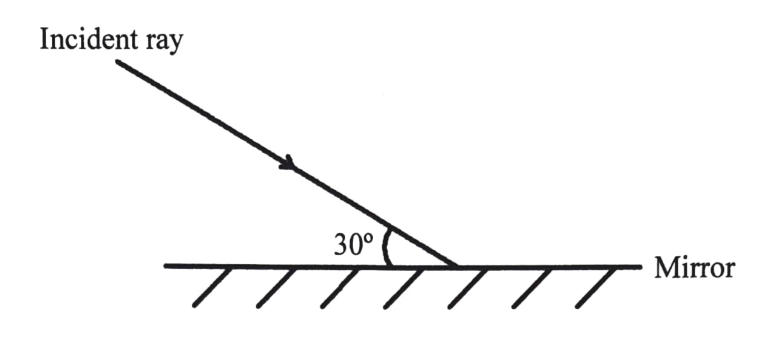
Complete the diagram to show the path of the reflected ray. (1 mark)
2. Figures 2(a), 2(b) and 2(c) show the process of charging an electroscope by induction.
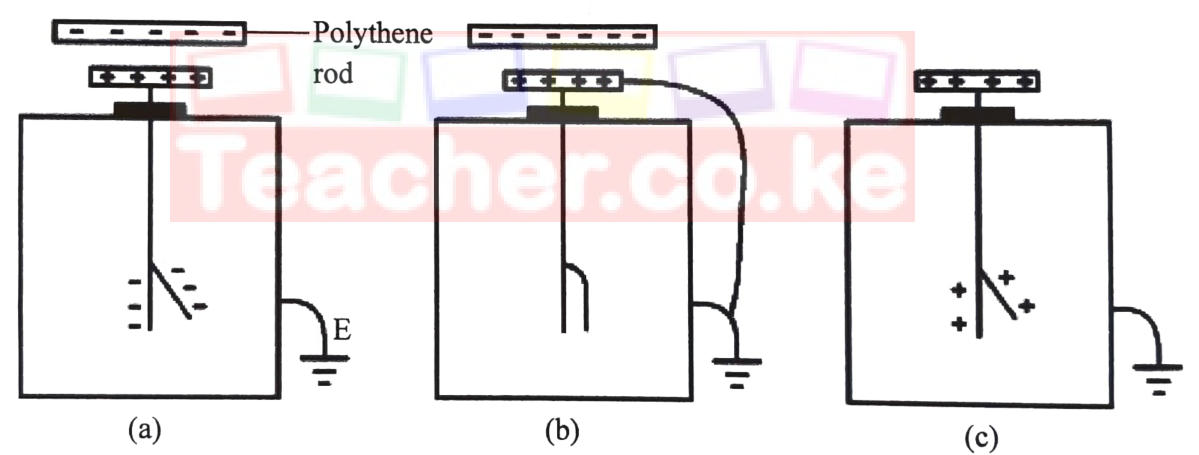
It is observed that the leaf rises in (a), collapses in (b) and then rises in (c). Explain why the leaf collapses in (b). (3 marks)
3. State one use of capacitors. (1 mark)
4. Figure 3 shows a graph of magnetic strength against time for two nails P and Q when magnetised in a solenoid. P and Q are of the same size but are made of different materials.
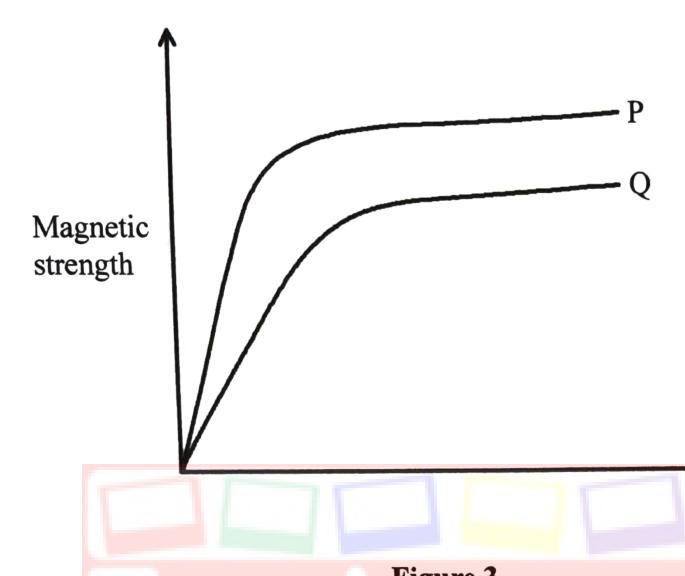
(a) Identify the material that is magnetised faster. (1 mark)
(b) Use the domain theory to explain the answer in 4(a). (2 marks)
5. State the meaning of the term principal focus of a convex mirror. (1 mark)
6. Figure 4 shows a current-carrying conductor placed between the poles of two magnets. (The direction of the current is into the paper.)
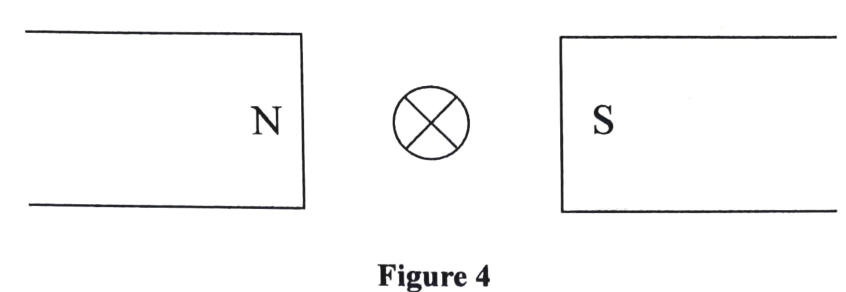
Sketch the magnetic field produced between the conductor and the poles of the magnets. (2 marks)
7. Figure 5 shows two coherent sources of sound A and B in phase. O is a point equidistant from A and B.
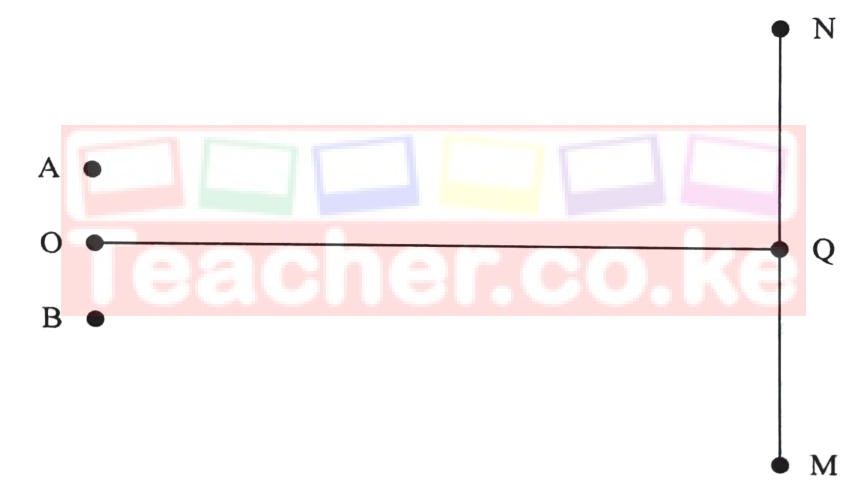
An observer moves from M to N through Q. Explain what is observed at point Q. (3 marks)
8. State one factor that affects the speed of sound in water. (1 mark)
9. Figure 6 shows a ray of light incident on a prism with a critical angle of 42°.
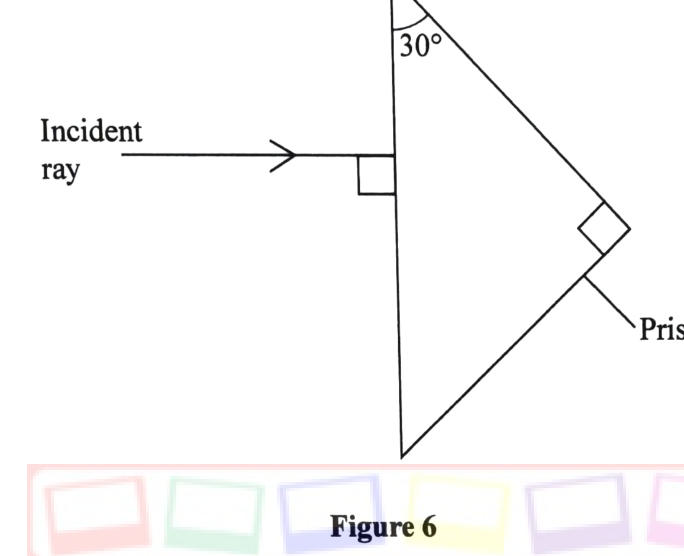
Complete the diagram to show the path of the ray through the prism. (2 marks)
10. It is observed that when the heater current of a cathode ray tube is increased, the intensity of the cathode rays increases. Explain this observation. (2 marks)
11. A current of 2 A flows through a bulb for 2.5 minutes. Determine the quantity of charge that flows through the bulb. (3 marks)
12. Figure 7 shows UV light passing through an aperture and incident on the cathode of a photocell.
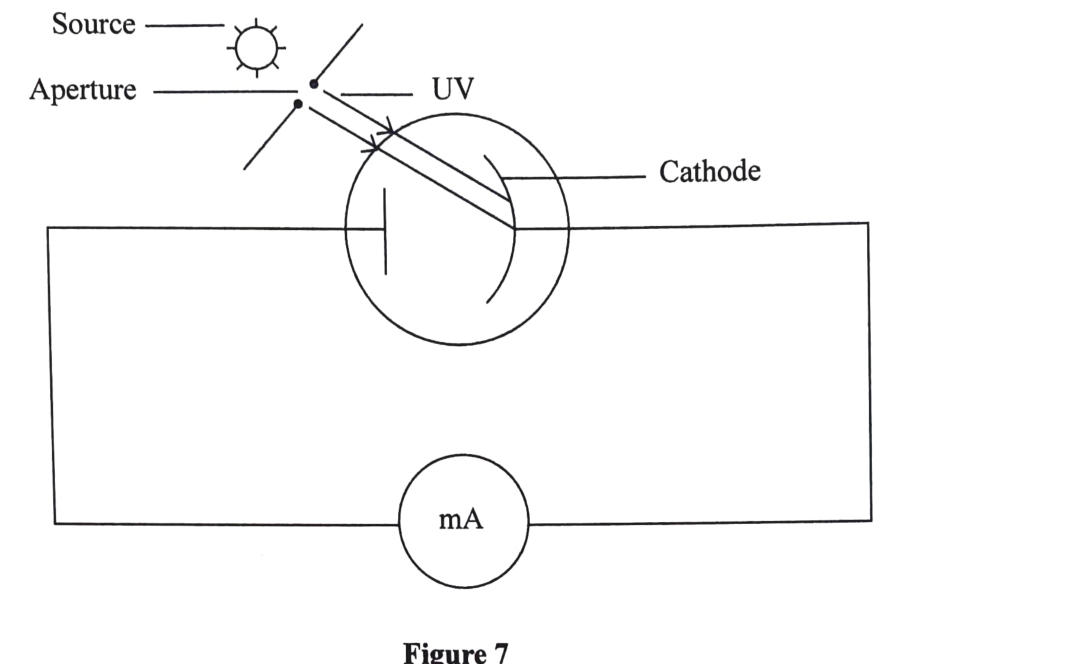
(a) State what is observed on the milliammeter when the size of the aperture is increased. (1 mark)
(b) State the reason for the answer in 12(a). (1 mark)
13. State the property of radio waves that makes them suitable for use in communication. (1 mark)
Section B (55 marks)
14. (a) State and explain how an increase in temperature affects the conductivity of a semiconductor. (2 marks)
(b) Figure 8 shows a graph of potential difference (V) across a bulb against the current (I) through the bulb obtained from an experiment.
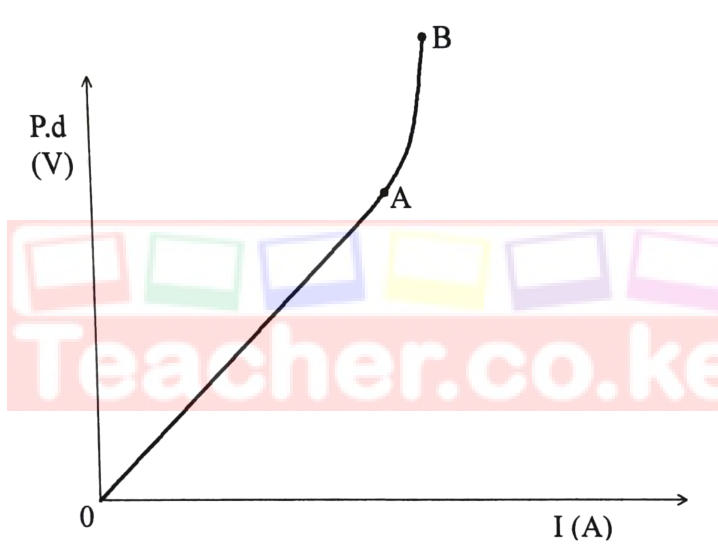
Explain why parts: (i) OA is straight; (1 mark) (ii) AB is curved. (2 marks)
(c) A circuit consists of 20 identical lamps connected in series to a 240 V mains supply. Determine the potential difference across each lamp. (2 marks)
(d) Figure 9 shows a circuit consisting of two identical lamps and three ammeters A₁, A₂ and A₃ connected to a cell.
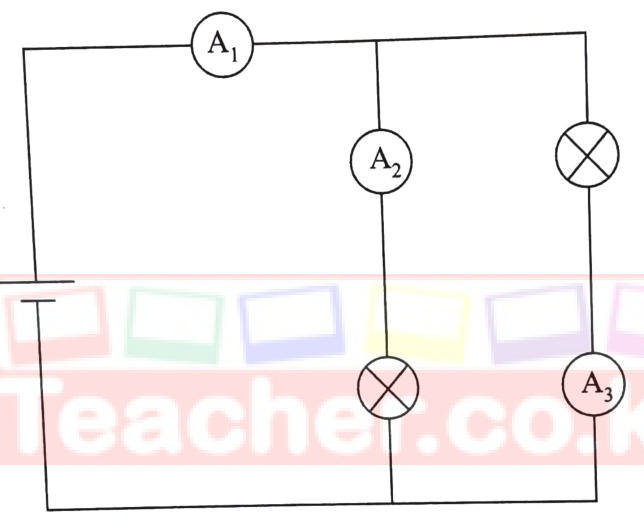
Given that ammeter A₁ reads 0.5 A: (i) state the reading on ammeter A₃; (1 mark) (ii) explain the answer in 14(d)(i). (2 marks)
15. (a) State the use of the eyepiece lens in a compound microscope. (1 mark)
(b) On the grid provided, draw a ray diagram to show how a convex lens forms a magnified real image. (3 marks)
(c) Figure 10 shows a defect of vision in a human eye.
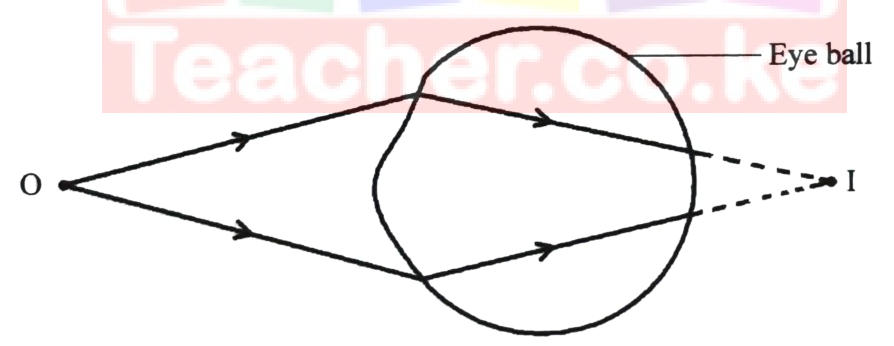
(i) State the type of defect shown. (1 mark)
(ii) State the type of lens that can be used to correct this defect. (1 mark)
(iii) On the same figure, draw rays to show how the lens in 15(c)(ii) corrects the defect. (2 marks)
(d) Figure 11 shows a graph of image distance V against object distance U obtained in an experiment to determine the focal length of a concave mirror.
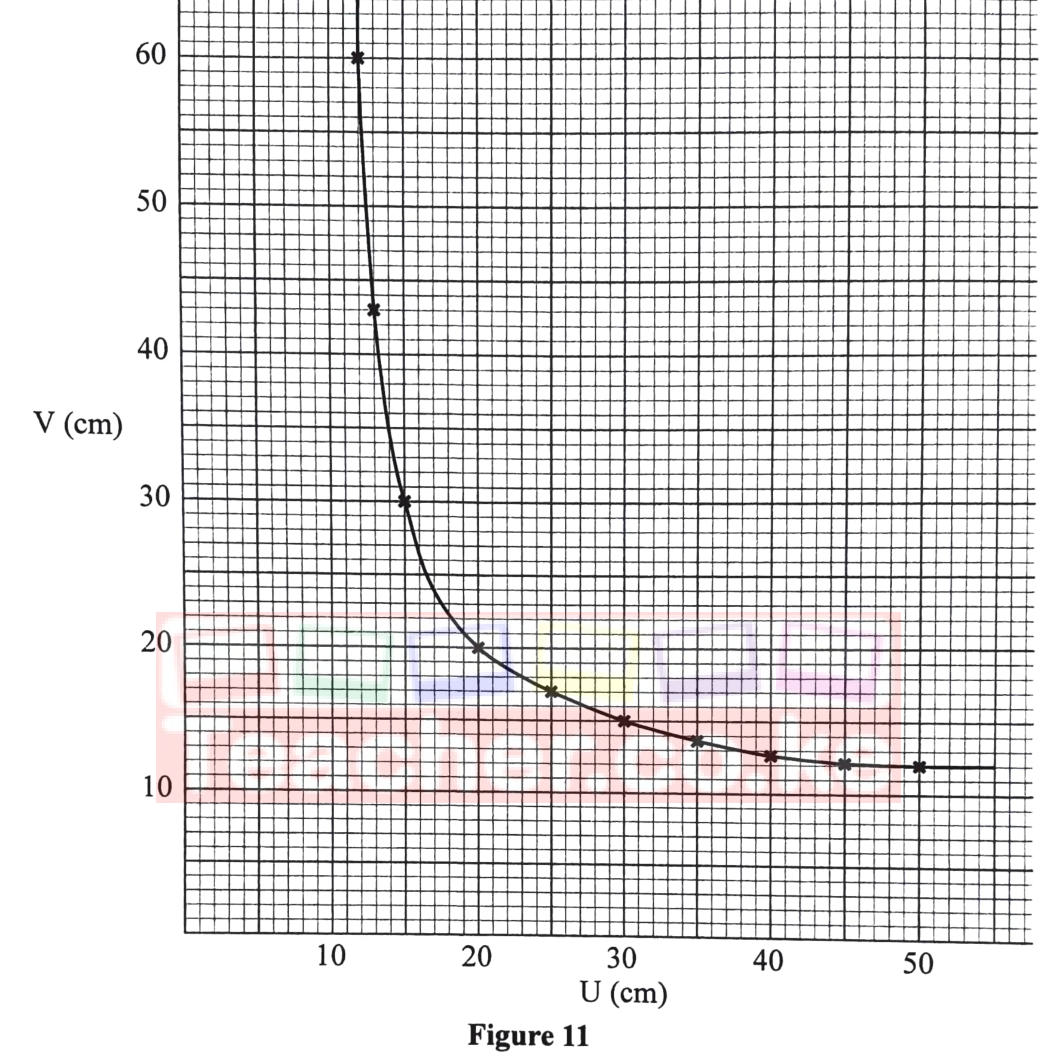
(i) Identify and mark a point X on the graph where V = U. (1 mark)
(ii) Use point X to determine: I. the radius of curvature, r; (2 marks) II. the focal length of the mirror. (1 mark)
16. (a) State Faraday's law of electromagnetic induction. (1 mark)
(b) Figure 12 shows a bar magnet being moved towards a solenoid. The solenoid is connected to a galvanometer.
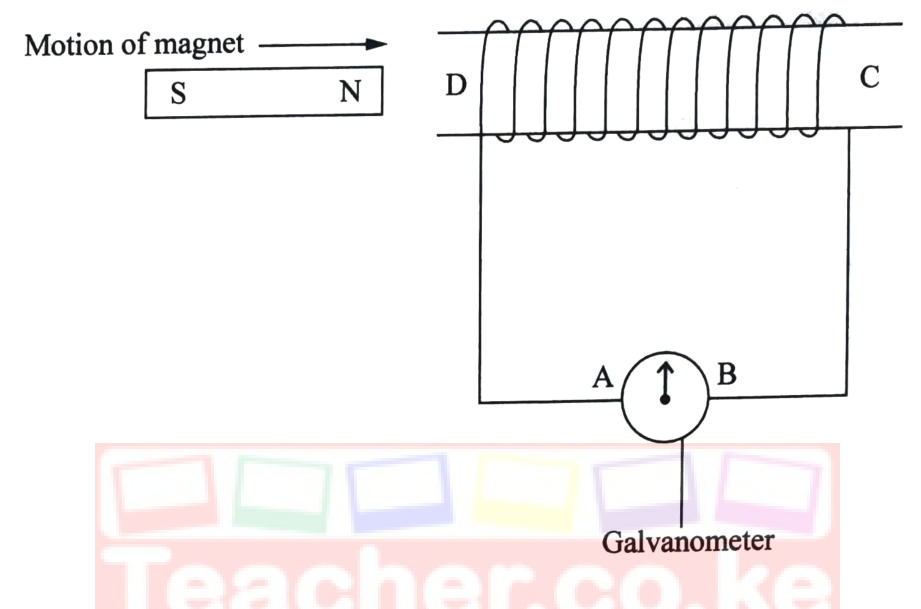
(i) Indicate on the diagram the direction of the induced current in the solenoid. (1 mark)
(ii) Identify the pole induced at D. (1 mark)
(iii) Explain the answer in 16(b)(ii). (2 marks)
(iv) Apart from the number of turns in the solenoid, state two factors affecting the magnitude of the induced current. (2 marks)
(c) Explain how laminating the core of a transformer increases its efficiency. (2 marks)
17. (a) Explain how a fuse protects electrical devices from damage. (2 marks)
(b) State and explain why the voltage in mains electricity is stepped up before long-distance transmission. (3 marks)
(c) Figure 13 shows how power can be transmitted from the generating station through transformers P, Q and R to the consumers.
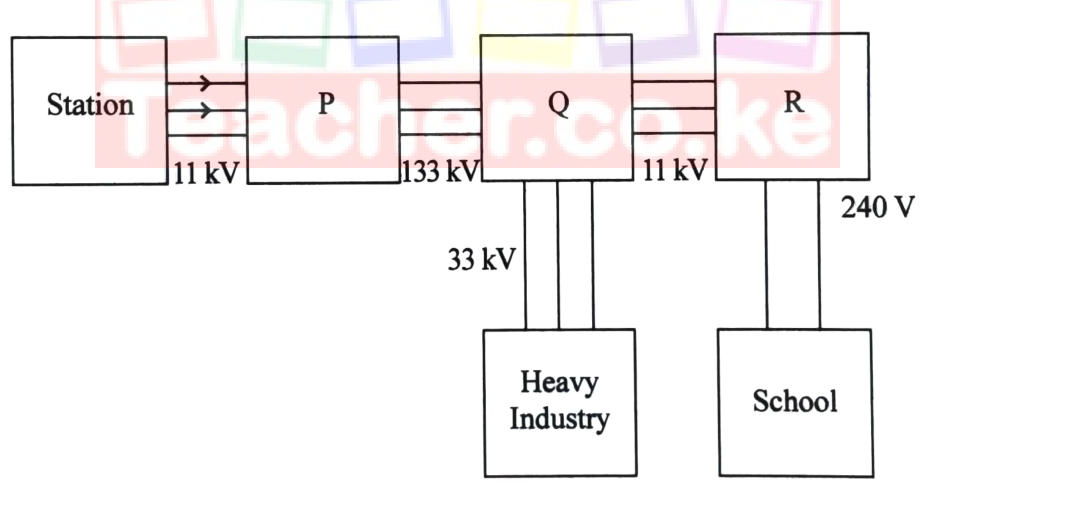
(i) Identify the type of transformer labelled P. (1 mark)
(ii) Explain how the number of turns in the primary and secondary coils of transformer P affects its output voltage. (3 marks)
(iii) State the reason why one of the wires from R to the school should be earthed. (1 mark)
(d) A power station generates 11 kV at a current of 1 A. The voltage is stepped up to 160 kV before being transmitted through electric cables. Assuming the transformer is 100% efficient, determine the secondary current. (3 marks)
18. (a) Figure 14 shows a cathode ray tube. A metal plate is placed between the anode and the screen.
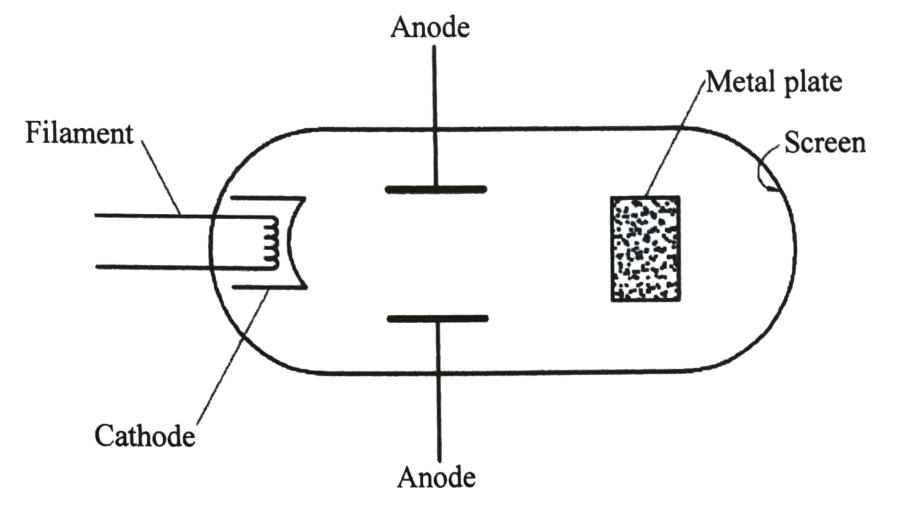
(i) State with a reason what would be observed on the screen when the cathode rays are produced. (2 marks)
(ii) State the effect on the cathode rays produced when the anode potential is increased. (1 mark)
(b) Explain how X-rays produce photographs of fractures in bones. (2 marks)
(c) Figure 15 shows monochromatic light incident on the cathode of a photocell connected to a milliammeter and three cells in series. The anode of the photocell may be connected to points P, Q, R and S through a jockey.
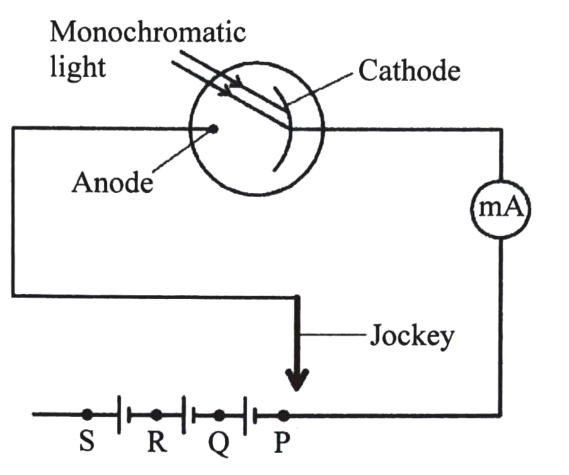
State what will be observed when the jockey is: (i) connected to point P; (1 mark) (ii) moved from P to Q, to R and then to S. (1 mark)
(d) Explain the answer in (c)(ii). (2 marks)
(e) State how radioactivity may be used to detect oil leakage in an underground pipeline. (2 marks)