232/1 · PHYSICS (Theory) · Paper 1 · Nov. 2023 · 2 hours
Instructions: This paper consists of two sections, A and B. Answer all the questions in sections A and B. All working must be clearly shown. Non-programmable silent electronic calculators may be used.
Section A (25 marks)
1. State one way in which Physics contributes to the study of History. (1 mark)
2. It is observed that diffusion is faster in gases than in liquids. State the reason for this observation. (1 mark)
3. A boarding school has two identical tanks A and B filled with water. All the surfaces of tank A are painted silvery shiny while the surfaces of tank B are painted black. It is observed that, for bathing in the morning, most of the students prefer fetching water from one particular tank.
(a) Identify the tank preferred by the students in the morning. (1 mark)
(b) Explain why students prefer to use water in the tank identified in 3(a). (2 marks)
4. Figure 1 shows a uniform metre rule of negligible weight pivoted at the 40 cm mark. It is kept at equilibrium by a spring balance attached at the 100 cm mark and force F at the 60 cm mark.
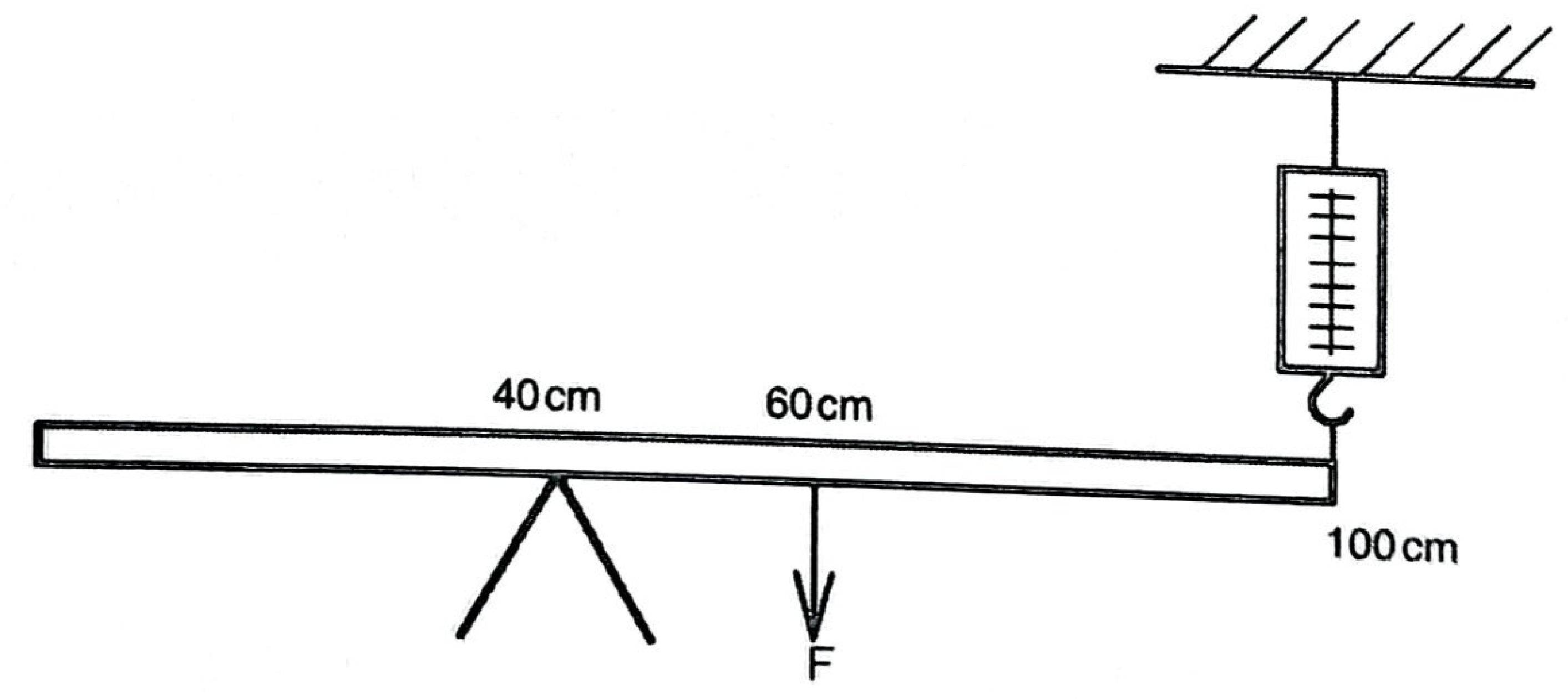
The reading on the spring balance is 1 N. Determine the value of F. (3 marks)
5. A mass of 40 g is suspended from a spring causing it to stretch. When a 20 g mass is added to it, the spring stretches further by 1.6 cm. Determine the spring constant. () (2 marks)
6. Figure 2 shows a test tube containing air and fitted with a sliding cork. The tube is suspended horizontally by a thread.
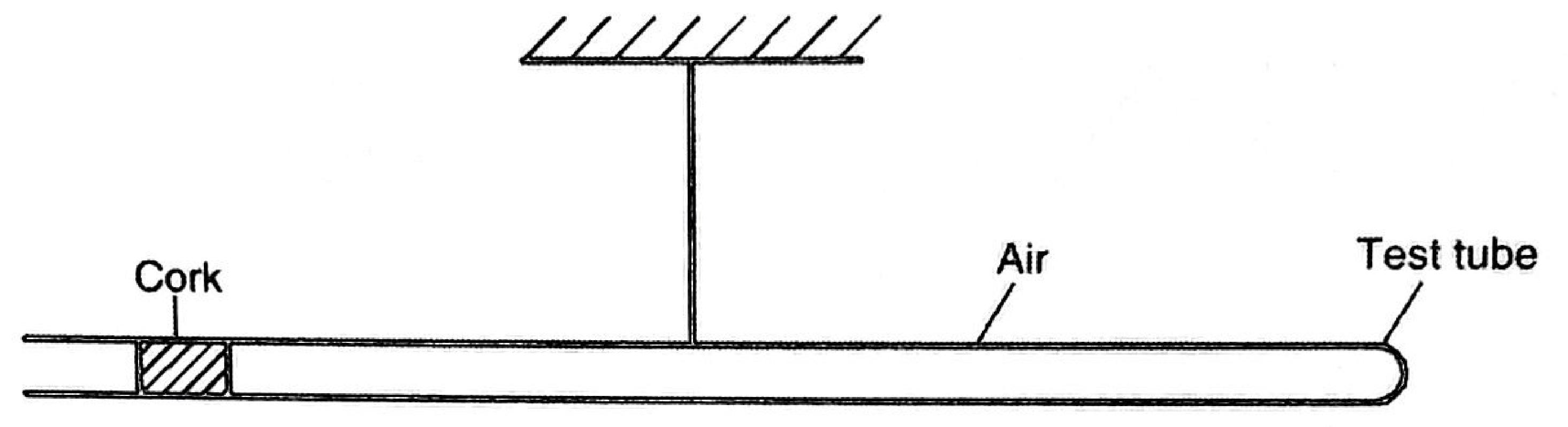
When the test tube was heated slightly, the cork moved and the tube tilted.
(a) State the direction in which the tube tilted. (1 mark)
(b) Explain why the tube tilted as in 6(a). (2 marks)
7. Figure 3 shows two identical tennis balls K and L moving in air. Ball K spins as it moves while ball L does not.
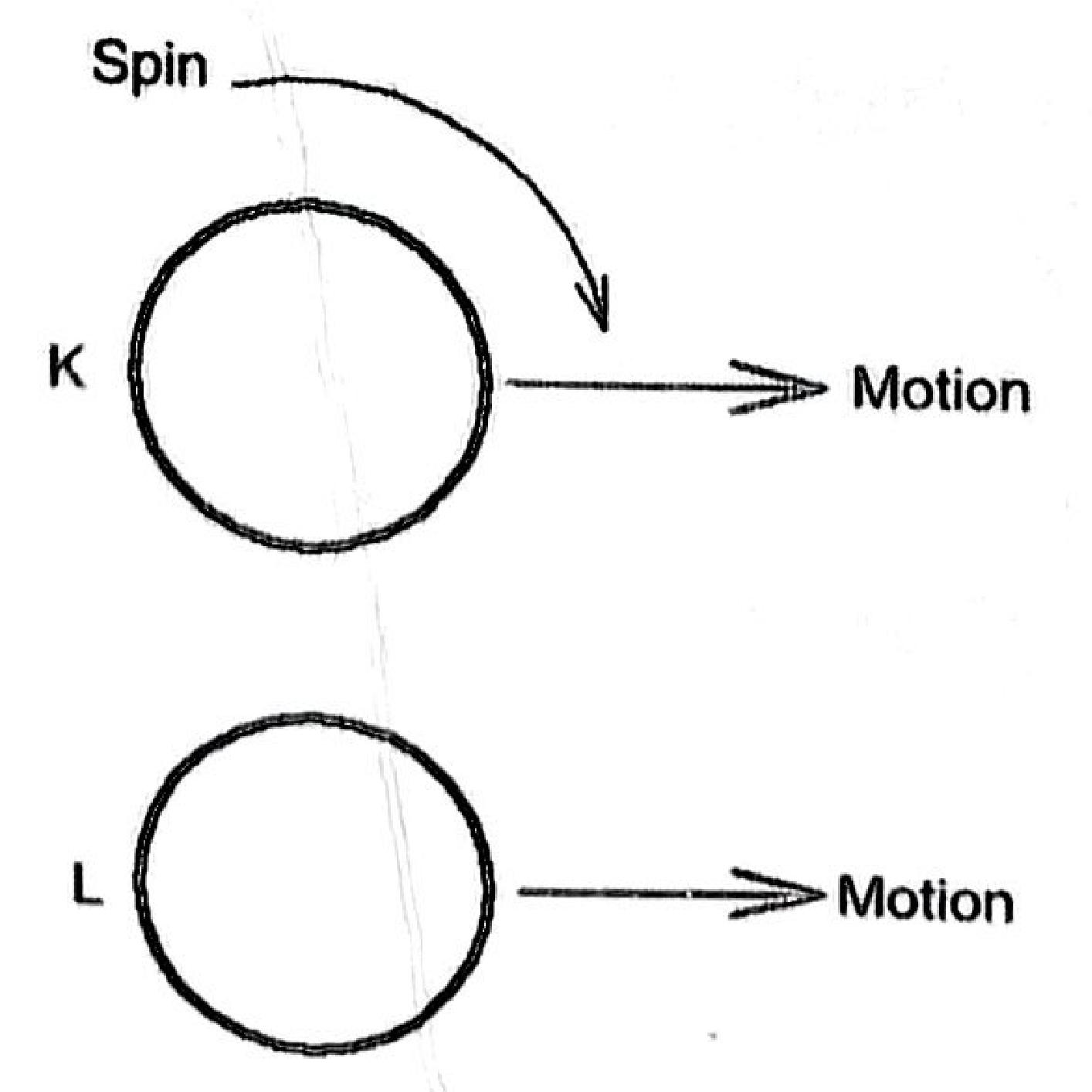
It is observed that ball K falls down faster than ball L. Explain this observation. (3 marks)
8. Figure 4 shows a velocity–time graph of a certain object.
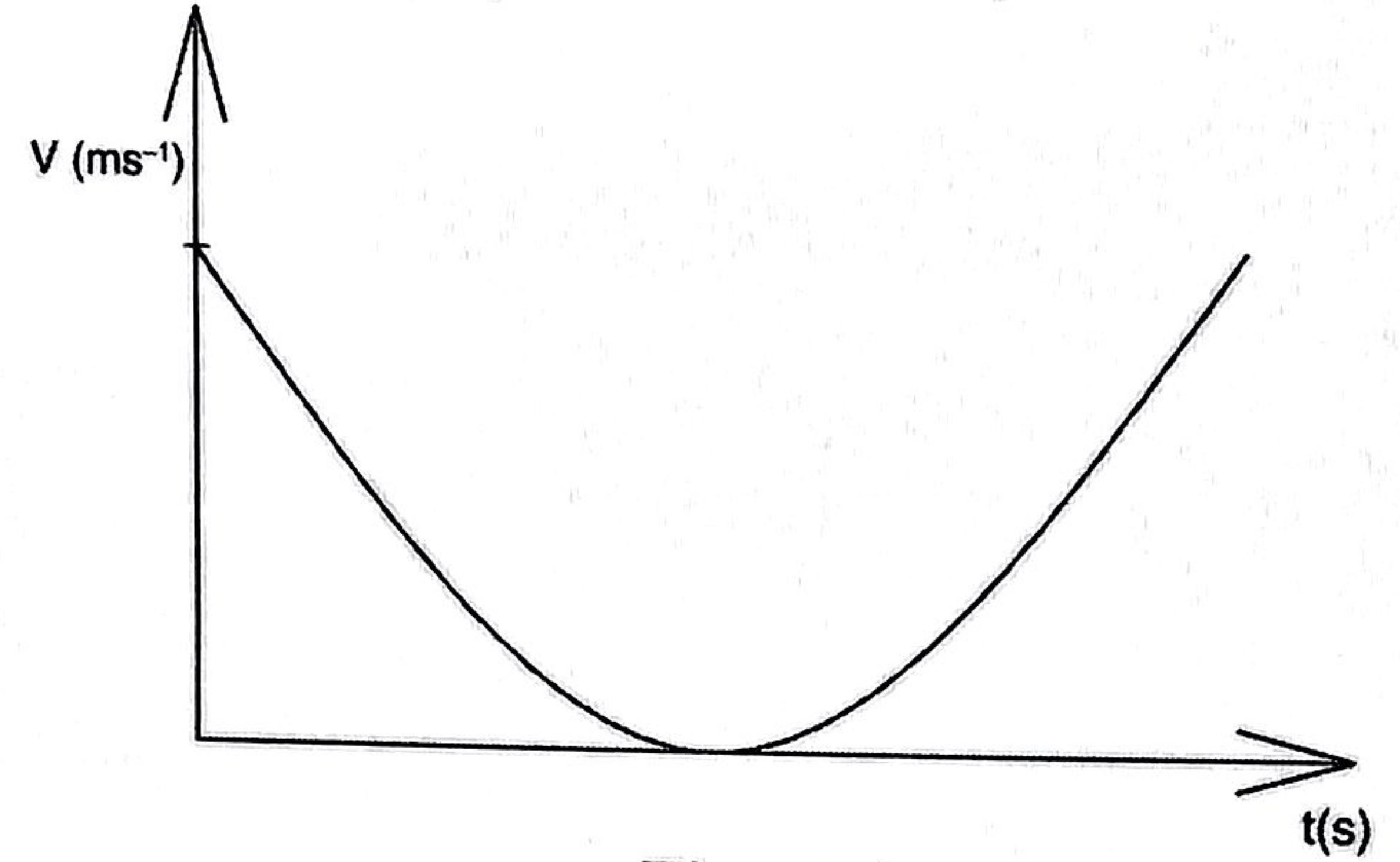
Describe the motion of the object. (2 marks)
9. Figure 5 shows a toy car of mass 250 g moving from rest on a curved frictionless bowl of height 0.2 m.
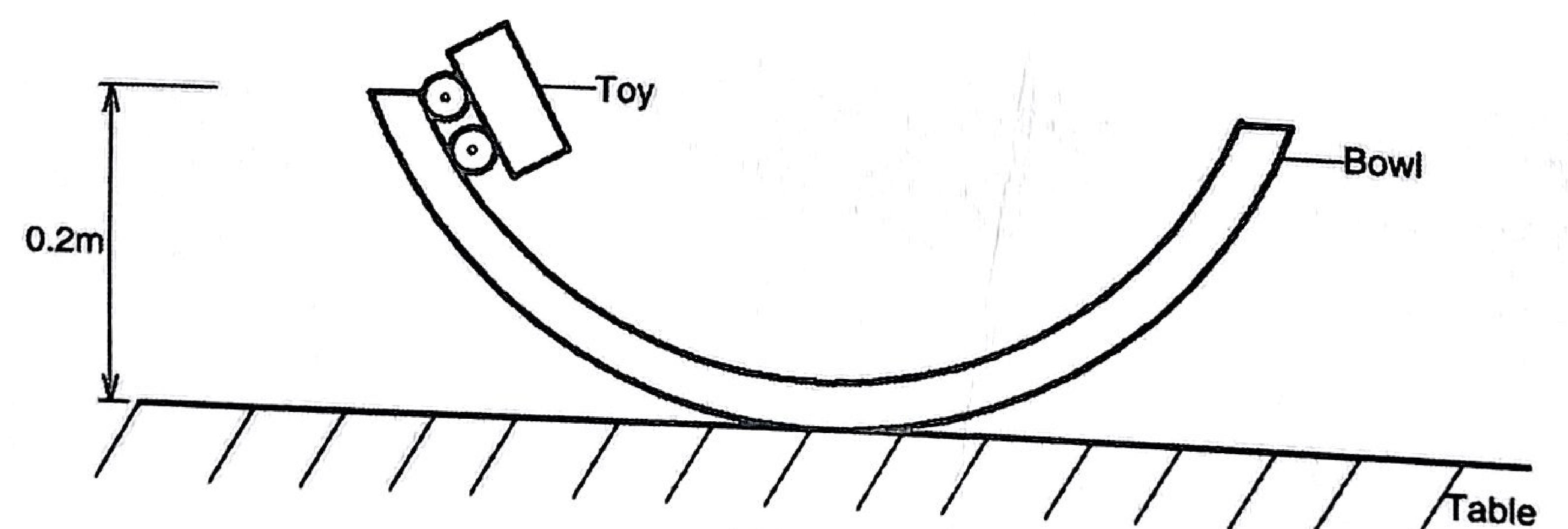
Determine the maximum kinetic energy that the toy attains. () (3 marks)
10. State one factor that determines the speed at which a car negotiates a level circular path. (1 mark)
11. A student observed that a burn by steam from boiling water was more severe than a burn by the boiling water. State the reason for this observation. (1 mark)
12. State one advantage of a force pump over a lift pump. (1 mark)
13. State one possible source of error that may occur when carrying out an experiment to verify Charles's law. (1 mark)
Section B (55 marks)
14. (a) State two properties of alcohol that make an alcohol thermometer more suitable than a mercury-in-glass thermometer in measuring temperature. (2 marks)
(b) Figure 6 shows Six's maximum and minimum thermometer.
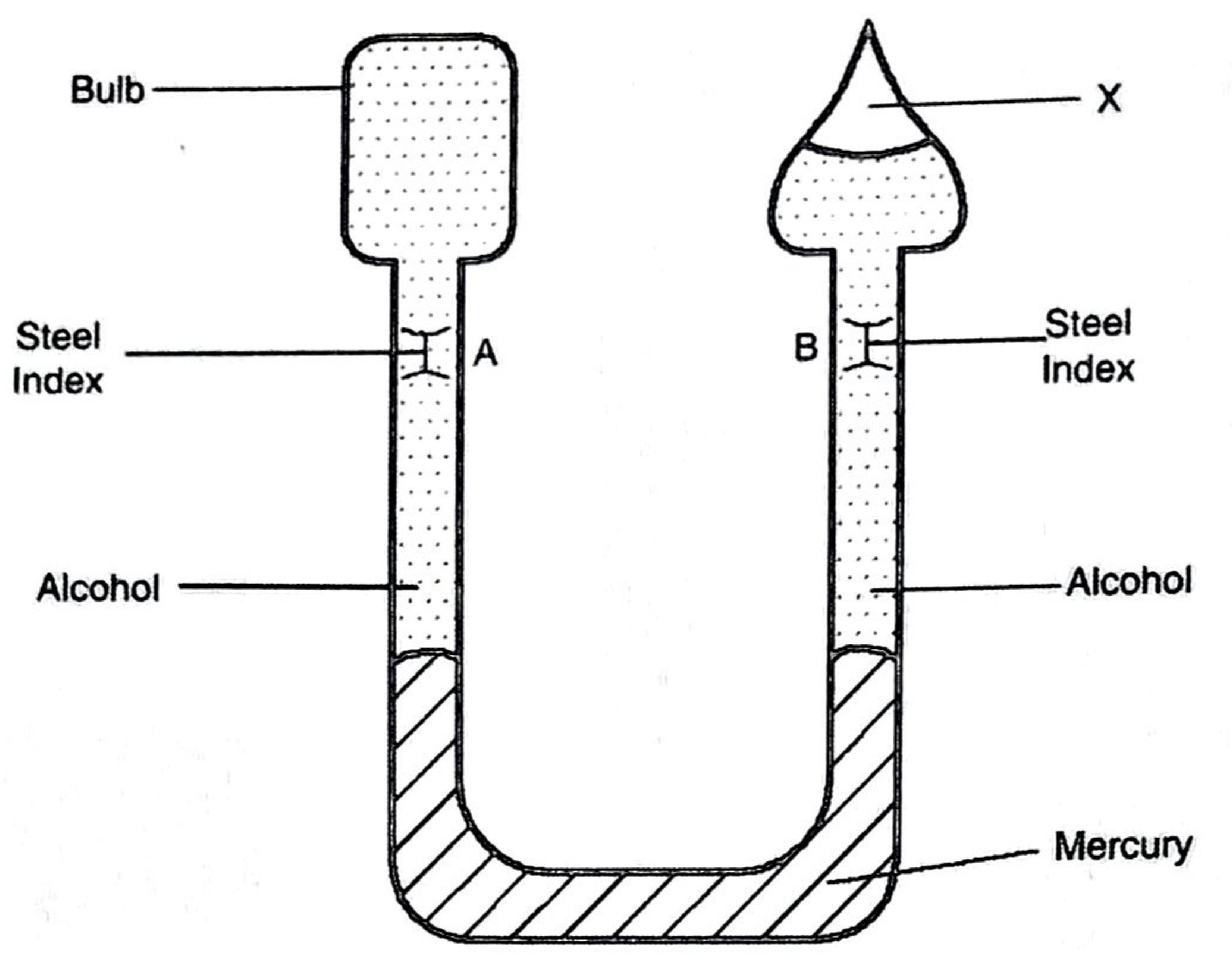
(i) State the purpose of the: I. part labelled X; (1 mark) II. mercury. (1 mark)
(ii) State the reason why indices A and B are made of steel. (1 mark)
(iii) Explain how the maximum temperature for a given day is determined using this type of thermometer. (3 marks)
(iv) State the reason for the shape of the meniscus of mercury in Figure 6. (1 mark)
(c) Figure 7 shows a cork stuck in the neck of a glass bottle.
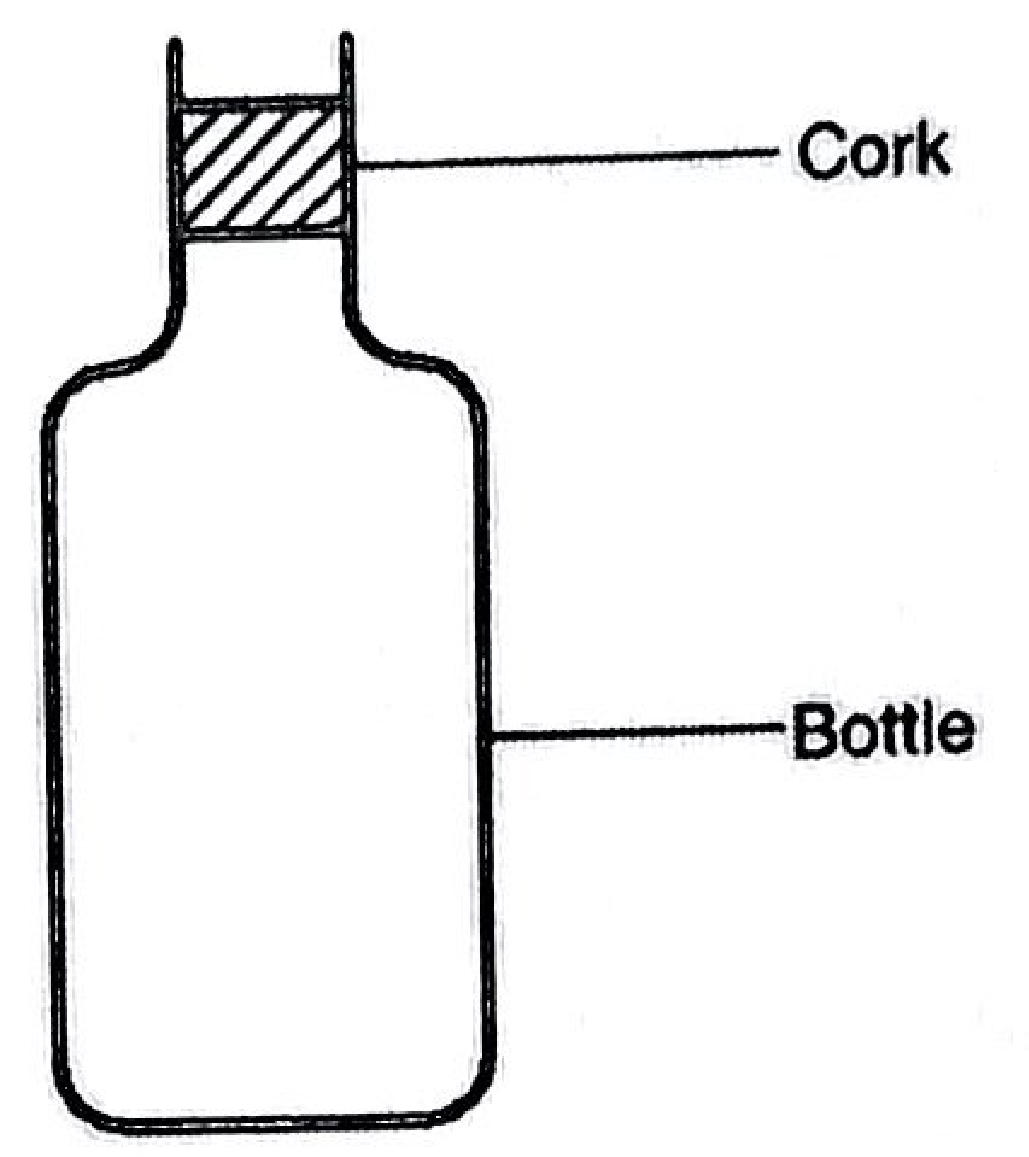
Explain how the cork can be removed from the bottle without breaking the bottle or the cork. (2 marks)
15. (a) Explain the following observations:
(i) A trolley moving on a bench in a straight line eventually comes to rest. (2 marks)
(ii) A passenger is jerked forward when a vehicle is suddenly stopped. (2 marks)
(b) Figure 8 shows a graph of velocity against time for two identical ball bearings dropped into water and glycerine.
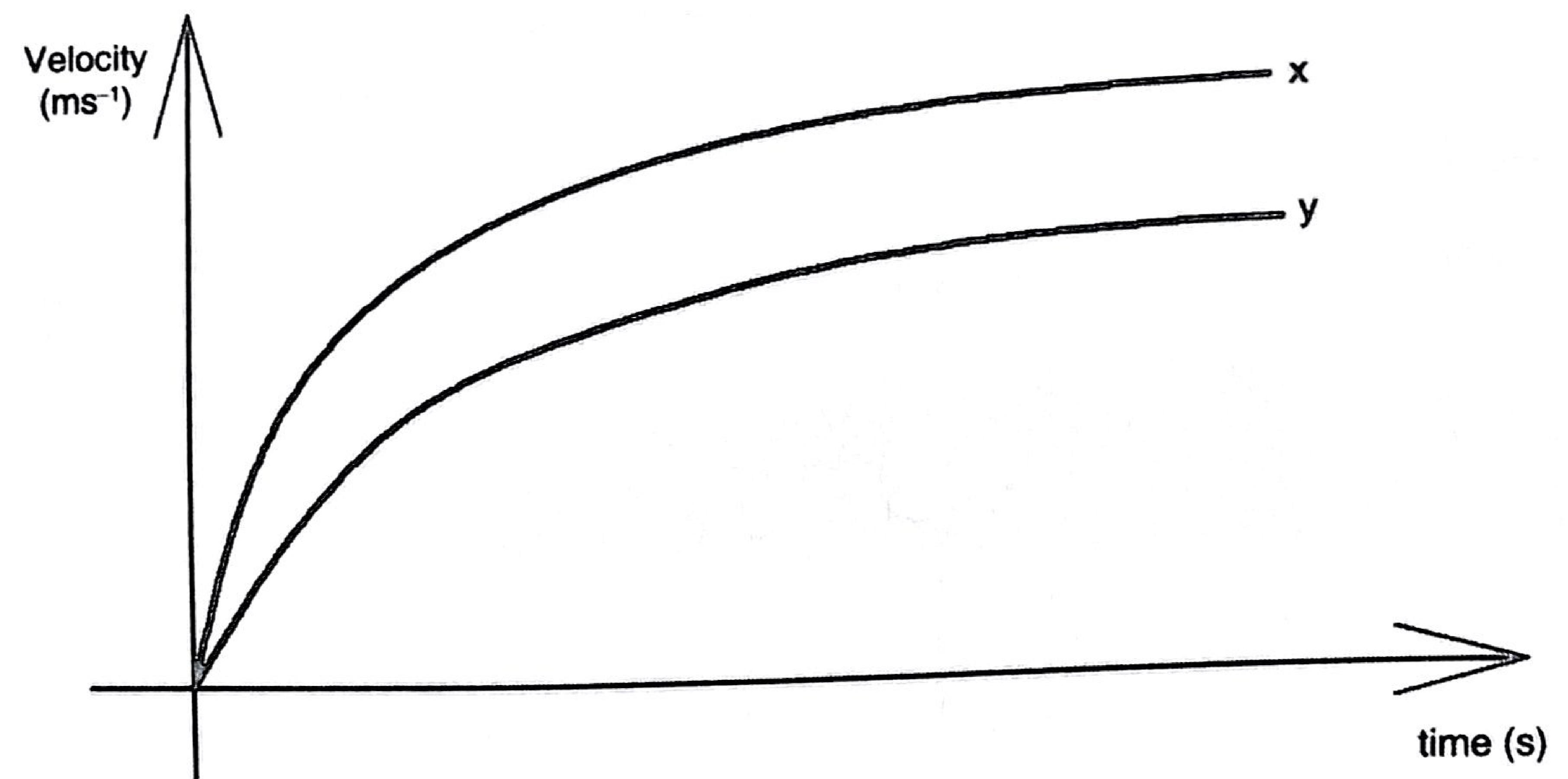
State with a reason which of the two curves x or y shows the velocity of the ball bearing falling through water. (3 marks)
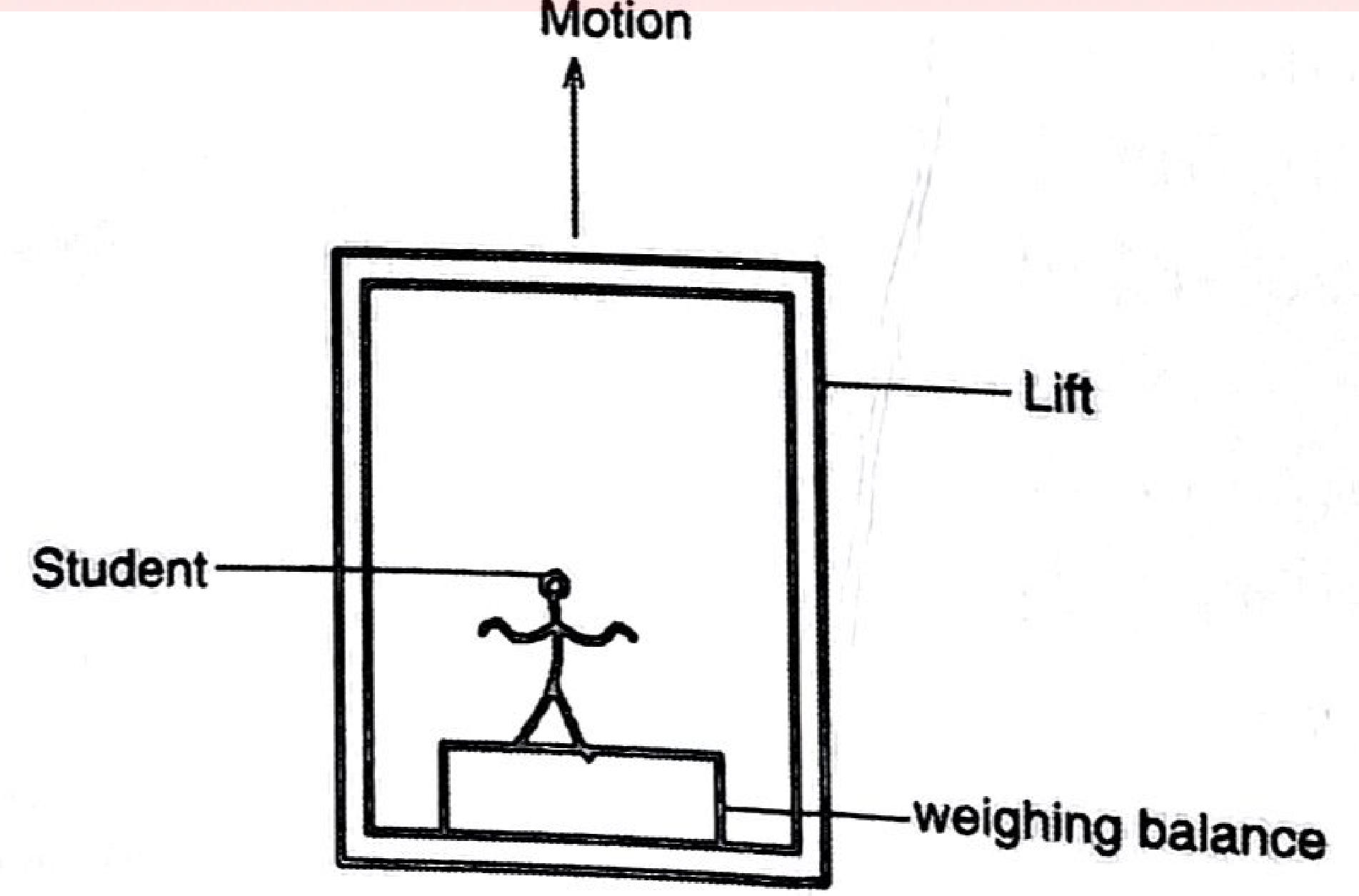
(c) Figure 9 shows a student of mass 60 kg standing on a weighing balance calibrated in newtons in a lift. The lift is accelerating upwards at 0.25 m s⁻².
Determine the reading on the weighing balance. (3 marks)
(d) State one way of reducing frictional force experienced by an object sliding on a flat surface. (1 mark)
16. (a) Figure 10 (a) shows two similar bottles P and Q of the same weight while Figure 10 (b) shows bottle P kept afloat in water using an inflated balloon.
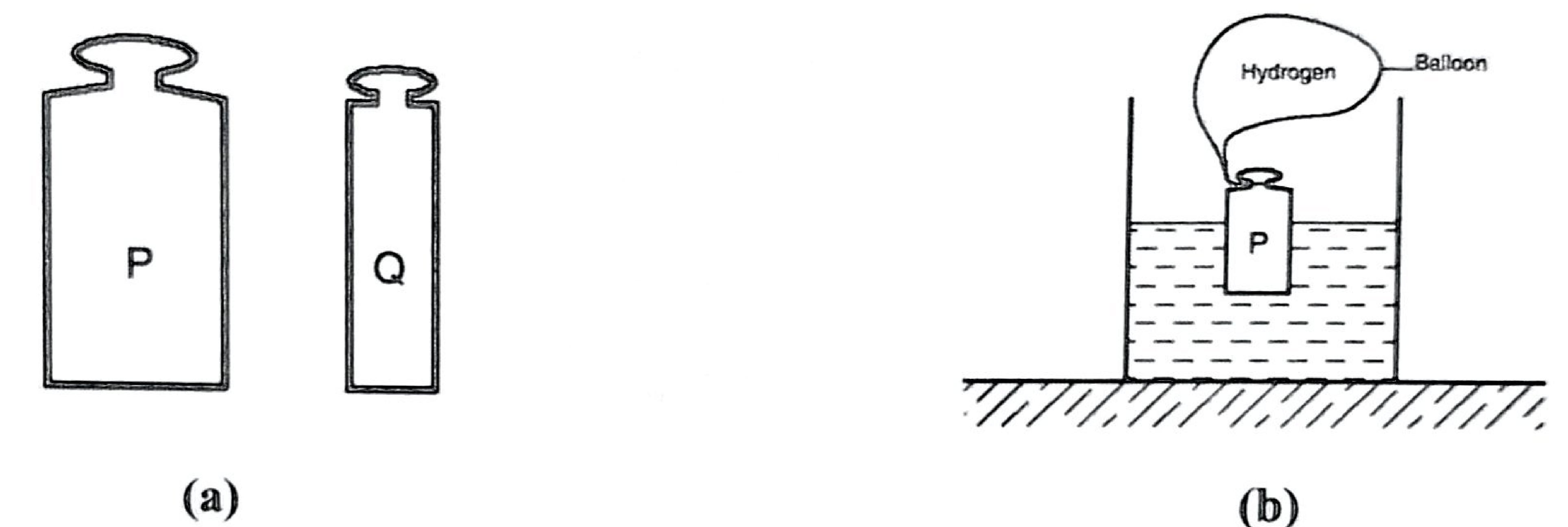
Bottle P in Figure 10 (b) is then replaced with bottle Q in Figure 10 (a).
(i) State what is observed on bottle Q. (1 mark)
(ii) Explain the observation in part (i). (2 marks)
(b) A piece of metal weighs 0.6 N in air and 0.5 N when fully submerged in water. When the metal is fully submerged in liquid L, it weighs 0.54 N. Determine the:
(i) relative density of the metal; (3 marks)
(ii) relative density of liquid L; (3 marks)
(iii) density of liquid L. (2 marks)
17. (a) In an experiment to estimate the diameter of an oil molecule, an oil drop of volume was placed on the surface of water. The oil spread to form a circular patch of diameter 8 cm.
(i) Determine the: I. area of the oil patch; (2 marks) II. diameter of the oil molecule. (3 marks)
(ii) State two assumptions made in such an experiment. (2 marks)
(iii) State any two possible sources of error in the experiment. (2 marks)
(b) Describe how the experiment in 17(a) could be used to determine the extent of accidental oil spillage in the sea. (2 marks)
18. (a) Figure 11 shows two liquids L and M each of mass 1 kg in identical containers. Liquid L has higher heat capacity than liquid M.
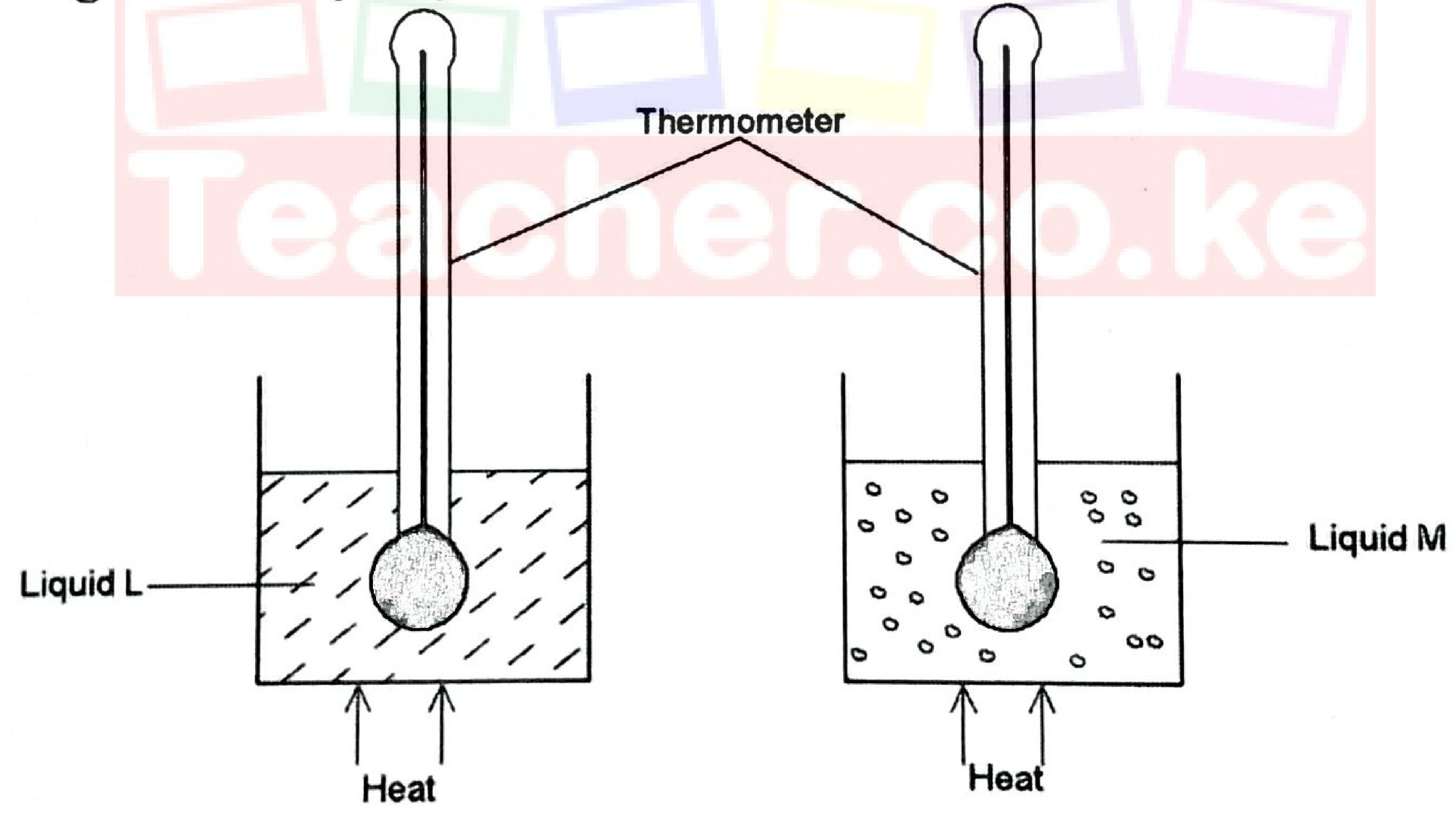
The liquids are heated with the same amount of heat for the same length of time.
(i) State the observation made on the readings of the two thermometers. (1 mark)
(ii) Explain the observation in part (i). (2 marks)
(iii) State two ways in which heat losses in the two calorimeters can be minimised. (2 marks)
(b) A block of ice at 0 °C and of mass 5 g is placed into a calorimeter containing 50 g of water at 25 °C. If all the ice melted, determine the final temperature of the mixture. (Assume that negligible heat is absorbed by the calorimeter. Specific heat capacity of water = 4200 J kg⁻¹ K⁻¹; specific latent heat of ice = .) (4 marks)
(c) It is observed that food cooks faster in a covered container than in an open container. Explain this observation. (2 marks)