232/3 · PHYSICS (Practical) · Paper 3 · Nov. 2023 · 2½ hours
Instructions: Answer all the questions. Spend the first 15 minutes reading the whole paper carefully. Marks are given for a clear record of the observations actually made, their suitability, accuracy and the use made of them. Record observations as soon as they are made. Non-programmable silent electronic calculators may be used.
Question 1
You are provided with: a strip of manila paper marked with an equal division scale on one end; a plane mirror; a biconvex lens; two pieces of wooden block; a stand, boss and clamp; some glycerine in a beaker; a dropper; a half metre rule.
Proceed as follows:
(a) Place the mirror on a horizontal surface and place the lens at the centre of the mirror.
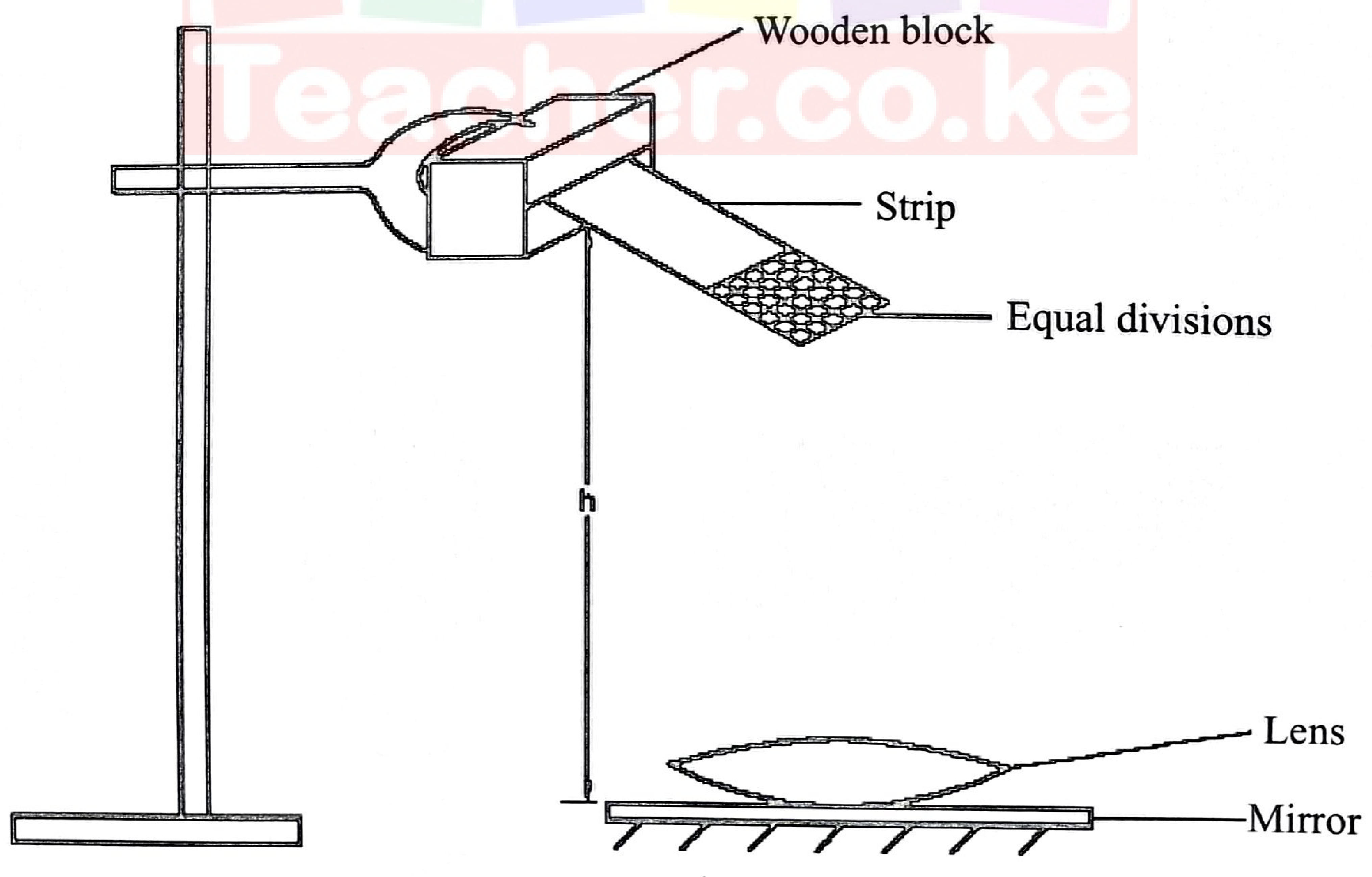
(b) Clamp the wooden blocks so that they hold the strip of manila with the millimetre scale facing upwards at a height above the centre of the lens. Let initially be about 300 mm (30 cm). (See Figure 1.)
(c) With the eye vertically above the lens, adjust the position of the mirror and lens so that you can see the image of the strip in the central region of the lens. Using the divisions on the scale on the top side of the strip, determine the width of the image when the object (strip) is 300 mm above the lens. (See Figure 2.)
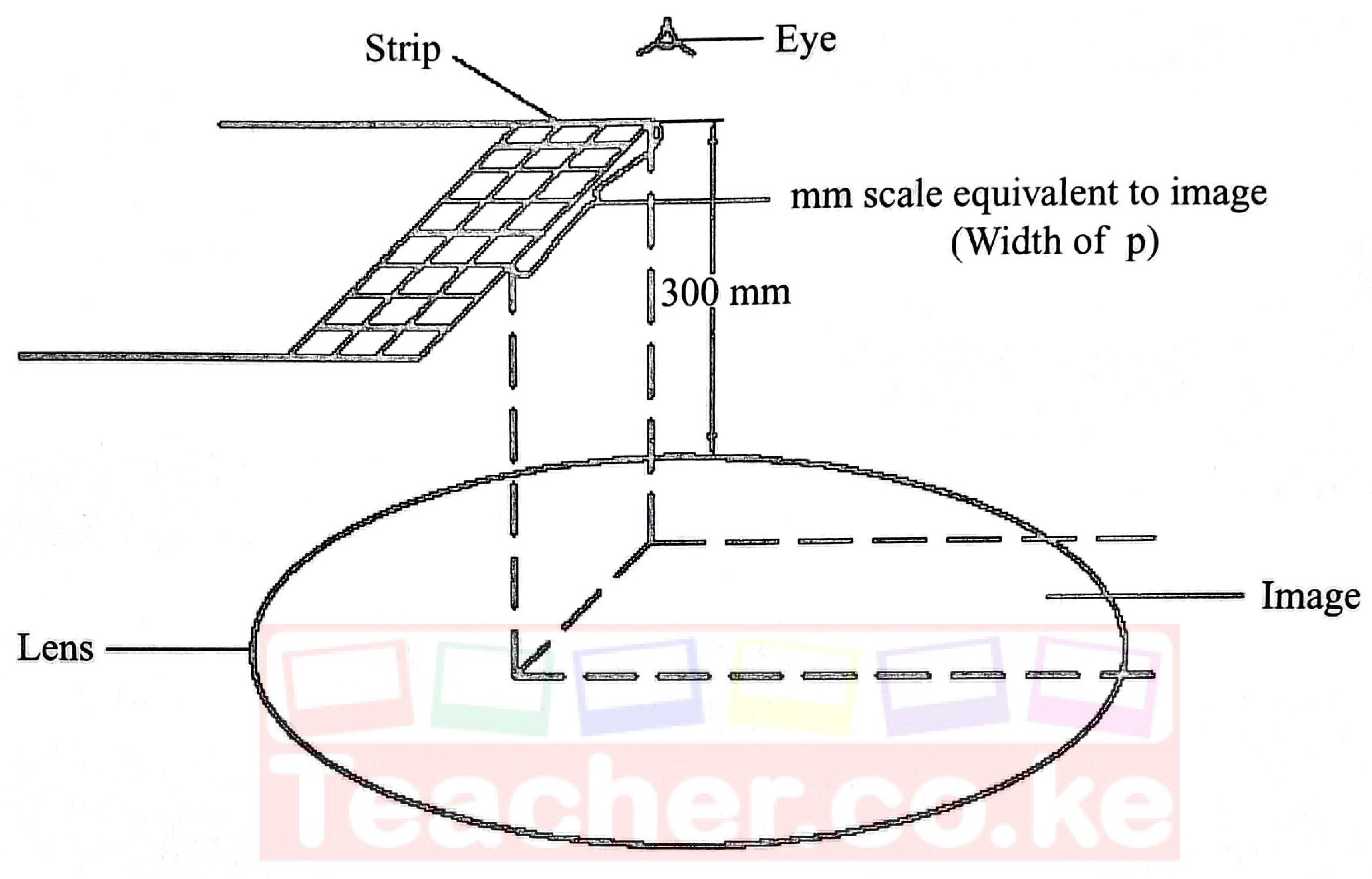
(width of image) = ……… divisions
(d) Repeat (c) to obtain for the other values of shown in Table 1. Record the results in Table 1.
(Hint: When the image is larger than the object, turn the strip upside down so that the scale faces downwards. In this case the width of the image where is the number of divisions on the image corresponding to the full width of the object. See Figure 3.)
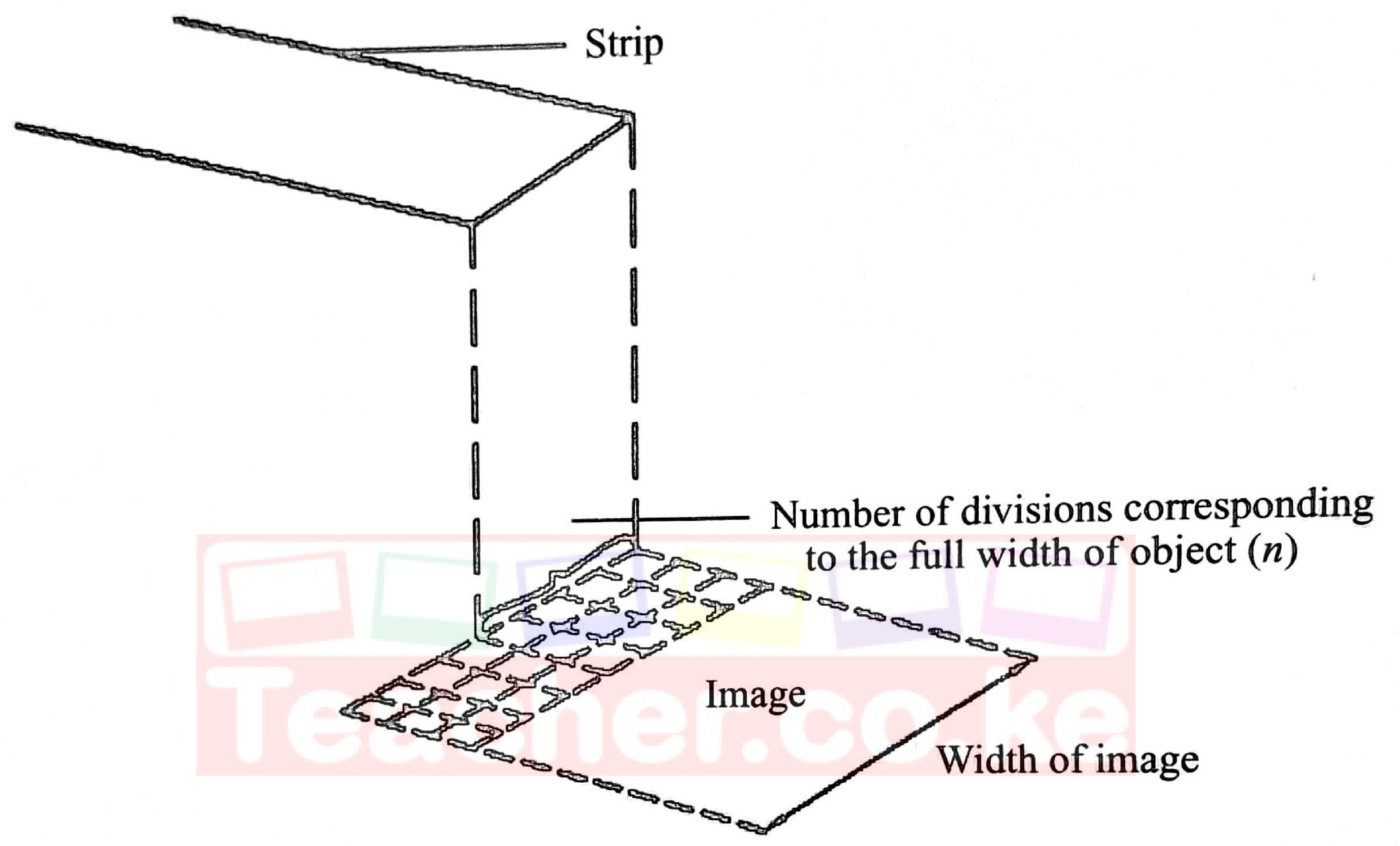
(e) Remove the lens. Put 8 drops of glycerine in the centre of the mirror. Replace the lens on top of the glycerine.
(f) Repeat (c) to obtain values of the width for the corresponding values of in Table 1 (up to mm). Complete Table 1.
Table 1 (8 marks)
| (mm) | 300 | 280 | 250 | 230 | 200 | 180 | 150 | 130 |
|---|---|---|---|---|---|---|---|---|
| (divisions) | ||||||||
| (divisions) |
(g) On the grid provided, plot a graph of (y-axis) against . (5 marks)
(h) Use the same axes as in (g) to plot a graph of (y-axis) against . (3 marks)
(i) From the graphs determine the:
(i) values of in each case when the image size is 10 divisions: = ……… (1 mark); = ……… (1 mark) (where is the value of for and is the value of for when the width of the image is 10 divisions);
(ii) refractive index of glycerine given that . (2 marks)
Question 2
You are provided with: two dry cells; a galvanometer; two cell holders; two switches; a voltmeter; an ammeter; a jockey; nine connecting wires; a resistance wire mounted on a millimetre scale labelled AB; a resistance wire mounted on a millimetre scale labelled PQ; a component X; a thermometer; two beakers, one containing water; one carbon resistor labelled 10 Ω; a source of hot water (to be shared).
Proceed as follows:
Part A
(a) Set up the circuit as shown in Figure 4.
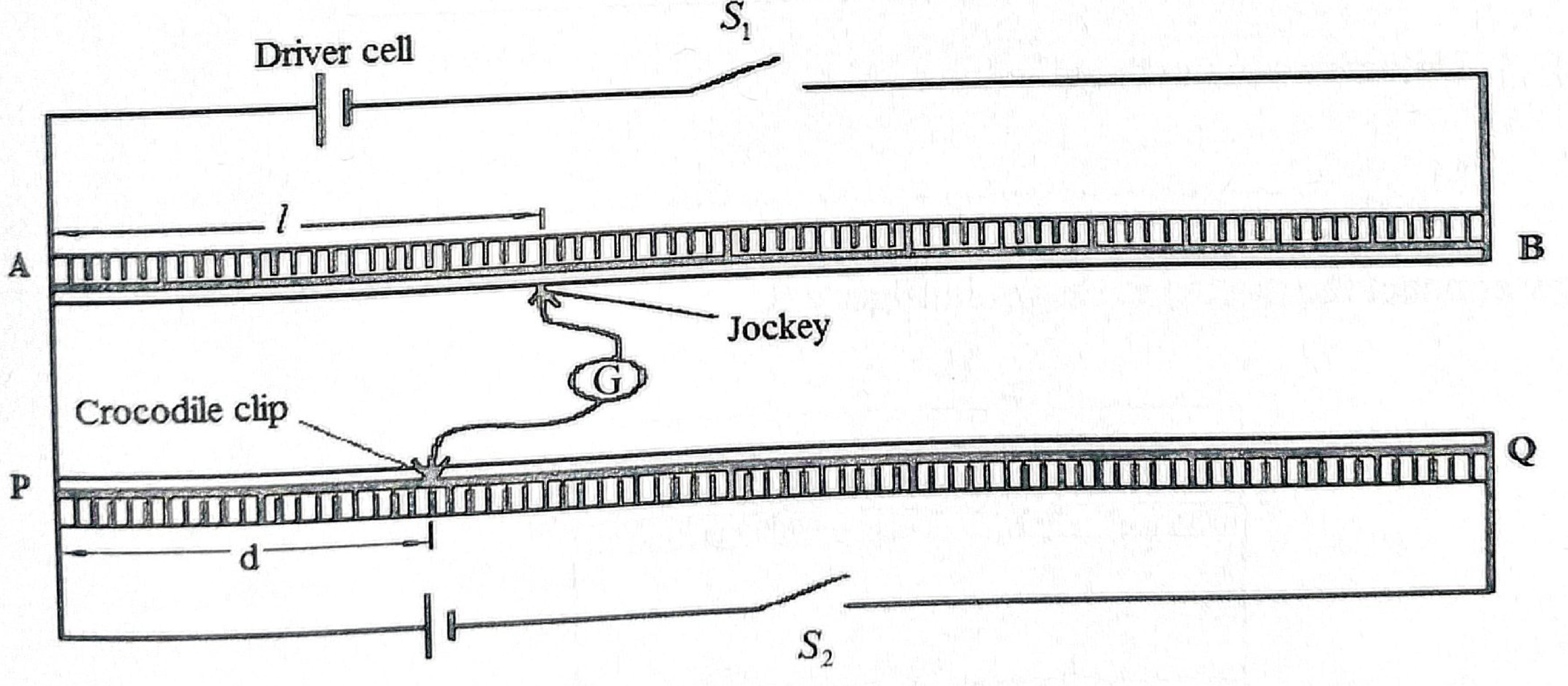
With and open, connect a voltmeter across the driver cell and record the voltmeter reading . = ……… volts (1 mark)
(b) (i) Adjust distance to 10 cm from P. Move the jockey along AB to obtain the balance length (no deflection on the galvanometer). = ……… cm (1 mark)
(ii) Determine constant given that . (1 mark)
(c) (i) Repeat (b) for the other values of in Table 2 and complete Table 2. (2 marks)
| (cm) | 10 | 30 | 50 |
|---|---|---|---|
| (cm) | |||
(ii) Determine the average value of . = ……… (2 marks)
(d) Now connect the circuit as shown in Figure 5. (2 marks)
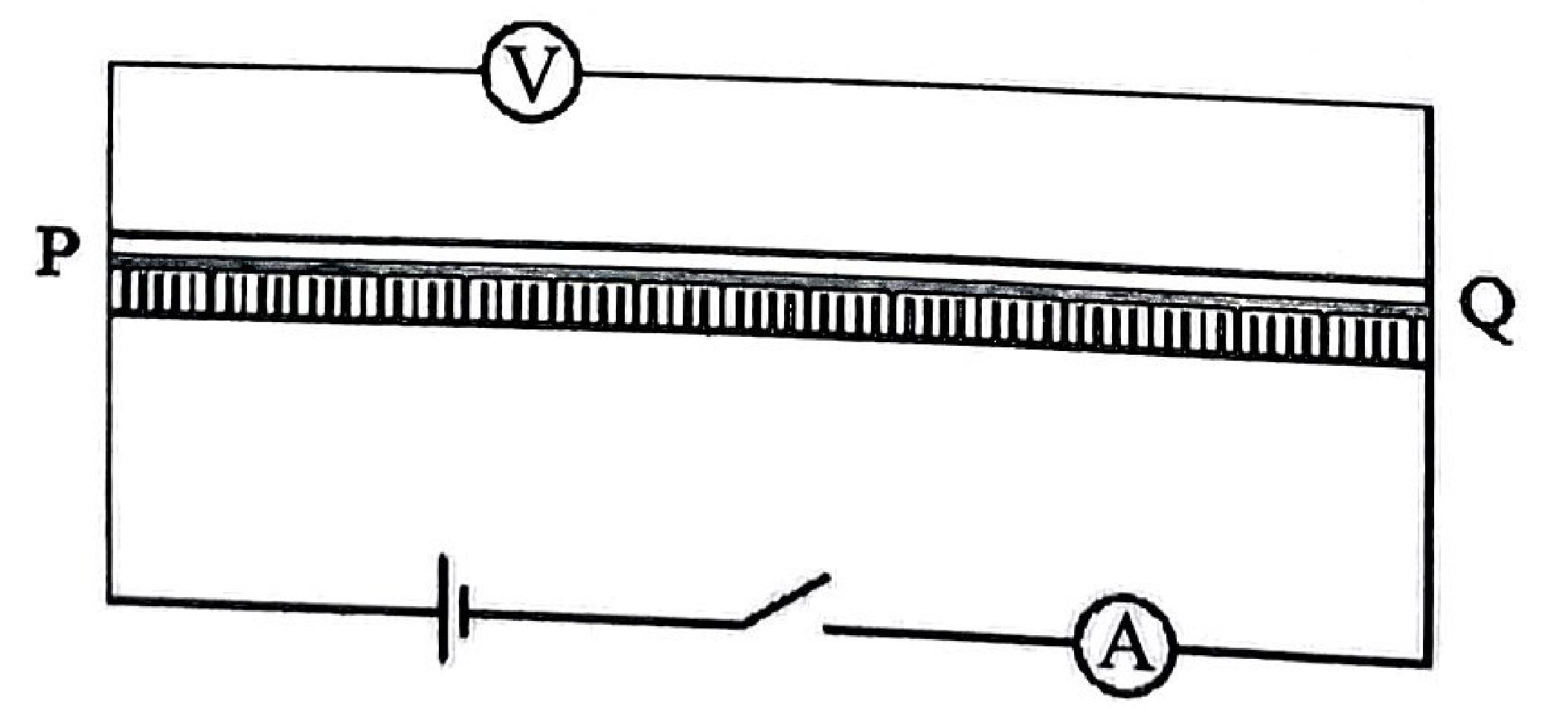
(i) Measure and record the current through the circuit and the potential difference across PQ. = ……… (1 mark) = ……… (1 mark)
(ii) Determine the resistance of the wire. (1 mark)
(iii) Determine constant given that . (2 marks)
Part B
(e) Connect the circuit as shown in Figure 6. Add cold water to the beaker until component X is just covered.
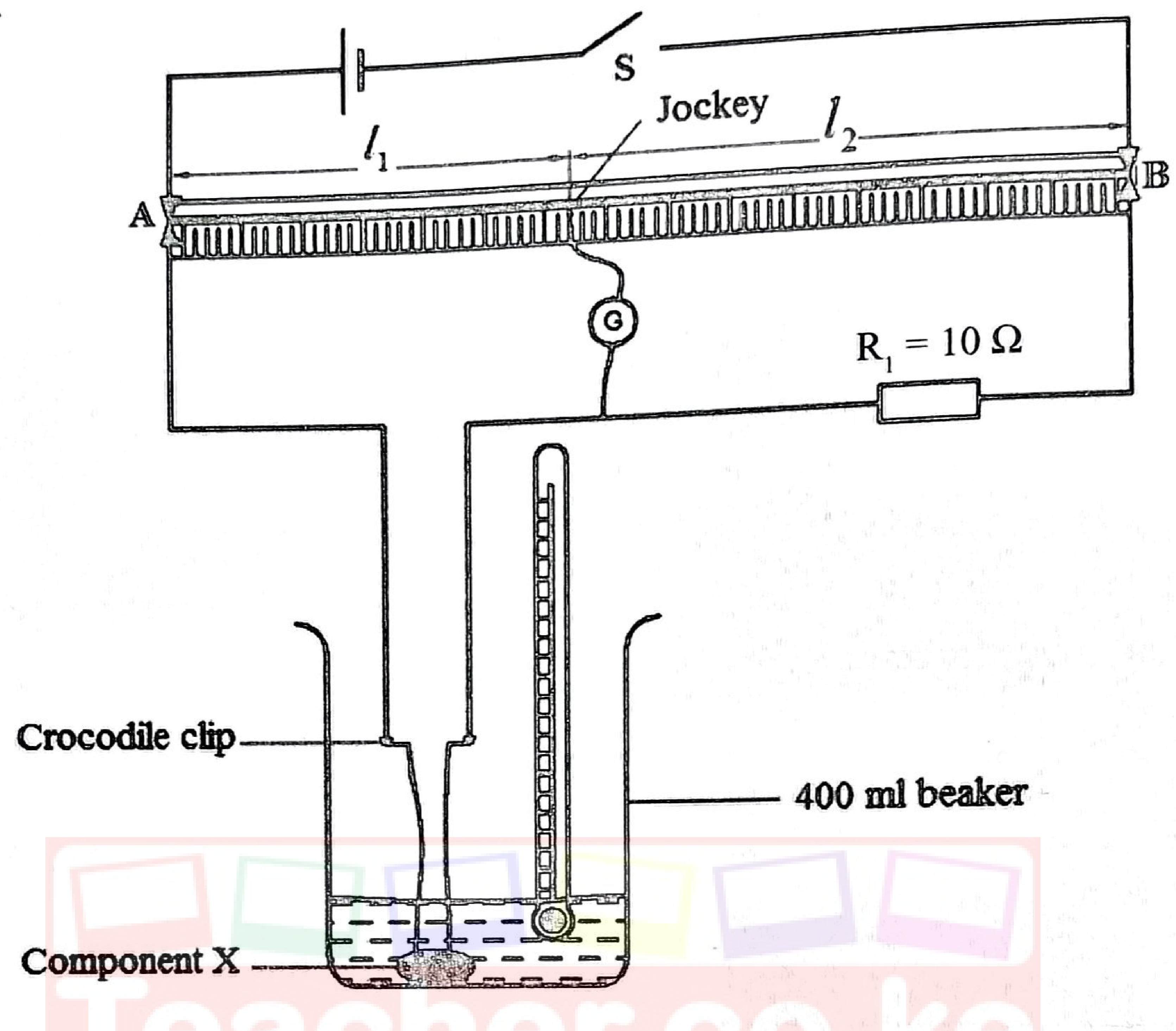
(f) (i) Record the initial temperature of the water in the beaker, = ……… °C (1 mark)
Close the switch and adjust the position of the jockey on wire AB until there is balance (no deflection on the galvanometer).
(ii) Record the balance lengths = ……… and = ……… (1 mark)
Open the switch.
(iii) Determine the initial resistance of the component X given that . (1 mark)
(g) Raise the temperature of the water covering component X by adding in little amounts of the hot water provided and stirring continuously using the thermometer. (It may be necessary to pour out some water in order to add more hot water.)
(i) Repeat (f) for the values of temperature () shown in Table 3.
(ii) For each of the temperatures in Table 3, determine the constant , and complete Table 3. (4 marks)
| Temperature (°C) | (cm) | (cm) | ||
|---|---|---|---|---|
| 40 | ||||
| 50 |
(iii) Determine the average value of . (1 mark)