232/3 · PHYSICS (Practical) · Paper 3 · Dec. 2022 · 2½ hours
Instructions: Answer all the questions. Spend the first 15 minutes reading the whole paper. Marks are given for a clear record of the observations actually made, their suitability, accuracy and the use made of them. Non-programmable silent electronic calculators may be used.
Question 1
You are provided with: a metre rule; a candle; a plain white screen labelled S₂; a white screen with cross-wires labelled S₁; a lens mounted on a lens holder.
Part A
(a) (i) Arrange the candle, the screen S₁, the lens and the plain screen S₂ in that order as shown in Figure 1.
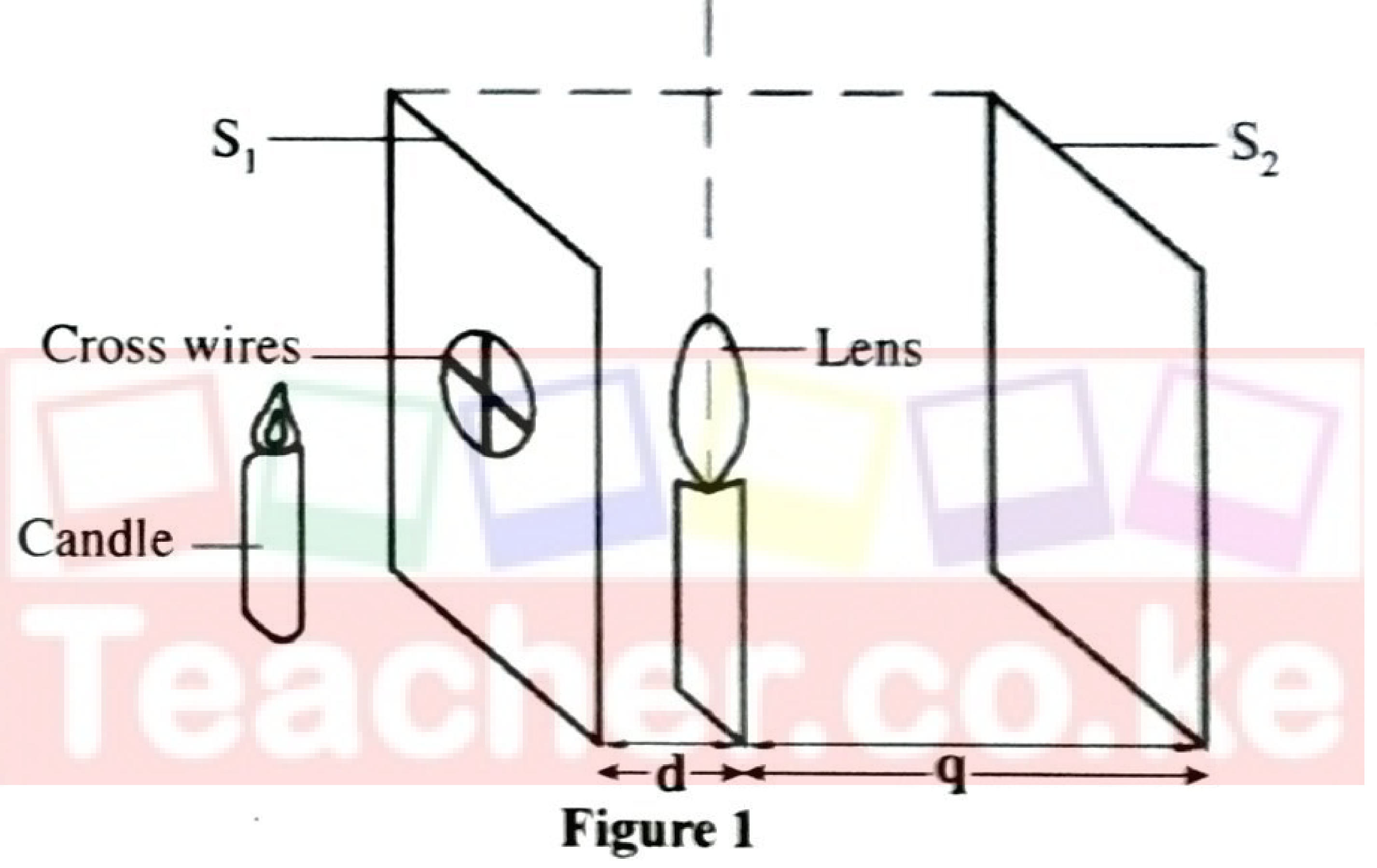
(ii) Light the candle. Ensure that the candle flame is close to the cross-wires and in a horizontal line with the centres of the lens and the screens.
(b) Set the distance between the cross-wires and the lens at = 16 cm. Adjust the distance between the lens and screen S₂ so that a sharp image of the cross-wires is formed on S₂.
(i) Record the distance . (1 mark)
(ii) Determine given that . (2 marks)
(c) Place screen S₂ aside and adjust the position of the lens until a sharp image of the flame is formed on the screen S₁ beside the cross-wires.
(i) Measure the distance between the screen and the lens. (1 mark)
(ii) Determine given that . (2 marks)
(iii) Determine given that . (1 mark)
(d) Place the plain screen S₂ back in its original position as in Figure 1. Set the distance between the cross-wires and the lens at = 14 cm.
(i) Adjust the position of S₂ to obtain a sharp image of the cross-wires. Measure the distance between the image and the lens. Record in Table 1.
(ii) Repeat (d)(i) for the other values of shown in Table 1 and complete the table. (5 marks)
| (cm) | 14 | 15 | 18 | 21 | 24 | 30 | 35 |
|---|---|---|---|---|---|---|---|
| (cm) | |||||||
| (cm) |
(e) Plot a graph of (y-axis) against . (5 marks)
(f) From the graph, determine the: (i) minimum distance between the object and its real image; (1 mark) (ii) focal length given that ; (1 mark) (iii) image distance when is minimum. (1 mark)
Question 2
You are provided with: a piece of thread; a metre rule; a triangular glass prism; a 50 g mass; a boss, clamp and stand; some water in a beaker; tissue paper; liquid L; an ammeter; a voltmeter; wires labelled P and Q; a switch; two dry cells; 9 connecting wires; a wire mounted on a metre rule labelled AB; a centre-zero galvanometer; a jockey.
Part A
(a) Using a piece of thread, a clamp and a stand, suspend the metre rule so that it balances horizontally about its centre of gravity.
(b) On the metre rule, suspend the glass prism at the 70 cm mark and the 50 g mass at a distance cm from the centre of gravity (CoG) so that the metre rule balances horizontally as shown in Figure 2. Maintain the prism at the 70 cm mark throughout the experiment.
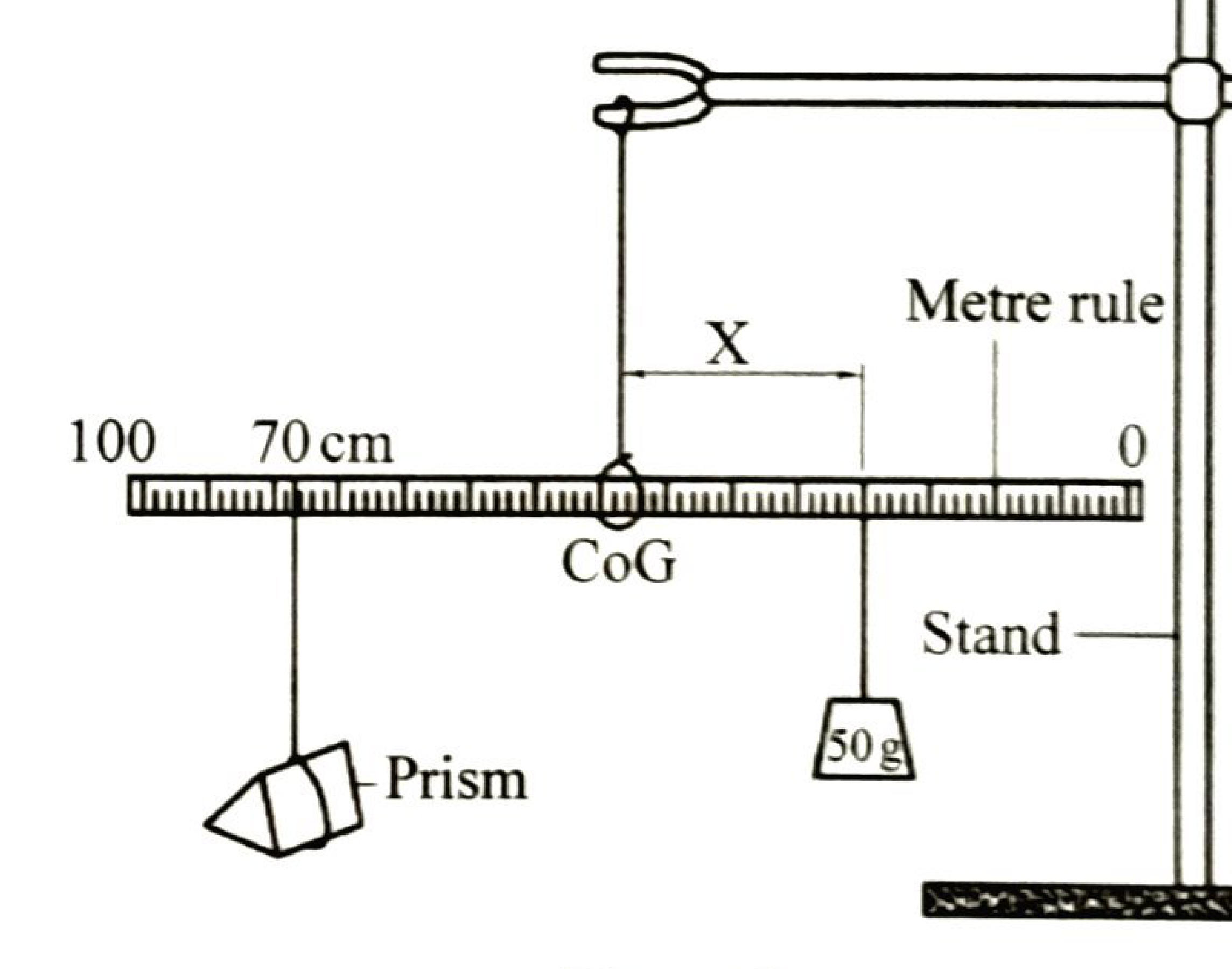
(i) Record the balance length . (1 mark)
(ii) Using the principle of moments, determine the mass of the prism. (3 marks)
(c) While maintaining the position of the prism on the metre rule, lower the clamp to adjust the height of the prism until it is fully submerged in water as shown in Figure 3. Ensure that the prism does not touch the sides of the beaker.
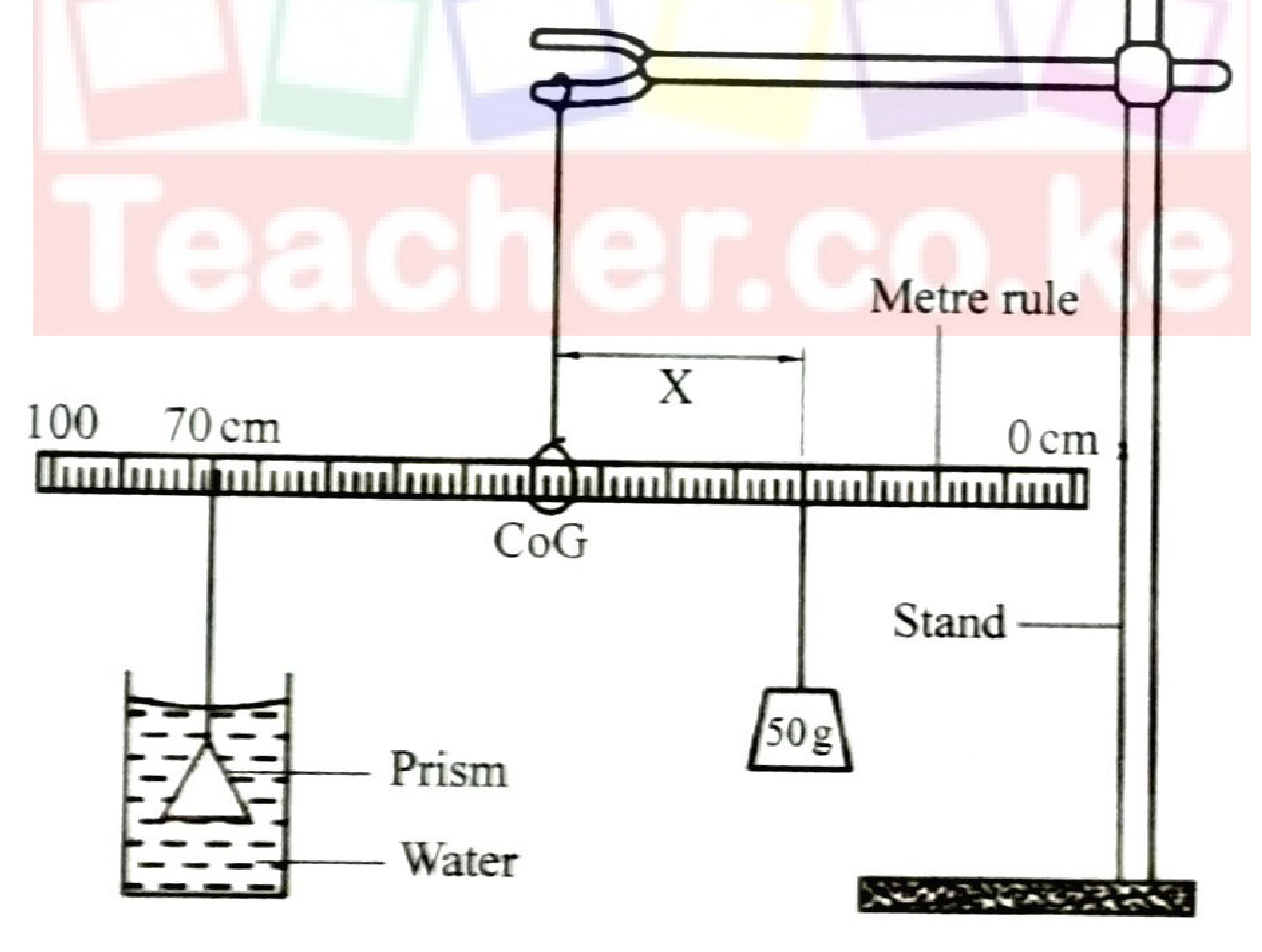
(d) Adjust the distance to restore the balance of the metre rule.
(i) Record the new balance length . (1 mark)
(ii) Using the principle of moments, determine the apparent loss in mass of the prism in water. (3 marks)
(iii) Determine the value of given that . (1 mark)
(iv) State the quantity represented by . (1 mark)
(e) Using tissue paper, dry the prism. Replace the water with liquid L and repeat the procedure in part (c), adjusting the distance to restore the balance of the metre rule.
(i) Record the new balance length . (1 mark)
(ii) Given that , where kg m⁻³, determine the quantity and state its SI unit. (3 marks)
Part B
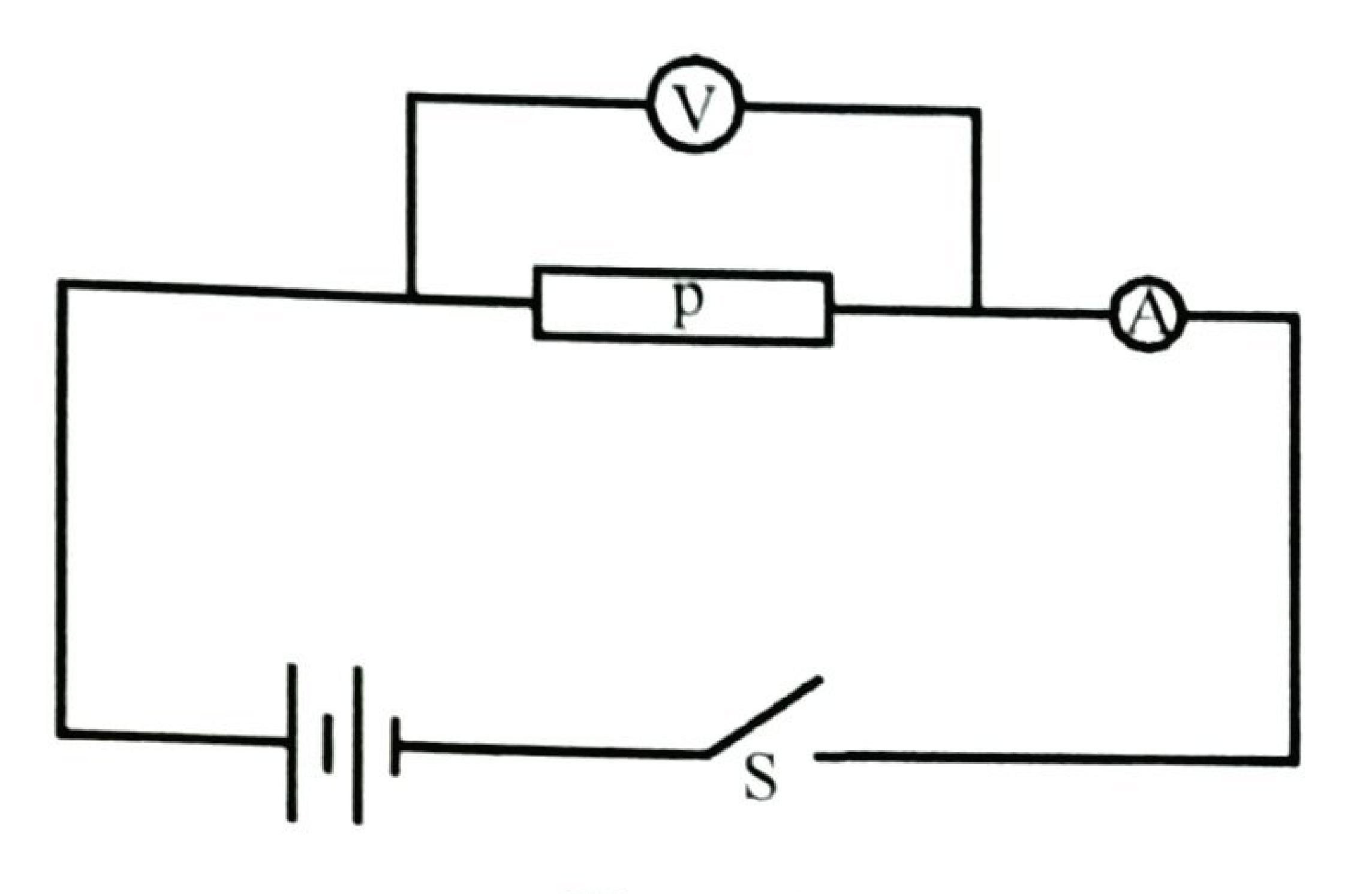
(f) Use the apparatus provided to set up the circuit shown in Figure 4.
(g) Close the switch S.
(h) Read and record: (i) current (A); (1 mark) (ii) voltage (V). (1 mark)
(i) Determine the resistance of P. (1 mark)
(j) Disconnect the circuit in Figure 4 and use the apparatus to connect the circuit in Figure 5.
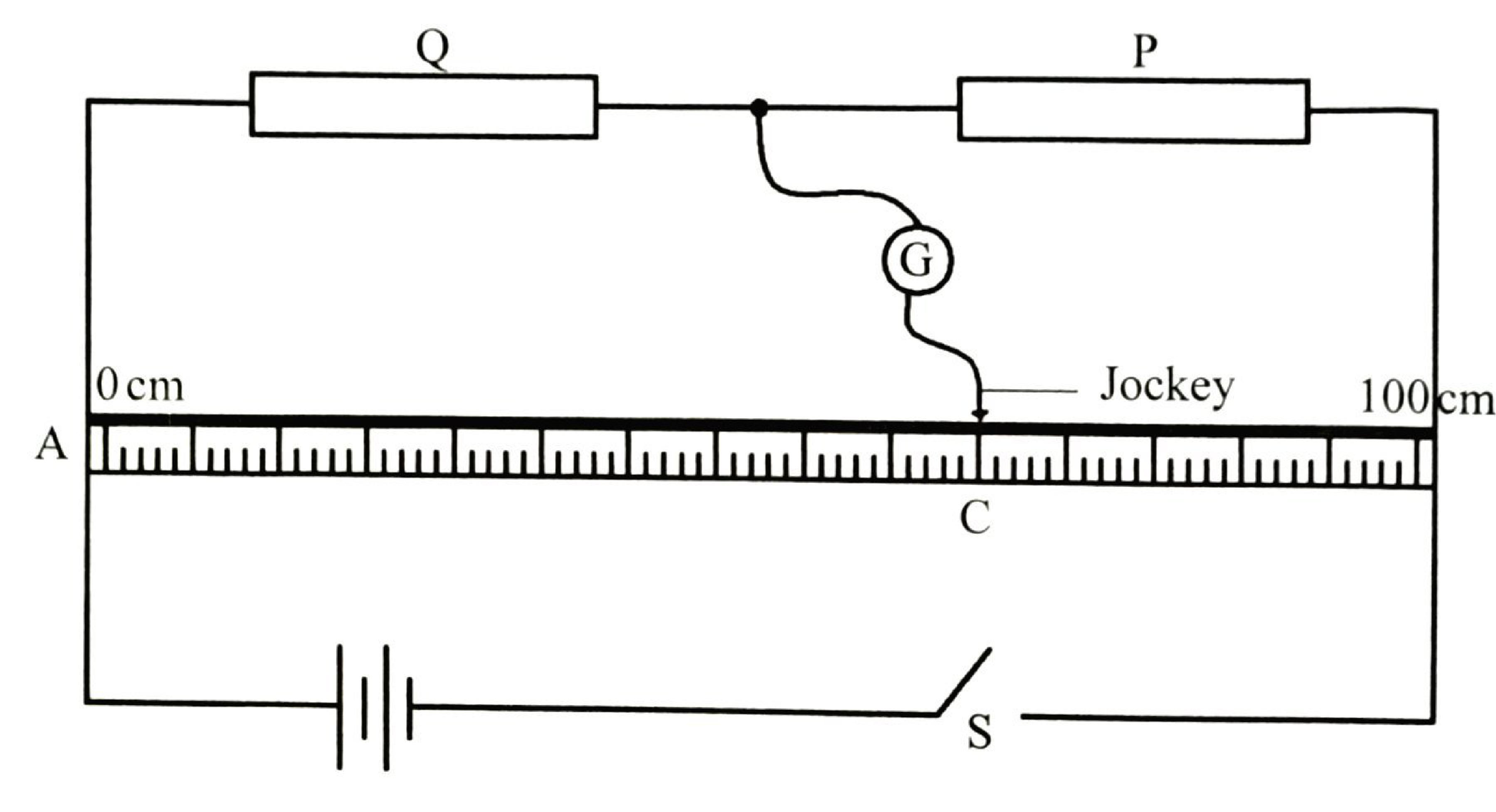
(k) Close the switch S. Using the jockey, tap the wire AB at various points to obtain point C where the galvanometer shows zero deflection.
(l) Record the balance length AC = . (1 mark)
(m) Determine the resistance of Q, given that . (2 marks)