232/1 · PHYSICS (Theory) · Paper 1 · Dec. 2022 · 2 hours
Instructions: This paper consists of two sections, A and B. Answer all the questions in sections A and B. All working must be clearly shown. Non-programmable silent electronic calculators may be used.
Section A (25 marks)
1. (a) State what is meant by "area". (1 mark) (b) State the SI unit of area. (1 mark)
2. Explain why water in a glass tube forms a concave meniscus. (2 marks)
3. Figure 1 shows how water is drawn from a large tank into a low-lying container using a rubber tube.
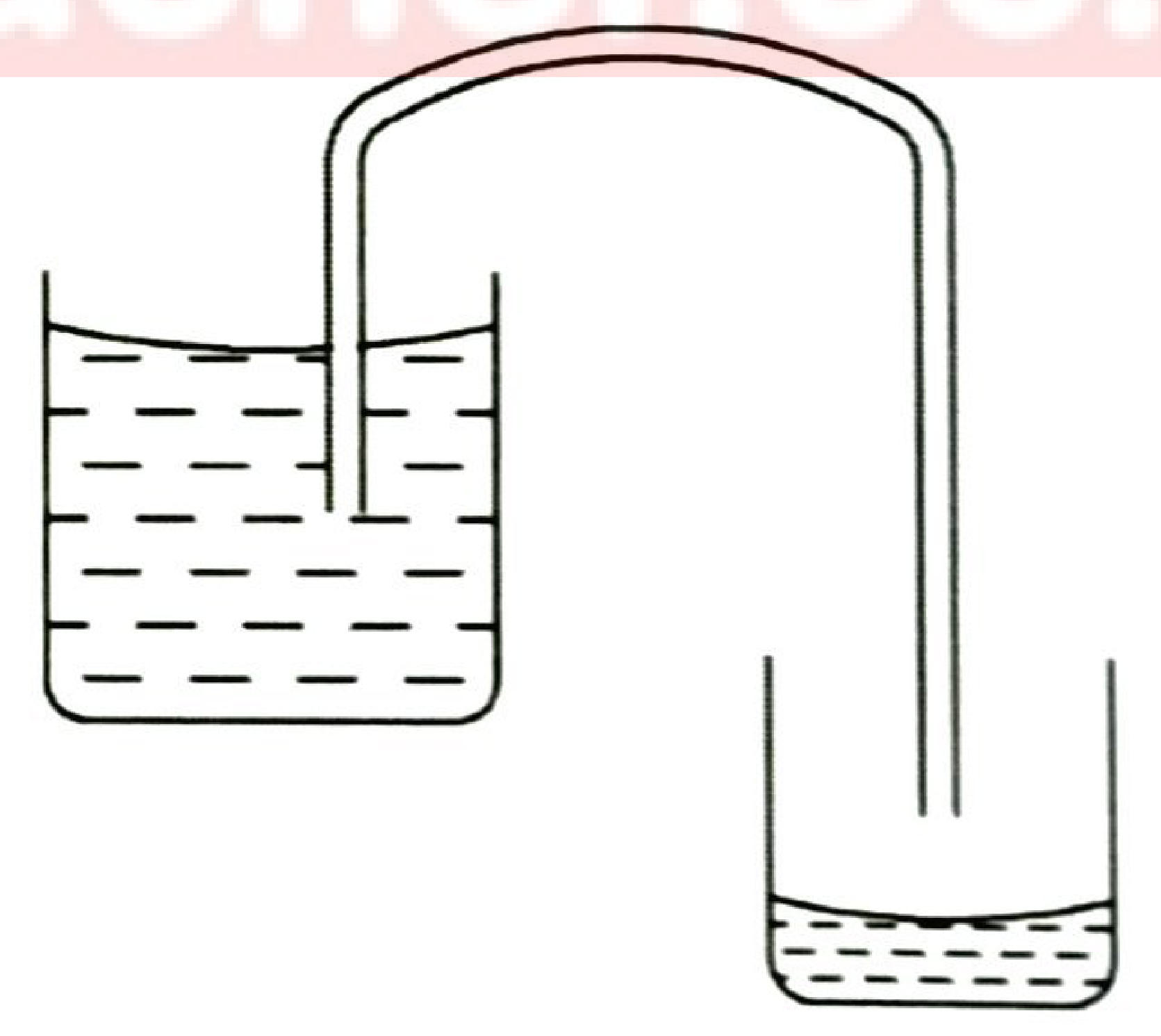
Explain how the process takes place. (2 marks)
4. State how a piece of paper can be used to demonstrate that matter is made of tiny particles. (1 mark)
5. Figure 2 shows Six's maximum and minimum thermometer.
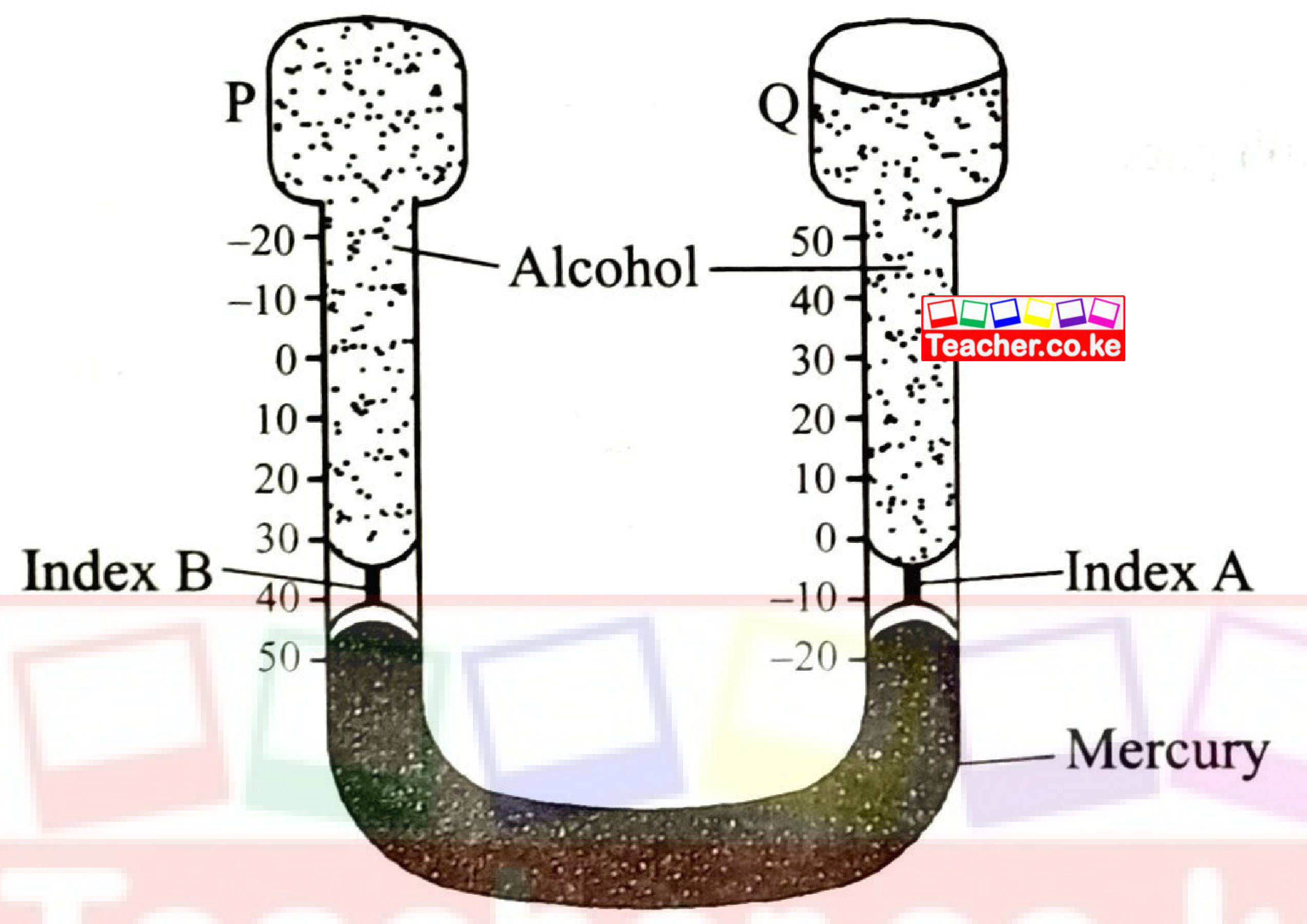
Explain how an increase in temperature causes index A to move upwards. (2 marks)
6. State the difference between heat and temperature. (2 marks)
7. State two factors that affect the stability of a cylindrical container. (2 marks)
8. Figure 3 shows a set-up in which a spring with a pointer is attached to a wooden strip that has a hanging hook. A graph paper is fixed along the strip to be used to calibrate the spring.
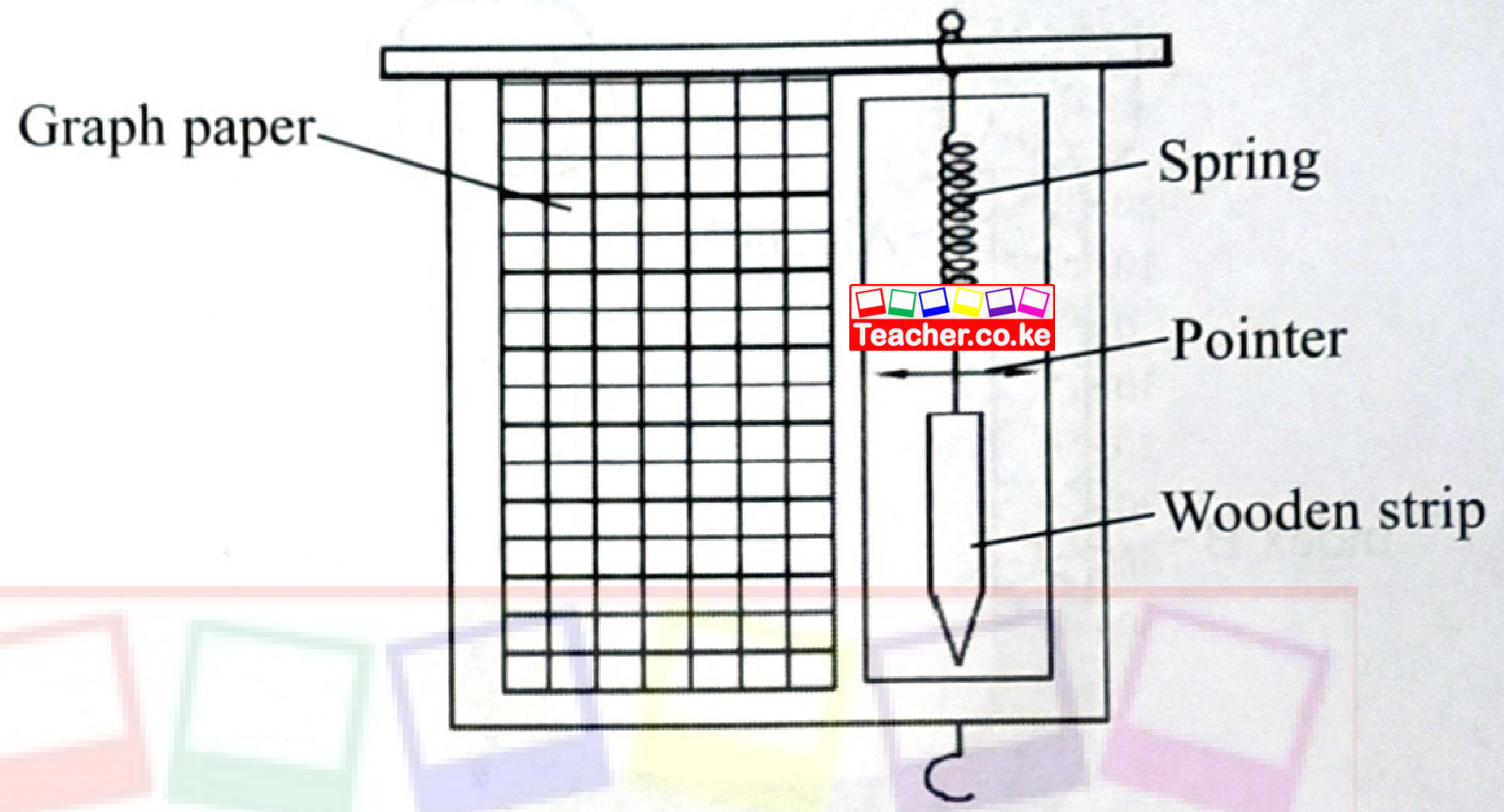
A mass of 100 g is provided. Explain how the spring balance can be calibrated. (3 marks)
9. Water enters a pipe at a velocity at a point where the cross-sectional area is . It leaves the pipe at a velocity at a point where the cross-sectional area is . Show that . (3 marks)
10. Sketch the displacement–time graph for a body moving with decreasing velocity. (1 mark)
11. Figure 4 shows a graph of force against time when a tennis ball is hit.
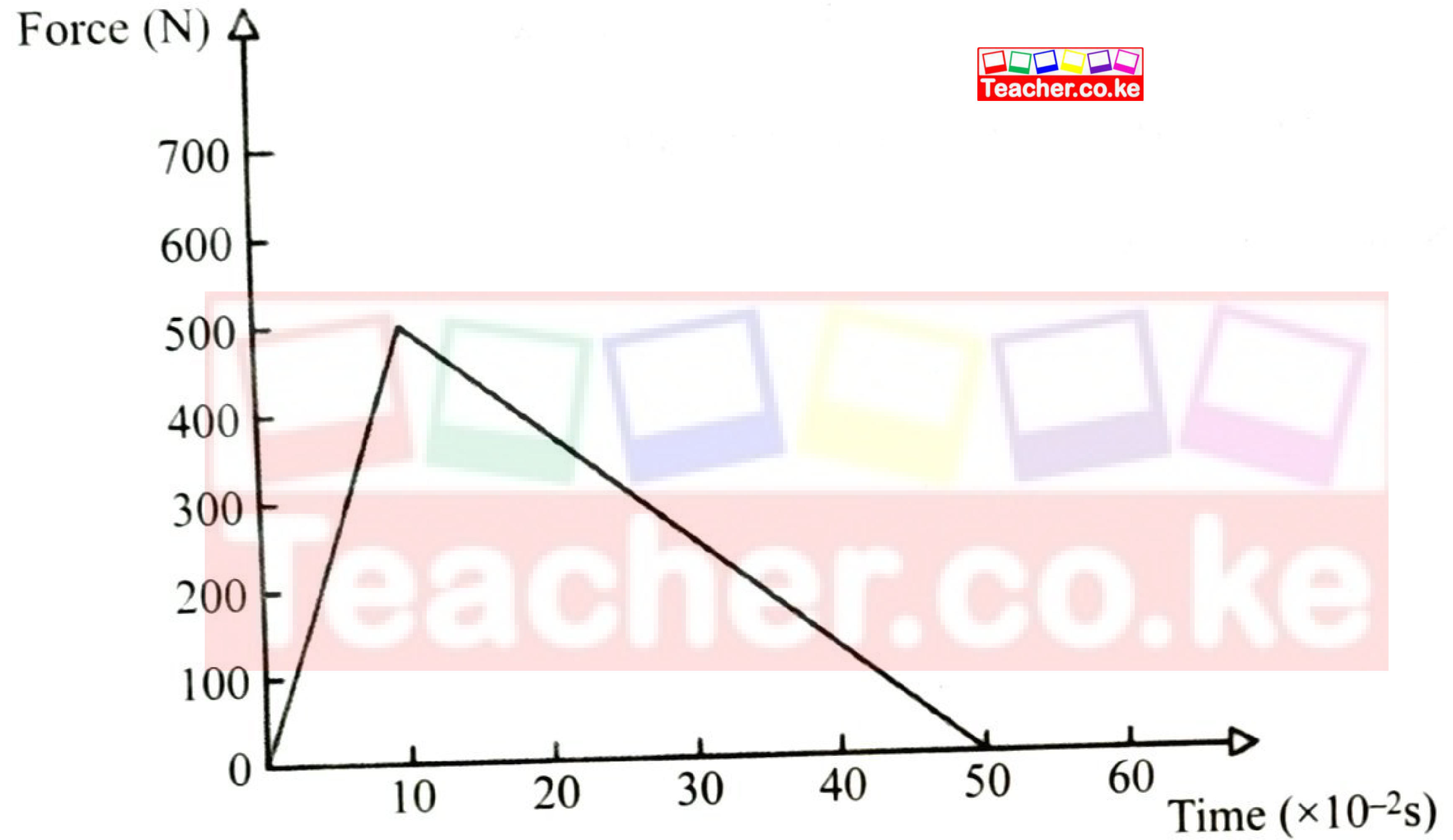
Determine the mass of the tennis ball whose velocity is 60 m s⁻¹. (Assume the ball is stationary before it is hit.) (3 marks)
12. State the energy transformations that take place as a pendulum bob swings. (1 mark)
13. When determining the specific latent heat of fusion of ice by the electrical method, other than mass, voltage and current, state one other measurement that should be taken. (1 mark)
Section B (55 marks)
14. (a) State Boyle's law. (1 mark)
(b) Figure 5 (a) shows a column of air of length 6 cm trapped by a mercury thread in a tube. Figure 5 (b) shows the same tube in a horizontal position.
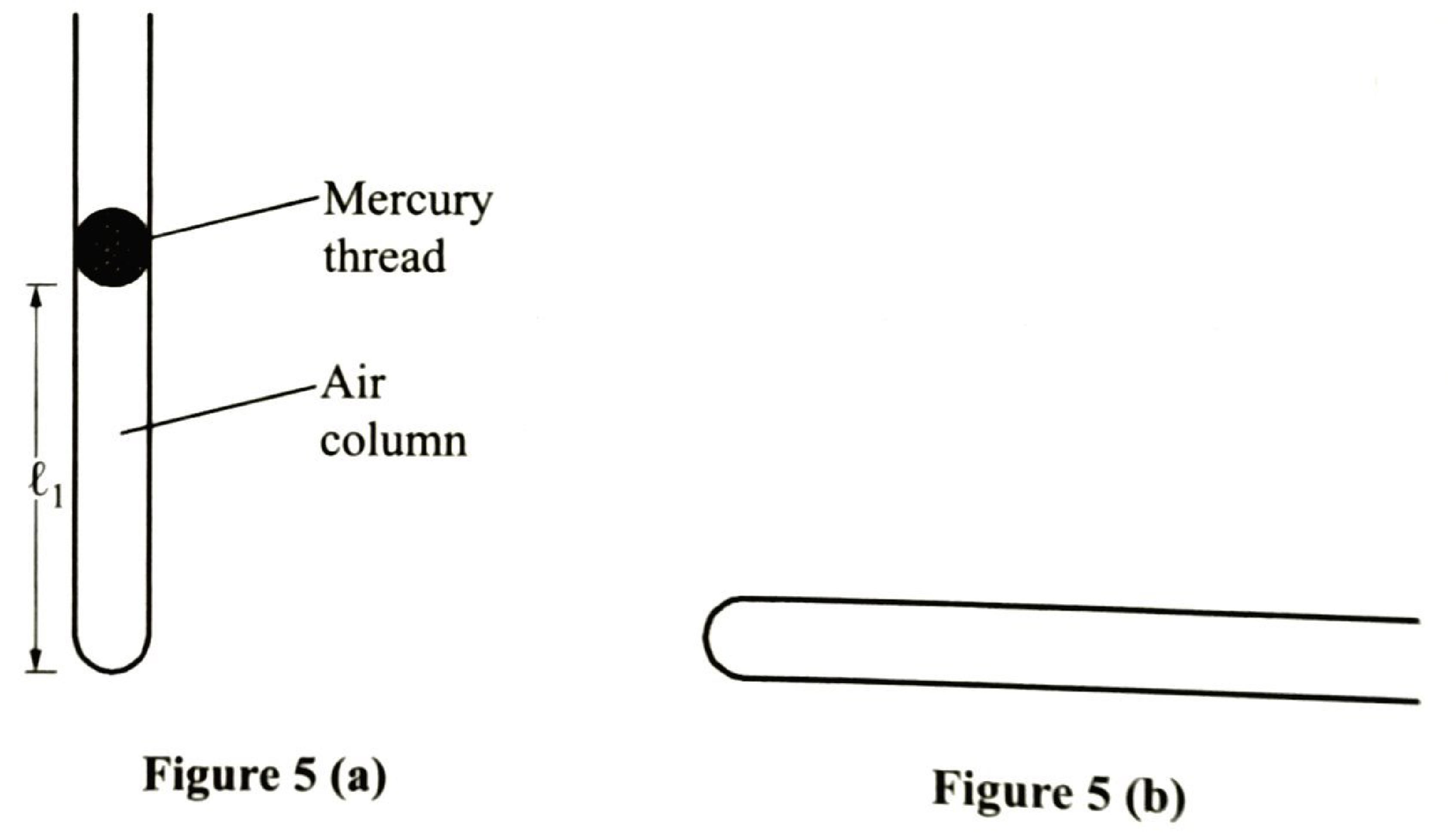
(i) Draw the mercury thread in Figure 5 (b). (2 marks)
(ii) Explain why the thread appears as in 14(b)(i). (2 marks)
(c) (i) State what is meant by "absolute zero temperature". (1 mark)
(ii) A balloon contains hydrogen gas at a temperature of 2 °C and a pressure of 6 mmHg. Determine the pressure in the balloon when the temperature is raised to 80 °C. (3 marks)
15. (a) State two ways in which the centripetal force acting on a body of mass M can be reduced. (2 marks)
(b) A stone of mass 0.5 kg tied to a string is whirled in a vertical plane along a circular path of radius 2 m and its frequency is 2 cycles per second. ()
(i) Determine the: I. velocity of the stone; (3 marks) II. tension in the string when the stone is at the topmost part of the circular path. (3 marks)
(ii) State with a reason how the tension in the string changes as the stone gets to the bottom of the circular path. (2 marks)
16. (a) Figure 6 shows a cube of mass 2 kg and sides 5 cm fully immersed in a liquid of density 0.8 g cm⁻³. The cube is balanced by a stone of mass M.
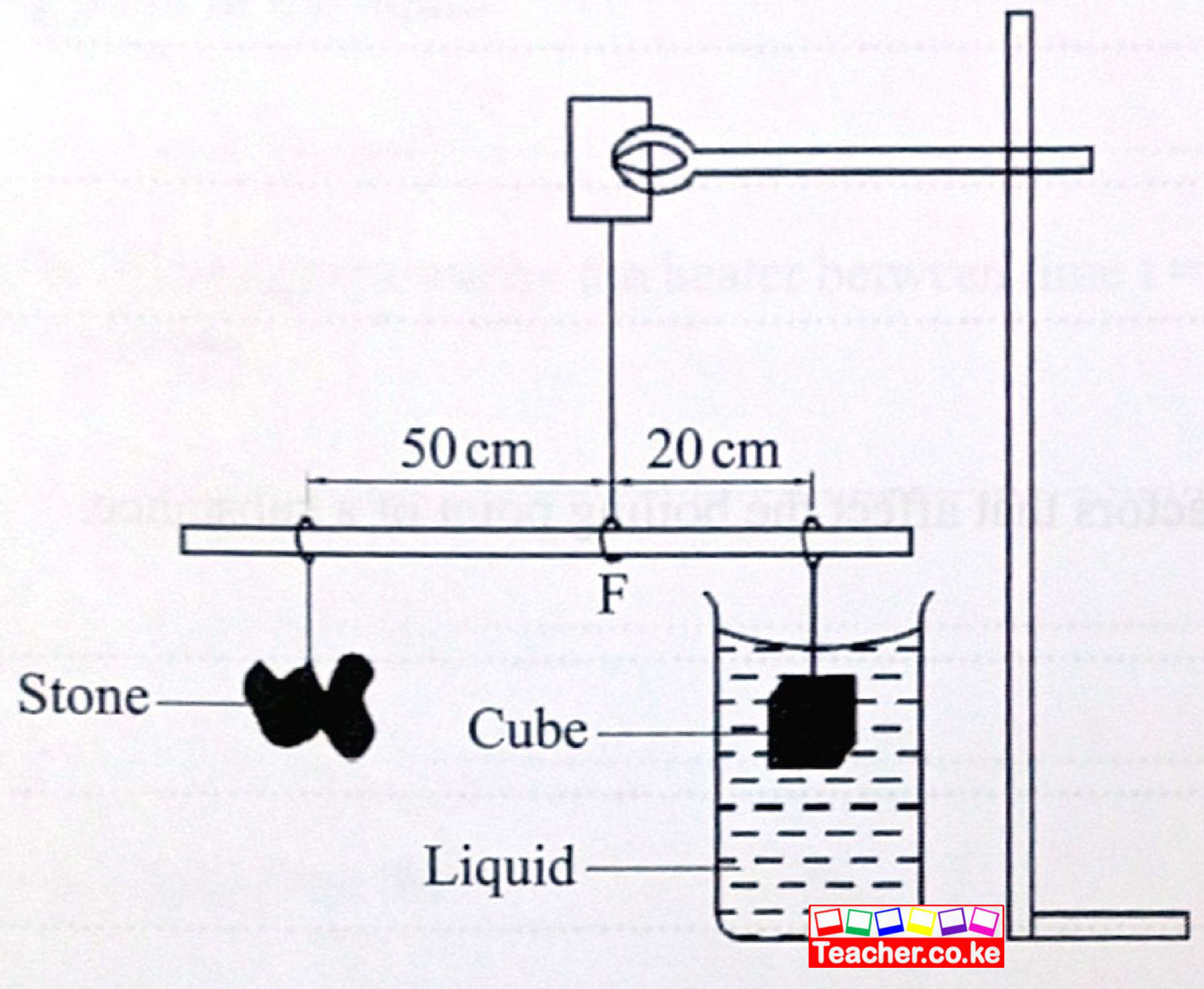
Given that the gravitational field strength, , is 10 N kg⁻¹, determine the: (i) upthrust acting on the cube; (3 marks) (ii) apparent weight of the cube; (3 marks) (iii) weight of the stone. (3 marks)
(b) A block of mass 500 g floats in water. Determine the volume of the block under the water. (Density of water = 1 g cm⁻³) (3 marks)
17. (a) State two factors that affect the boiling point of a substance. (2 marks)
(b) A well-lagged calorimeter contains a liquid of mass 200 g at a temperature of 10 °C. An electric heater rated 80 W is used to heat the liquid. Figure 7 shows a graph of temperature against time for the liquid.
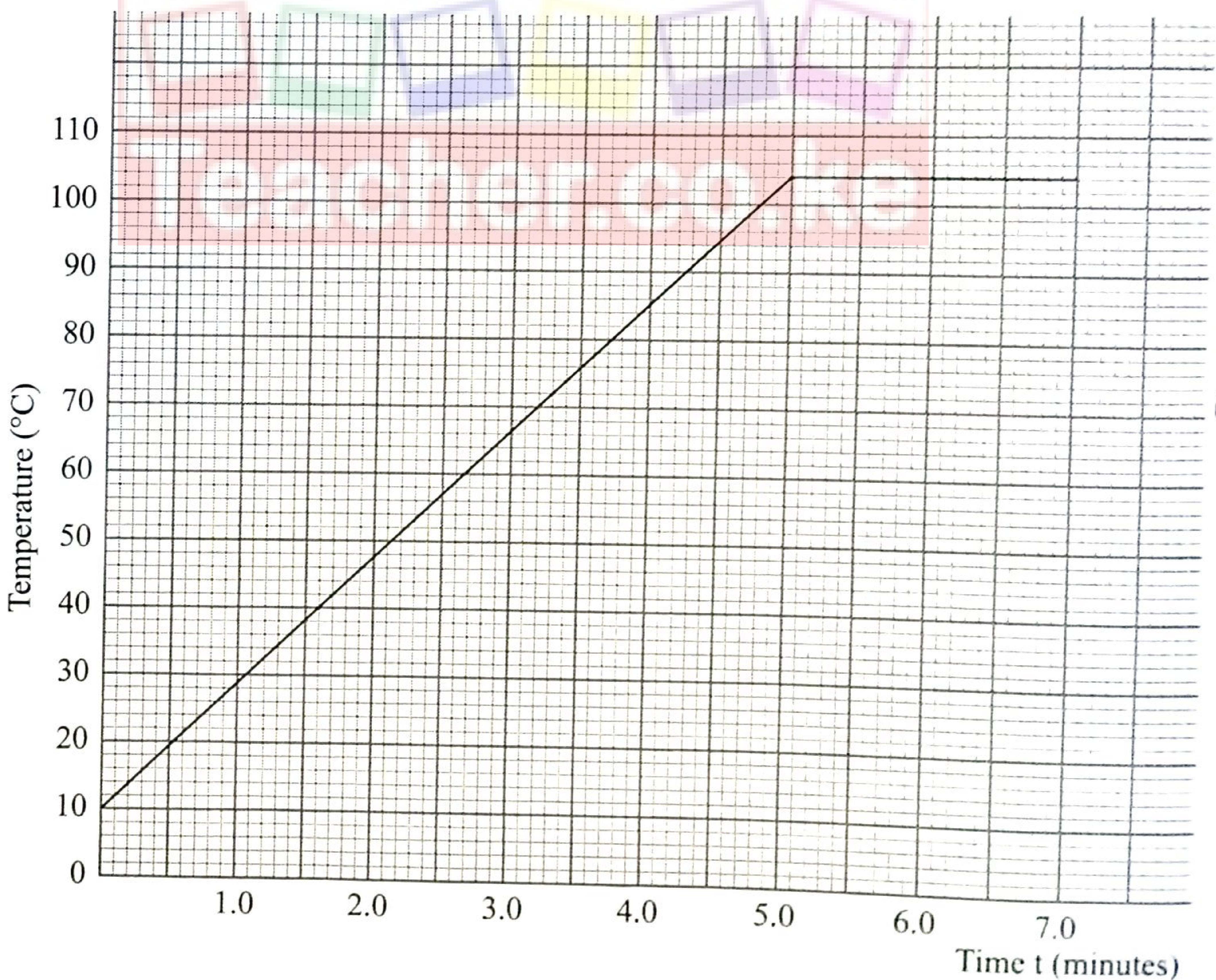
From the graph, determine the: (i) boiling point of the liquid; (1 mark) (ii) quantity of heat given out by the heater between time = 1 minute and time = 4.5 minutes. (3 marks)
(c) Based on (b)(ii), determine the: (i) temperature change between time = 1 minute and = 4.5 minutes; (1 mark) (ii) specific heat capacity of the liquid. (3 marks)
(d) 2 g of vapour was collected from the liquid between times = 5.4 minutes and = 6.3 minutes. Determine the specific latent heat of vaporisation of the liquid. (3 marks)
18. (a) A weighing balance placed on the floor of a lift is used to measure the weight of a body of mass 80 kg. Determine the reading on the balance when the lift moves upwards ( = 10 m s⁻²): (i) with uniform velocity; (3 marks) (ii) with an acceleration of 3 m s⁻². (3 marks)
(b) Explain why a person standing on a boat is likely to fall into the water when attempting to jump to the shore. (3 marks)
(c) A box is moved 30 m along a surface whose frictional force is 1000 N with uniform velocity. Determine the work done against friction. (2 marks)