232/1 · PHYSICS (Theory) · Paper 1 · Mar. 2022 (KCSE 2021) · 2 hours
Instructions: This paper consists of two sections, A and B. Answer all the questions in sections A and B. All working must be clearly shown. Non-programmable silent electronic calculators may be used. Take N/kg where needed.
Section A (25 marks)
1. Figure 1 shows part of the thimble scale of a screw gauge with 50 divisions.
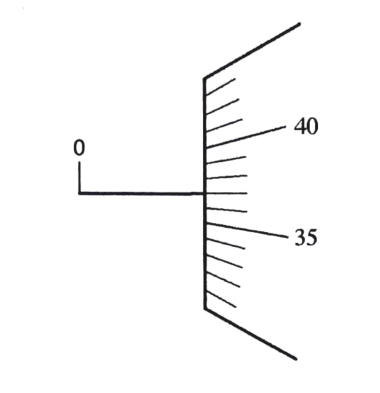
On the diagram, draw the sleeve scale to show a reading of 3.87 mm. (1 mark)
2. Figure 2 shows a siphon used to empty a tank.
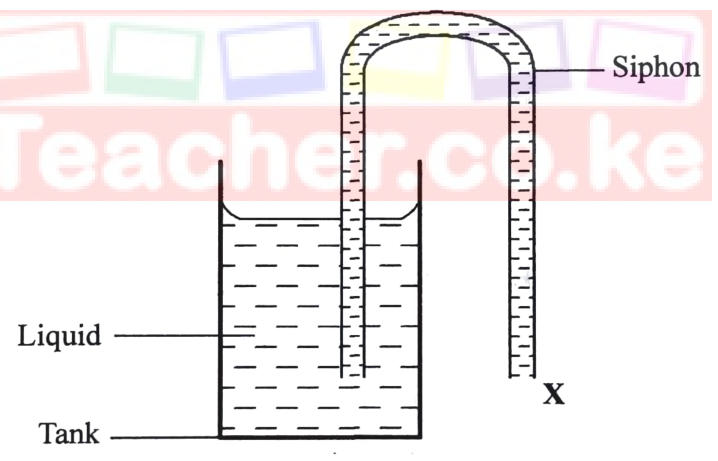
In order to start the siphon, state why: (a) it must be full of liquid; (1 mark) (b) end X must be below the level of the liquid in the tank. (1 mark)
3. Figure 3(a) shows a horizontal tube containing air trapped by a mercury thread of length 5 cm. The length of the enclosed air column is 7.5 cm. The atmospheric pressure is 76 cmHg.
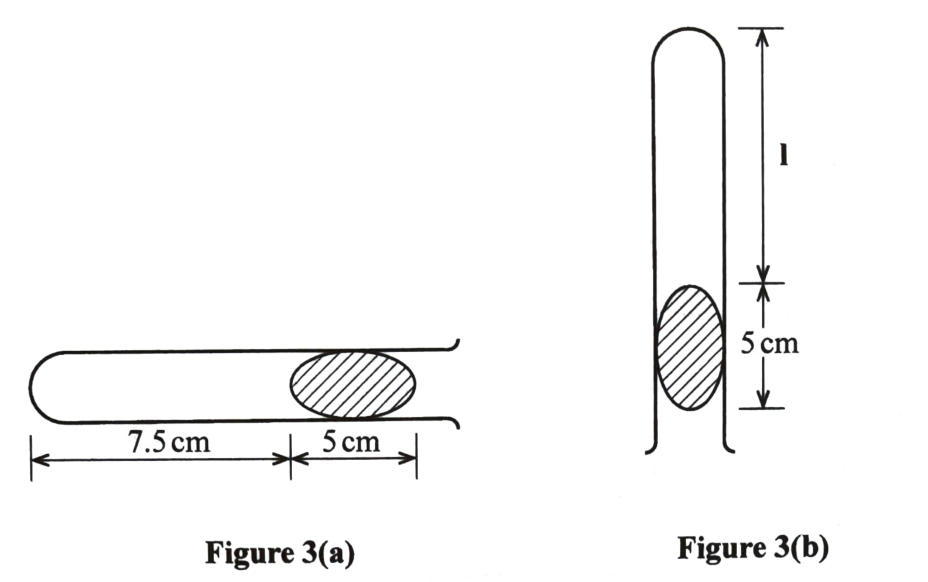
The tube is then turned vertically with its mouth facing down as shown in Figure 3(b).
(a) Determine the length of the air column. (3 marks)
(b) State the reason why the mercury thread did not fall out in Figure 3(b). (1 mark)
4. In a physics experiment, a student filled a burette with water up to a level of 15 ml. The student ran out 3 drops of water each of volume 2 cm³ from the burette into a beaker. Determine the final reading of the burette. (2 marks)
5. State two factors that affect the angular velocity of a body moving in a circular path. (2 marks)
6. Figure 4 shows two capillary tubes X and Y of different diameters dipped in mercury.
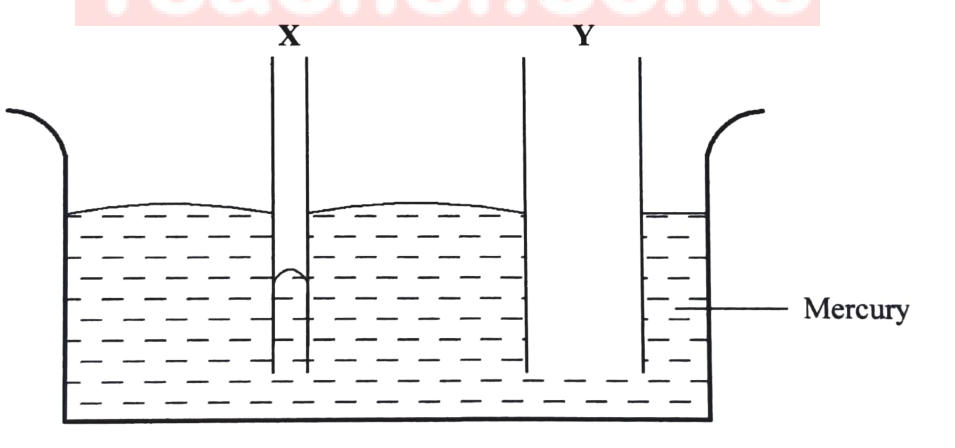
Complete the diagram to show the meniscus in Y. (1 mark)
7. In an experiment, a drop of black ink is introduced at the bottom of a container filled with water. It is observed that the water gradually turns black. State the effect on the observation when the experiment is carried out using water at a lower temperature. (1 mark)
8. Figure 5 shows two identical springs arranged side by side and supporting a weight of 50 N.
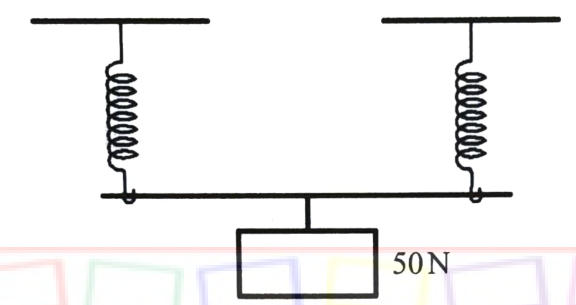
When the same weight is supported by one of the springs, it produces an extension of 1 cm. Determine the effective spring constant of the arrangement in Figure 5. (3 marks)
9. On the axes provided (density in g cm⁻³ against temperature in °C), sketch a graph of density against temperature for water between 0 °C and 10 °C. (1 mark)
10. State the reason why a student climbing a hill tends to bend forward. (1 mark)
11. Figure 6 shows a graph of temperature against time for a pure molten substance undergoing cooling.
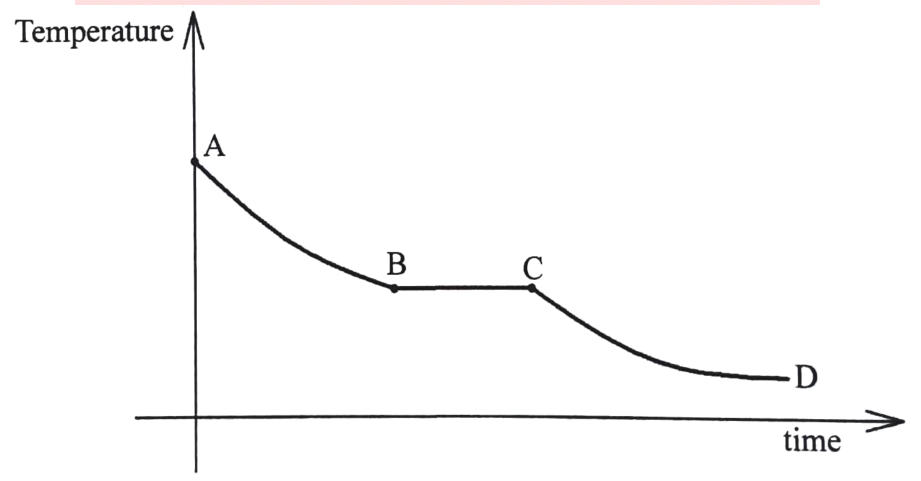
Explain what happens to the substance in region BC. (2 marks)
12. Figure 7 shows a uniform rod AB 2 m long and of mass 1 kg. It is pivoted 0.5 m from end A and balanced horizontally by a string attached 0.1 m from end B.
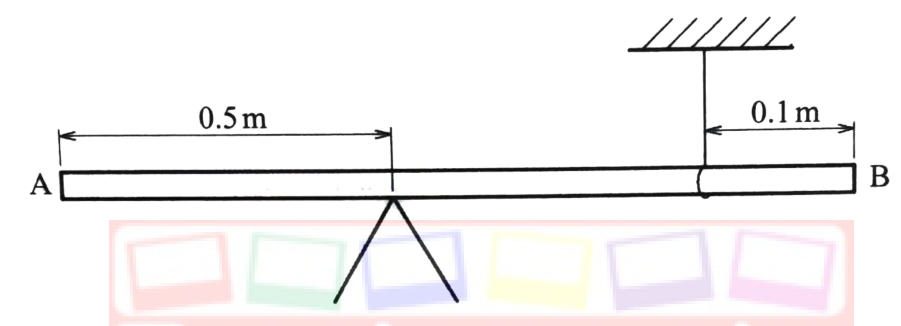
Determine the tension in the string. (2 marks)
13. Figure 8 shows two pieces of ice A and B trapped using wire gauze in a large beaker containing water.
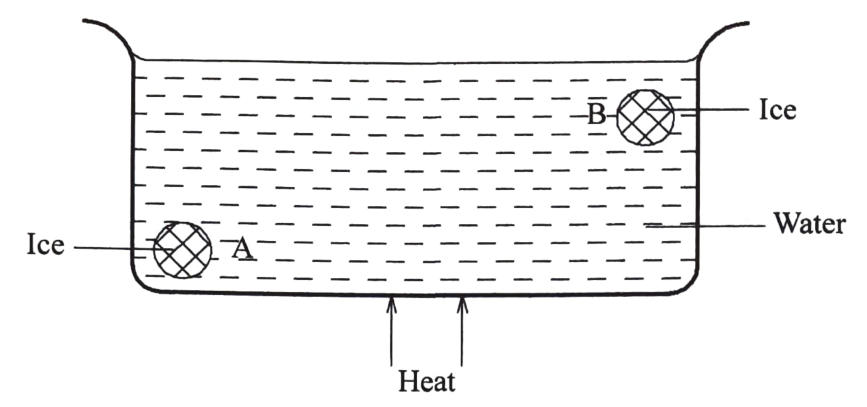
Heat is supplied at the centre of the base of the beaker as shown. State the reason why B melted earlier than A. (1 mark)
14. Figure 9 shows a folded piece of paper. A stream of air is blown underneath the paper.
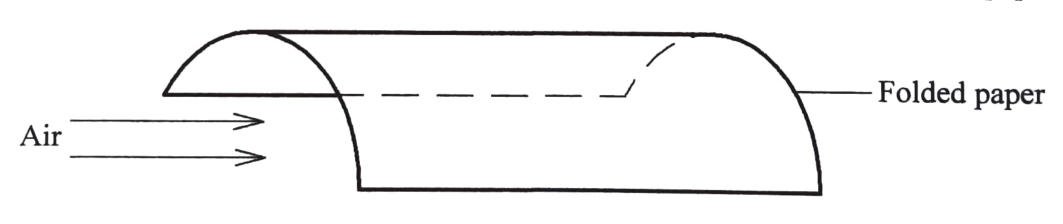
Explain why the paper collapsed. (2 marks)
Section B (55 marks)
15. (a) Figure 10 shows a wooden block of volume 90 cm³ floating with of its body submerged in water of density 1 g cm⁻³.
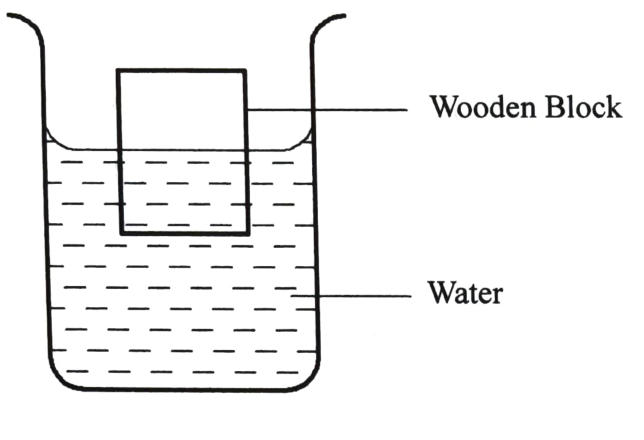
Determine: (i) the weight of the block; (3 marks) (ii) the weight of a metal block that can be placed onto the block so that its top surface is on the same level as the water surface. (3 marks)
(b) Figure 11 shows a solid metal sphere suspended in oil using a thread.
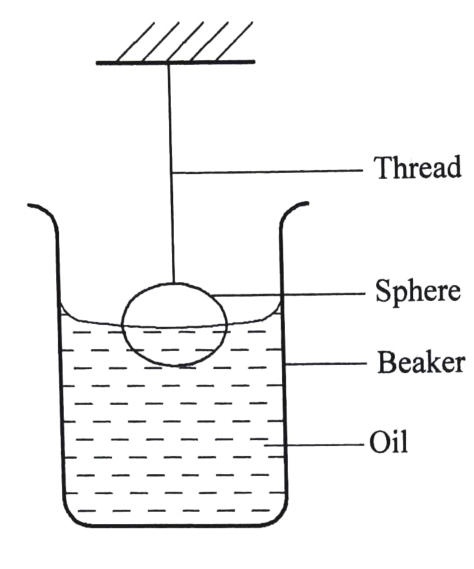
(i) Other than upthrust, list two other forces acting on the sphere. (2 marks)
(ii) The oil is carefully and gradually drawn from the beaker. State the effect on each of the two forces in 15(b)(i). (2 marks)
16. (a) Define the term "specific latent heat of fusion". (1 mark)
(b) Ice of mass 5 g at a temperature of −10 °C is immersed into 10.5 g of hot water at 100 °C in a container of negligible heat capacity. All the ice melts and the final temperature of the mixture is 40 °C. Assume there are no heat losses to the surroundings and take the specific latent heat of fusion of ice as . ( J kg⁻¹ K⁻¹ and J kg⁻¹ K⁻¹) Determine the:
(i) heat lost by the hot water; (3 marks)
(ii) heat gained by the ice from −10 °C to 0 °C; (2 marks)
(iii) heat required to melt the ice in terms of ; (1 mark)
(iv) heat gained by the melted ice; (2 marks)
(v) specific latent heat of fusion of ice. (3 marks)
17. Figure 12 shows a hydraulic lift system. The radius of the small piston is 5.64 cm while that of the large piston is 14.24 cm. The small piston is operated using a lever. A force of 100 N is applied to the lever.
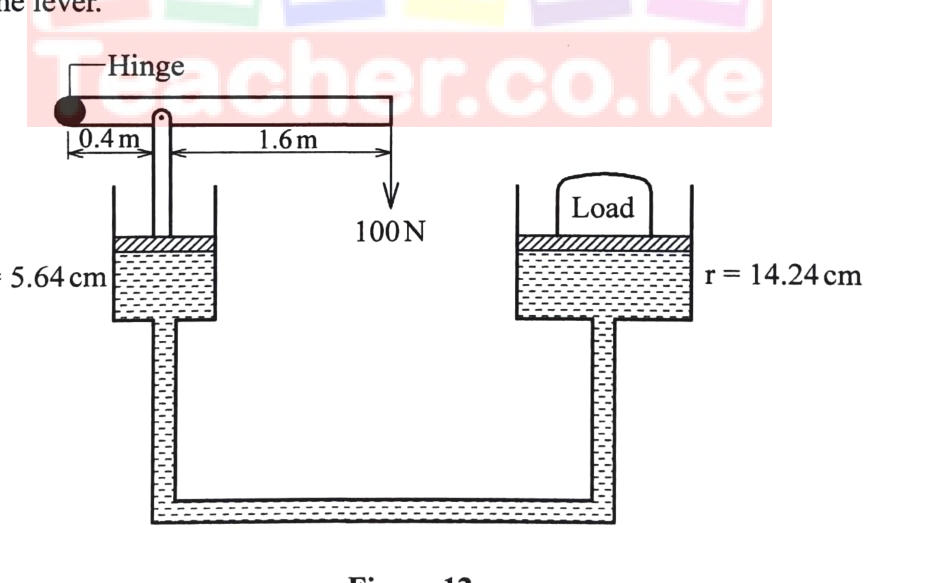
Determine the: (a) pressure exerted by the smaller piston; (5 marks) (b) load that can be lifted; (3 marks) (c) mechanical advantage of the system. (3 marks)
18. (a) A bus moving initially at a velocity of 20 m s⁻¹ decelerates uniformly at 2 m s⁻².
(i) Determine the time taken for the bus to come to a stop. (3 marks)
(ii) Sketch the velocity–time graph for the motion of the bus up to the time it stopped. (2 marks)
(iii) Use the graph to determine the distance moved by the bus before stopping. (1 mark)
(b) A car of mass 1 000 kg travelling at a constant velocity of 40 m s⁻¹ collides with a stationary metal block of mass 800 kg. The impact takes 3 seconds before the two move together. Determine the impulsive force. (4 marks)
19. (a) State two conditions necessary for a body to be in equilibrium. (2 marks)
(b) Figure 13 shows a non-uniform log of wood AB of length 4 m. The log is held horizontally by applying forces of 80 N at end A and 120 N at end B.
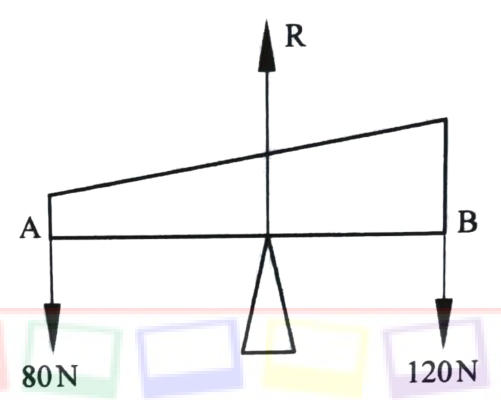
Determine: (i) the value of R; (1 mark) (ii) the position of the centre of gravity of the log from end B. (3 marks)
(c) You are provided with a metre rule, a knife edge and a mass .
(i) Describe how the position of the centre of gravity of the metre rule can be determined using the knife edge. (2 marks)
(ii) Using the position of the centre of gravity determined in 19(c)(i) and the mass , describe how the mass M of the metre rule can be determined. (4 marks)