231/1 · BIOLOGY (Theory) · Paper 1 · Mar. 2022 (KCSE 2021) · 2 hours
Instructions: Answer all the questions in the spaces provided.
1. Explain why it is necessary for plants to have their leaves spread out. (2 marks)
2. The diagram below represents the transverse section through a young dicotyledonous stem and a structure, F, obtained from the same section.
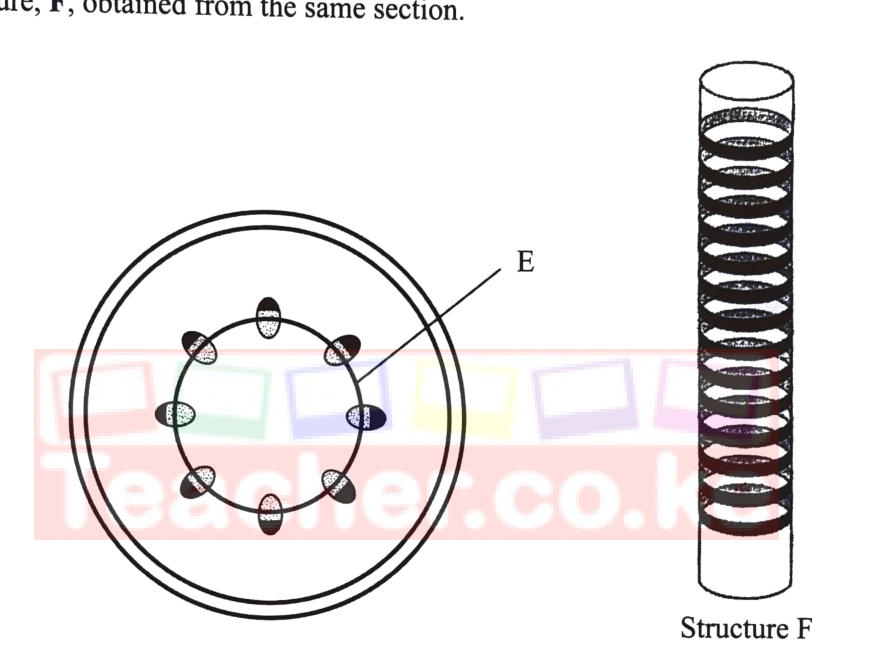
(a) (i) Identify the part labelled E. (1 mark) (ii) State the function of the part labelled E. (1 mark)
(b) (i) Label the part Z on the section from which structure F was obtained. (1 mark) (ii) State two ways in which structure F is structurally adapted to its functions. (2 marks)
3. State two ways in which herbaceous plants obtain their mechanical support. (2 marks)
4. (a) Name the proteinous substance that makes up the exoskeleton of members of Phylum Arthropoda. (1 mark)
(b) State two functions of the exoskeleton. (2 marks)
(c) State one disadvantage of the exoskeleton to members of Phylum Arthropoda. (1 mark)
5. Explain how each of the following structures adapts the fish to movement in water: (a) swim bladder; (1 mark) (b) head. (1 mark)
6. The diagram below represents the anterior view of a mammalian vertebra.
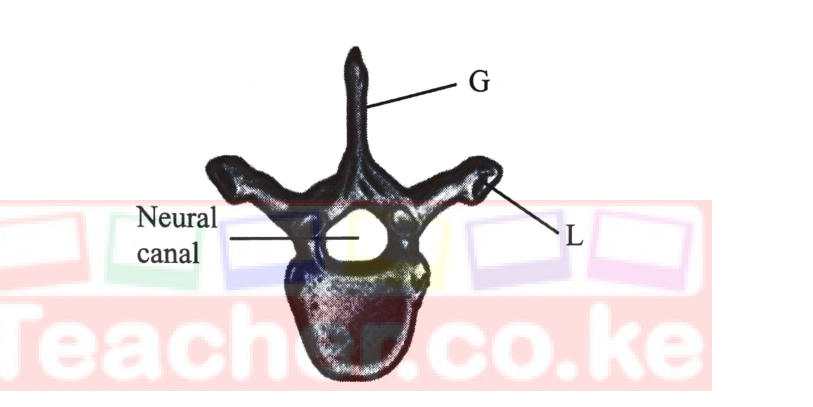
(a) (i) Identify the vertebra. (1 mark) (ii) Name the region of the vertebral column where the vertebra was obtained. (1 mark)
(b) Name the part labelled G. (1 mark)
(c) Name the bone in the mammalian endoskeleton that articulates with the vertebra at the part labelled L. (1 mark)
7. The word equation below shows a process that takes place in a certain living organism:
(a) Name process K. (1 mark)
(b) State the importance of substance J in living cells. (1 mark)
8. The set-up below was used to demonstrate products of exhalation in grasshoppers. The set-up was left undisturbed for 48 hours and observations made.
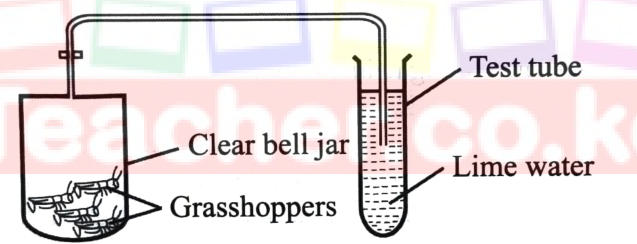
(a) (i) State the observation made in the test tube. (1 mark) (ii) Account for the observation made in 8(a)(i). (2 marks)
(b) Explain the observation made in the test tube if a similar set-up included young growing plants in the jar containing grasshoppers at the beginning of the experiment. (2 marks)
9. State the difference between glycolysis and Krebs cycle based on: (a) where they occur; (1 mark) (b) amount of energy produced. (1 mark)
10. (a) Distinguish between gaseous exchange and respiration. (2 marks)
(b) Explain the importance of algae in a pond. (2 marks)
11. State two advantages of an insect undergoing complete metamorphosis. (2 marks)
12. Complete the table below, outlining the differences between members of Class Diplopoda and Chilopoda. (3 marks)
| Characteristic | Diplopoda | Chilopoda |
|---|---|---|
| (a) Body shape | ||
| (b) Body segmentation | ||
| (c) Number of legs per segment |
13. (a) State two reasons why the snake is classified as a reptile. (2 marks)
(b) Name the structure which enables Paramecium to move. (1 mark)
14. The diagram below represents an apparatus used to collect specimens for study.
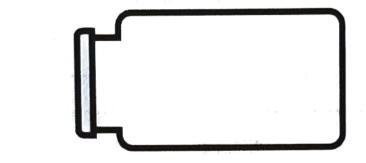
(a) Identify the apparatus. (1 mark)
(b) State why it is advisable to have the apparatus made of glass. (1 mark)
15. (a) State two activities that take place in the ovule of a flowering plant during fertilisation. (2 marks)
(b) State two functions of the seminal fluid in reproduction. (2 marks)
(c) Name the hormone that stimulates the contraction of muscles of the uterine wall during birth. (1 mark)
16. (a) Giving an example in each case, state the difference between internal and external fertilisation. (2 marks)
(b) State the agent of pollination in a maize plant. (1 mark)
17. Identify the response and receptor from the following list of sensory structures and processes: salivary gland; smell of fried eggs; olfactory cells; salivation. (a) Response; (1 mark) (b) Receptor. (1 mark)
18. Explain how the knowledge of apical dominance is applied in agriculture. (2 marks)
19. (a) Explain why the population of people with sickle-cell anaemia is higher in malaria-prone areas. (2 marks)
(b) Explain why it is not advisable to put a patient on a drip of distilled water for rehydration. (3 marks)
20. In an experiment, the stem of a plant was cut above the soil surface and a thin, transparent tube inserted immediately as shown below.
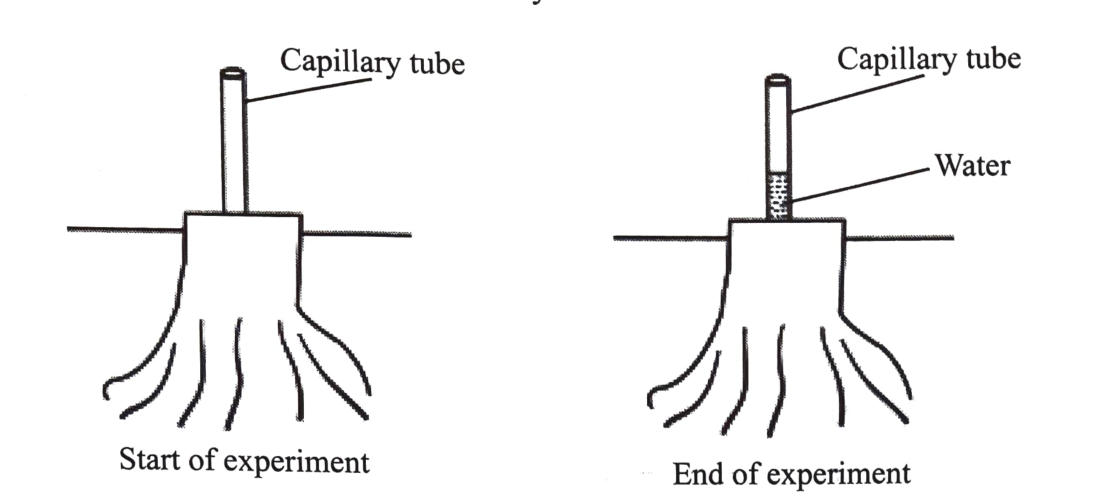
(a) Name the process by which mineral salts are absorbed from the soil. (1 mark)
(b) Account for the observation made at the end of the experiment. (3 marks)
21. In an experiment, live termites were placed at the junction between two interconnected chambers, L and M. Chamber L contained dry cotton wool and was covered by a transparent lid. Chamber M contained moist cotton wool and was covered with an opaque lid.
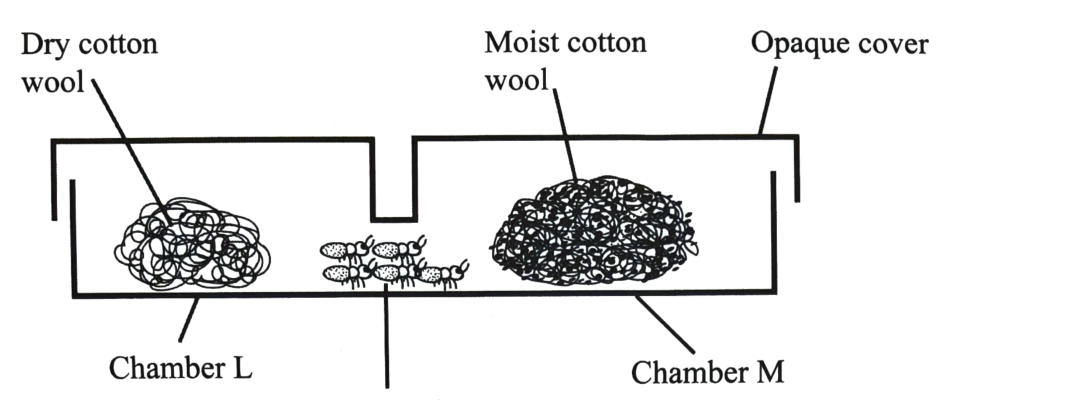
(a) (i) State the likely observation at the end of the experiment. (1 mark) (ii) Explain two factors responsible for the observation in 21(a)(i). (2 marks)
22. State one function of each of the following parts of mammalian movable joints: (i) synovial membrane; (1 mark) (ii) ligaments. (1 mark)
23. A form of dwarfism called achondroplasia is caused by a dominant gene (D) located on body chromosomes. Individuals who are homozygous (DD) for the condition do not survive. Those who are homozygous (dd) are of normal height, while heterozygous (Dd) individuals are dwarfs. If two dwarfs married, work out the likely survival chances of their offspring. (4 marks)
24. Explain the difference in basal metabolic rate (BMR) between a 55-year-old man and his 8-year-old grandson. (3 marks)
25. The illustration below represents a plant learners collected and drew during a field study.
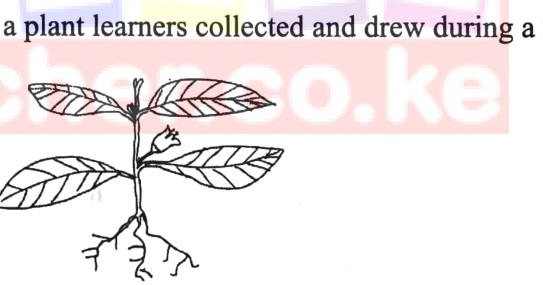
With a reason, state the: (i) Division; (2 marks) (ii) Class to which the plant belongs. (2 marks)