231/2 · BIOLOGY (Theory) · Paper 2 · Nov. 2023 · 2 hours
Instructions: The paper has two sections, A and B. Answer all the questions in section A. In section B answer question 6 (compulsory) and either question 7 or 8.
Section A (40 marks)
1. The following diagram represents a section of the mammalian respiratory system.
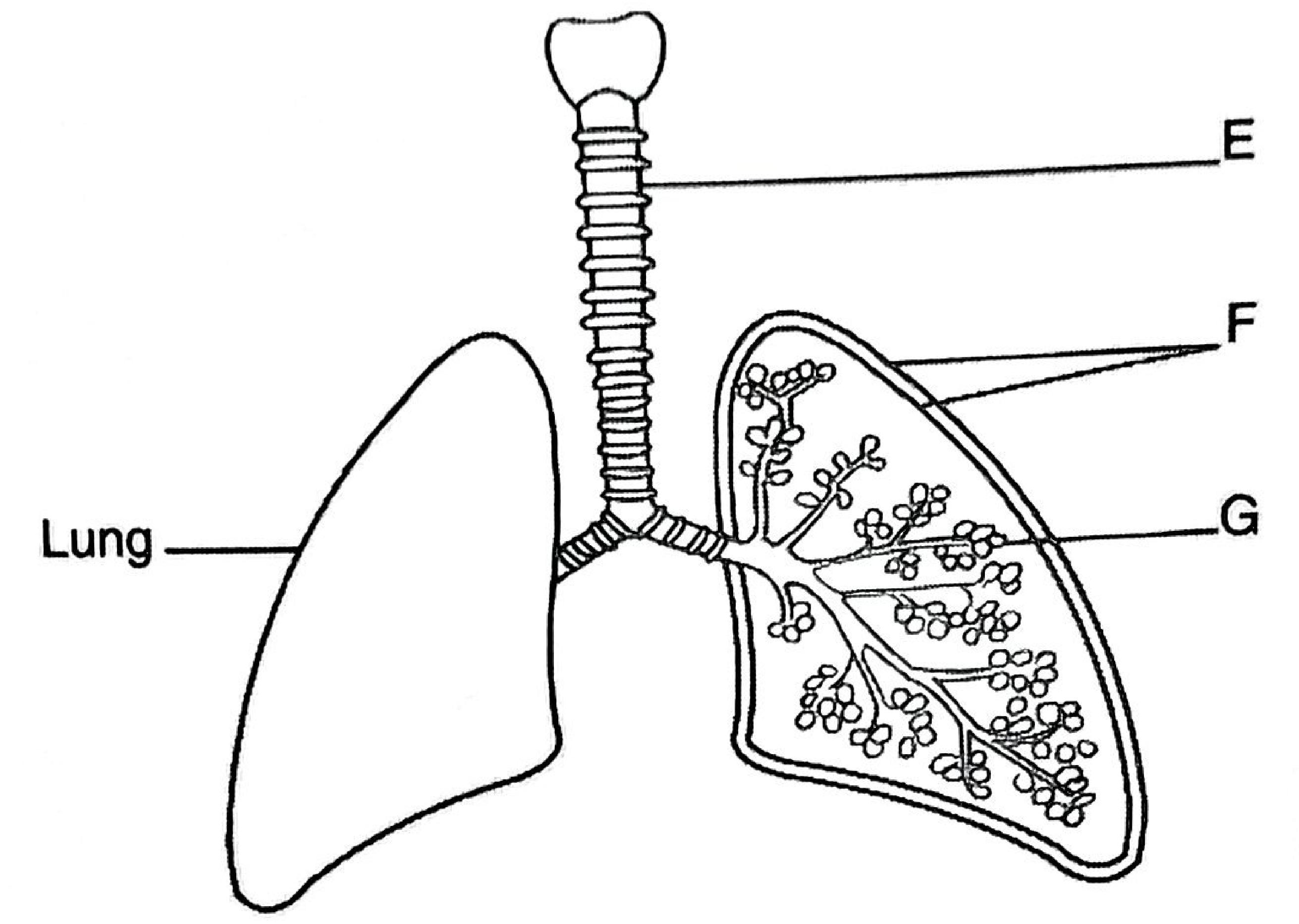
(a) Identify: (i) the region of the mammalian skeleton where the represented section is found; (1 mark) (ii) the part labelled F. (1 mark)
(b) Explain the function of the part labelled F. (2 marks)
(c) Explain the structural adaptations of the parts labelled E and G to their functions. (2 marks)
(d) Give similarities between the part labelled G and gill filaments. (2 marks)
2. In an investigation, data on students' heights and blood groups were collected and presented in graphs H and J as shown.
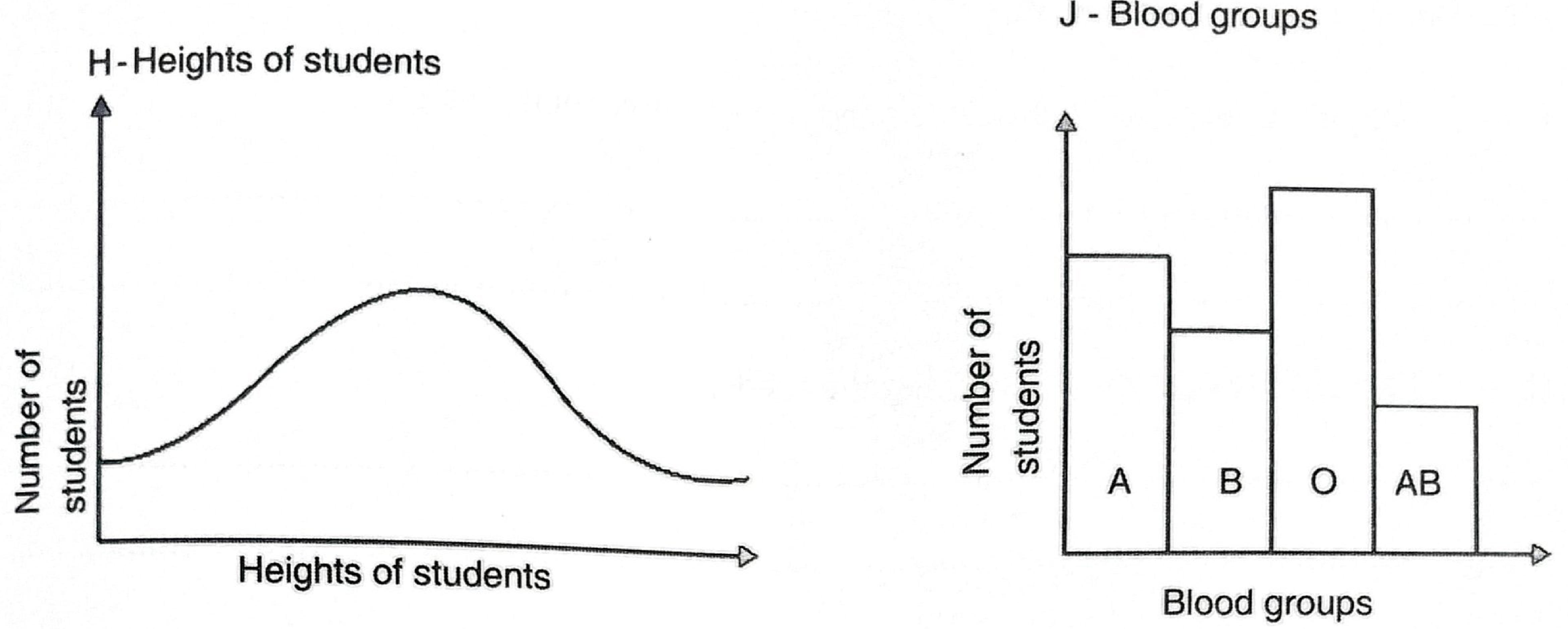
(a) (i) State the type of variation illustrated by graph H. (1 mark) (ii) Give a reason for your answer in 2(a)(i). (1 mark)
(b) Explain the advantage of having the greatest proportion of students with blood group O as illustrated in graph J. (2 marks)
(c) After the investigation, a student of blood group O reported that the father and mother are blood group A and B respectively. Use a genetic cross to illustrate this possibility. (4 marks)
3. In an experiment, students soaked maize seeds in water for 48 hours at room temperature and tested them for reducing sugars.
(a) Name the reagent the students used to test for reducing sugars. (1 mark)
(b) Explain the reasons for soaking the seeds. (2 marks)
(c) State the observation made by the students during the food test. (1 mark)
(d) Explain the effect of soaking the seeds in hot water on the food test results. (2 marks)
(e) A sample of maize seeds was planted in soils with favourable conditions but failed to germinate. Suggest possible causes of this failure. (2 marks)
4. In an investigation, students placed dry cobalt(II) chloride paper on both sides of a mesophyte leaf and covered the strips with cellotape as shown in the following experimental setup.
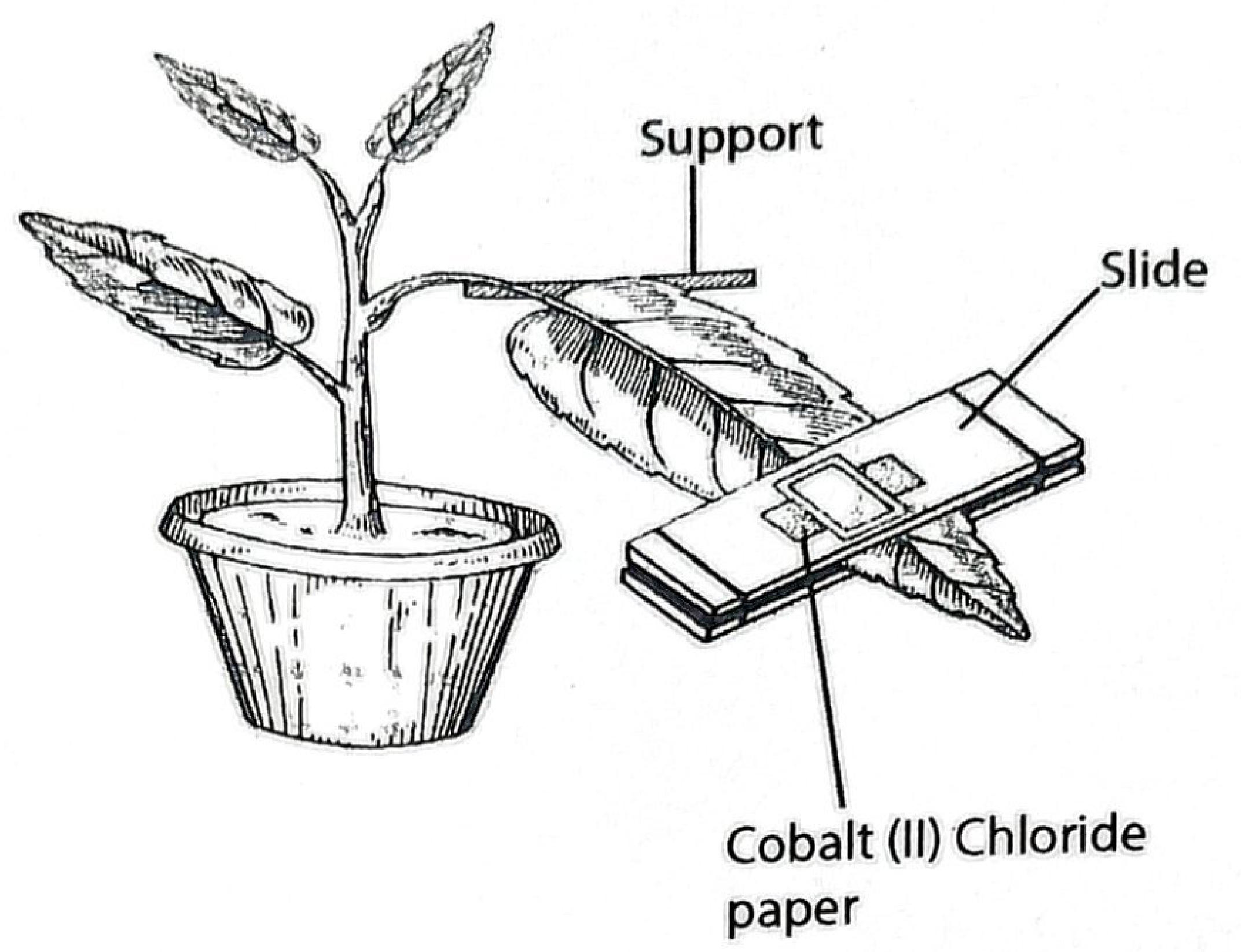
(a) State the aim of the experiment. (1 mark)
(b) (i) State the observation the students made on the cobalt(II) chloride paper. (1 mark) (ii) Account for the difference in the time taken for the observations to be made on the two cobalt(II) chloride papers. (3 marks)
(c) Suggest two modifications students would make on the setup to have the observations made within a shorter time. (3 marks)
5. The following diagram represents the structure of a human eye.
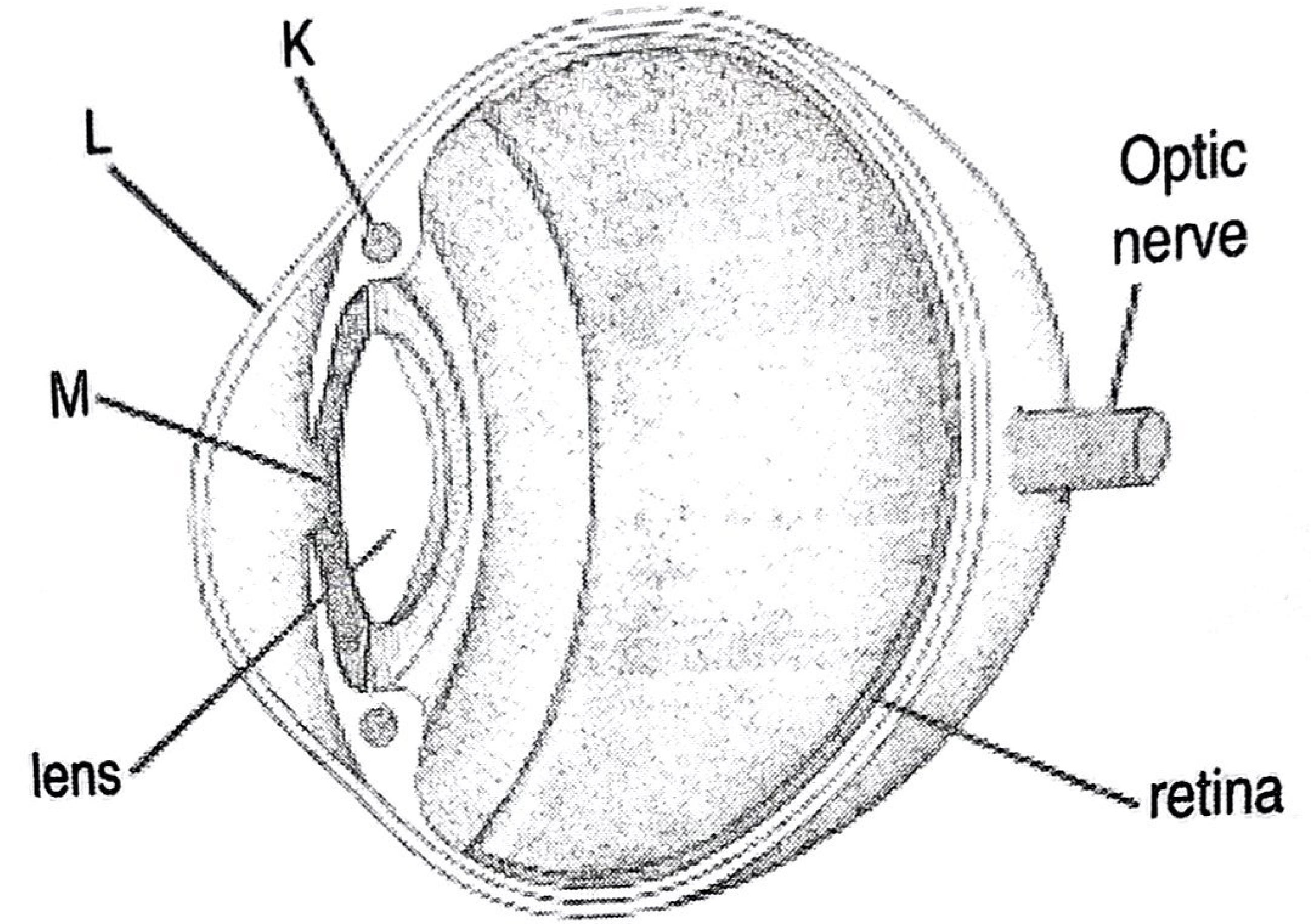
(a) Name the part labelled M. (1 mark)
(b) Explain the adaptations of the part labelled L to its function. (2 marks)
(c) Describe the events initiated in the part labelled K to enable a distant object to be clearly seen. (3 marks)
(d) State the role of tears in the human eye. (2 marks)
Section B (40 marks)
Answer question 6 (compulsory) and either question 7 or question 8.
6. During an ecological study, students obtained the following data from a certain ecosystem.
| Trophic level of organisms | Number of organisms |
|---|---|
| Producers | 1000 |
| Primary consumers | 200 |
| Secondary consumers | 30 |
| Tertiary consumers | 4 |
(a) Use the data in the table to draw a pyramid of numbers on the grid provided. (5 marks)
(b) Account for the shape of the pyramid. (3 marks)
(c) If the following organisms were found in the ecosystem represented by the data — eagle, plant, snake, mouse:
(i) Draw a food chain to illustrate the feeding relationship in this ecosystem. (1 mark)
(ii) Which of the organisms will have the least biomass? (1 mark)
(iii) Explain the effect of a severe drought on the population of organisms in the ecosystem. (3 marks)
(iv) How would predation by snakes lead to the emergence of new species of mice in the ecosystem? (3 marks)
(d) Describe the method one would use to estimate the population of a particular plant species in the ecosystem. (4 marks)
7. (a) Describe the various functions of lipids in the human body. (10 marks)
(b) Describe how the process of photosynthesis occurs in green plants. (10 marks)
8. Describe how the section of the human digestive system from the mouth to the stomach is adapted to its functions. (20 marks)