231/3 · BIOLOGY (Practical) · Paper 3 · Nov. 2023 · 1¾ hours
Instructions: Answer all the questions in the spaces provided. You are required to spend the first 15 minutes of the 1¾ hours reading the whole paper carefully before commencing your work. Additional pages must not be inserted.
Question 1 (11 marks)
You are provided with the following materials: two similar leaves of Brassica oleracea (sukuma wiki); a scalpel; 5 cm³ of liquid K₁ in a test tube; 5 cm³ of liquid K₂ in a test tube; (access) to means of timing.
Procedure
(i) Remove the entire leafy parts along the midribs of both leaves.
(ii) Retain the two midribs still attached to their petioles.
(iii) Discard the hard lower petiole.
(iv) Measure about 4 cm of the remaining midrib towards the tip. Cut and discard the tip. The process is illustrated as follows:
(v) Make a 2 cm slit from the tip end of each of the 4 cm portions as shown in the diagram above.
(vi) Place one piece into the test tube with liquid K₁ and the other into liquid K₂, and leave them for 20 minutes. Remove the two pieces and make observations.
(a) Draw the appearance of each piece: (i) piece from K₁; (1 mark) (ii) piece from K₂. (1 mark)
(b) Account for the observations made on the piece from each liquid: (i) piece from K₁; (3 marks) (ii) piece from K₂. (3 marks)
(c) State how the experiment would be modified to obtain the same results within a shorter period of time. (2 marks)
(d) Explain why the petiole and the lower parts of the midribs were not suitable for use in this experiment. (1 mark)
Question 2 (15 marks)
You are provided with three plant specimens labelled E, F and G obtained from different plants belonging to different families.
(a) Use the specimens provided together with the photographs below to construct a dichotomous key that can be used to identify them. Use the features below in the order given to construct the key: (10 marks)
- simple or compound leaves;
- leaf venation;
- type of compound leaf;
- leaf margin;
- nature of leaf lamina.
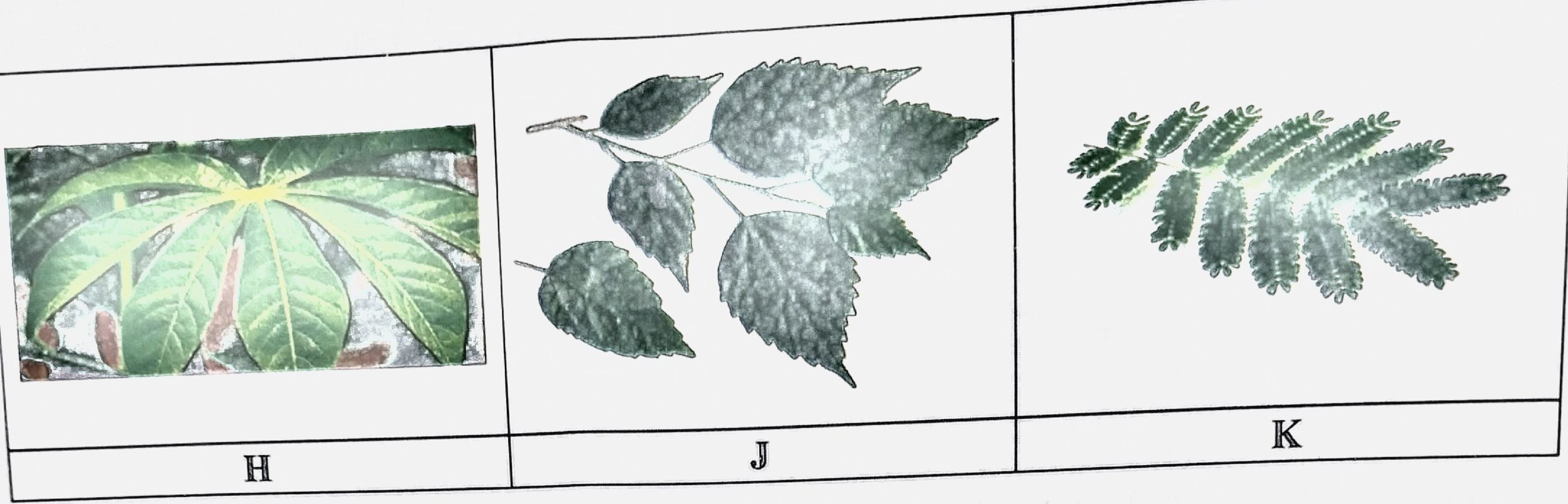
(b) Fill in the following table indicating the steps followed to identify specimens E, F and G. (3 marks)
| Specimen | Steps |
|---|---|
| E | |
| F | |
| G |
(c) State one feature in the root and one in the stem of specimen G that places the plant in its class. (2 marks)
Question 3 (14 marks)
You are provided with the following materials: 3 test tubes and means of labelling them; solutions L₁, L₂ and L₃; a 10 cm³ measuring cylinder; iodine solution.
Procedure
- Label the three test tubes A, B and C.
- To test tube A, add 1 cm³ of L₁ and one drop of iodine solution. Record the observations in the table below.
- Add 1 cm³ each of L₁ and L₂ into tube B. Place it on the test tube rack and leave it undisturbed for ten minutes. Add a drop of iodine solution and record the observations in the table below.
- To the third test tube, C, add 1 cm³ of L₂ and two drops of dilute hydrochloric acid. Leave the contents undisturbed for ten minutes. Add 1 cm³ of L₁, shake the contents and again place the contents on the test tube rack for about five minutes; add a drop of iodine solution.
- Record the observations and inferences in the table below. (6 marks)
| Test tube | Observations after adding iodine solution | Conclusion |
|---|---|---|
| A | ||
| B | ||
| C |
(a) (i) Suggest the likely identity of solution L₂. (1 mark) (ii) Explain your answer in 3(a)(i). (2 marks)
(b) Suggest with a reason where the process being investigated in this experiment would take place in the human alimentary canal: (i) part of alimentary canal; (1 mark) (ii) reason. (2 marks)
(c) State two other modifications one would make in test tube C to obtain similar observations. (2 marks)