232/1 · PHYSICS (Theory) · Paper 1 · Nov. 2025 · 2 hours
Instructions: This paper consists of two sections, A and B. Answer all the questions in sections A and B. All working must be clearly shown. Non-programmable silent electronic calculators may be used.
Section A (25 marks)
1. A micrometer screw gauge with an error of +0.02 mm shows a reading of 0.31 mm when used to measure the diameter of a steel ball. Determine the actual diameter of the steel ball. (2 marks)
2. Students want to cut down a tree without destroying any of the houses around it. Describe how the students can estimate the height of the tree using the height of one student, to safely cut down the tree. (2 marks)
3. Figure 1 shows a building block placed on a plank of wood supported by two pivots.
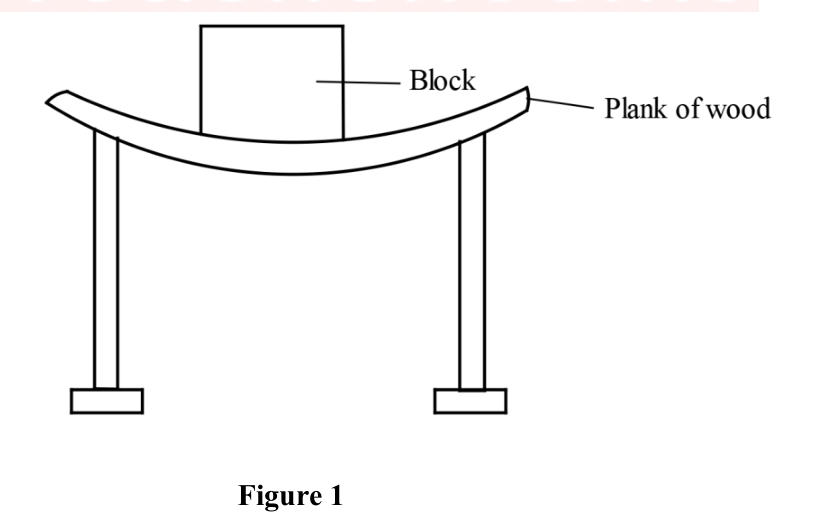
On the diagram, show how the tensional force acts on the plank of wood. (1 mark)
4. Figure 2 shows a person squeezing a tube of toothpaste.
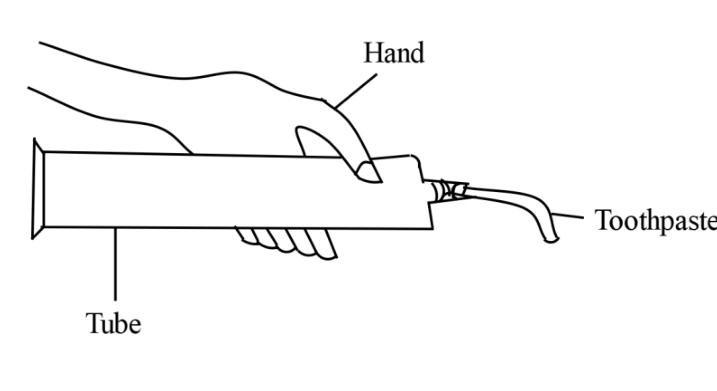
State the principle that is applied in squeezing the toothpaste out of the tube. (1 mark)
5. In a certain experiment, 2 cm³ of dry salt was dissolved in 10 cm³ of water. It was observed that the volume of the salt solution was 10.5 cm³. Explain why the volume of the solution was not the same as the sum of the volumes of the individual substances. (2 marks)
6. State one feature of a clinical thermometer that allows the reading to remain constant when the thermometer is no longer in contact with the body of a patient. (1 mark)
7. Figure 3 shows two spanners that can be used to loosen a nut.
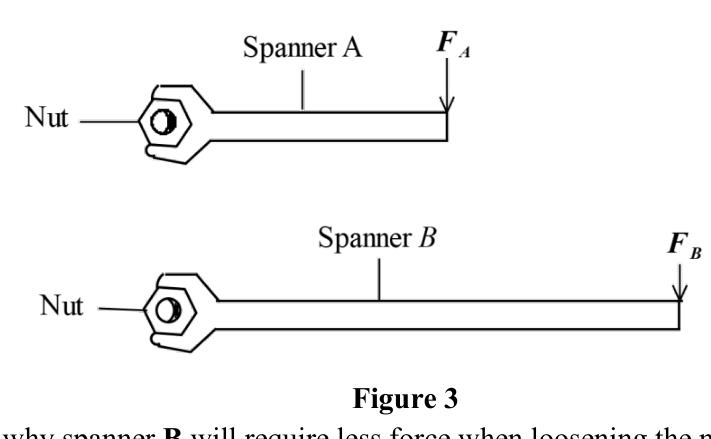
Explain why spanner B will require less force when loosening the nut. (2 marks)
8. Figure 4 shows an oval ball balanced on the ground.
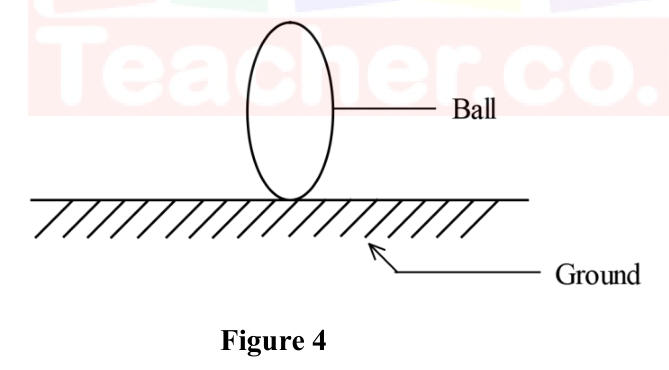
Explain why the ball is said to be in unstable equilibrium. (1 mark)
9. A student is required to calibrate a spring balance for use in measuring weight. Other than the spring and the masses, name one other apparatus the student must have in order to calibrate the spring. (1 mark)
10. It is observed that a vehicle travelling on a dusty road leaves a trail of dust rising high above the ground. Explain this observation. (2 marks)
11. An object moving with an initial velocity of 3 m s⁻¹ is uniformly decelerated to a stop after moving through a distance of 10 m. Determine its acceleration. (3 marks)
12. A student placed a coin on a smooth cardboard which was on top of an empty glass beaker. The cardboard was then suddenly pulled horizontally away from the beaker. State and explain the observation made. (3 marks)
13. State one source of non-renewable energy. (1 mark)
14. Explain why a person trapped inside a smoke-filled room is advised to crawl along the floor towards the exit. (3 marks)
Section B (55 marks)
15. (a) State the meaning of the term specific heat capacity. (1 mark)
(b) (i) A student observed that when an ice cube is placed in water it melts. Explain this observation. (2 marks) (ii) State two ways in which the melting point of ice can be reduced. (2 marks)
(c) A block of ice at 0 °C is supplied with 2000 J of heat. Determine the mass of water that will melt. (Specific latent heat of fusion of ice is J kg⁻¹) (3 marks)
(d) A student mixed 25 g of hot water at 50 °C with 75 g of cold water at 20 °C. Determine the final temperature of the mixture. (Specific heat capacity of water = 42 000 J kg⁻¹ K⁻¹ [sic — 4 200]) (3 marks)
16. (a) Students of a certain school want to verify Boyle's law. (i) State two apparatus that the students will need. (2 marks) (ii) State one quantity that they would keep constant while verifying Boyle's law. (1 mark)
(b) Figure 5 shows an apparatus that was used to investigate the rate of diffusion of two gases A and B, which form a white deposit when they interact.
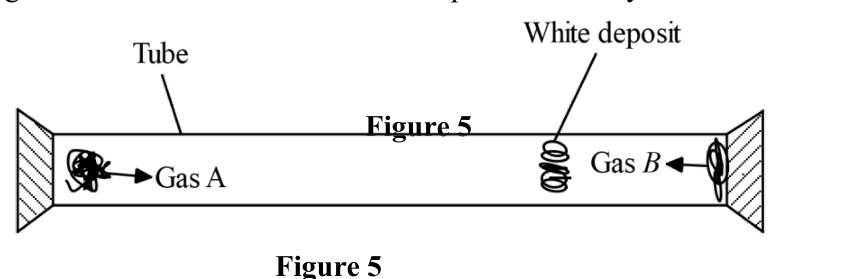
(i) Identify the gas that diffused faster. (1 mark) (ii) State two ways of increasing the rate of diffusion of the two gases in the tube. (1 mark)
(c) (i) Explain Charles's law using the kinetic theory of gases. (3 marks) (ii) The volume of a fixed mass of gas is 20.0 cm³ at a temperature of 19 °C. Determine the volume of the same mass of gas when the temperature increases to 24 °C at constant pressure. (3 marks)
17. (a) Figure 6 shows an object moving at a uniform speed on a circular path of radius r. The object moves from point A to B in a time t seconds.
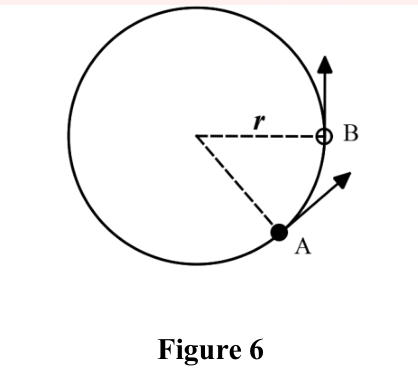
(i) Indicate on the diagram the: I. angular displacement θ; (1 mark) II. linear displacement S. (1 mark)
(ii) I. Write down an expression for the angular velocity ω in terms of t. (1 mark) II. Derive an expression for the linear velocity v in terms of the angular velocity ω. (2 marks)
(b) A pendulum bob of mass 20 g is whirled in a circular path of radius 100 cm at a velocity of 0.5 m s⁻¹. Determine the: (i) centripetal acceleration of the bob; (3 marks) (ii) centripetal force acting on the bob. (2 marks)
(c) Explain why a car should reduce its speed when negotiating a sharp corner. (2 marks)
18. (a) State Archimedes' principle. (1 mark)
(b) To verify Archimedes' principle, a student is provided with water in a measuring cylinder, a solid metal, a piece of thread and a spring balance. Describe how: (i) the mass of water displaced may be measured using these apparatus; (3 marks) (ii) Archimedes' principle may be verified. (3 marks)
(c) (i) State one way of reducing surface tension in liquids. (1 mark)
(ii) It is observed that when a certain object is placed in water, it gets fully submerged. However, when the same object is placed in glycerine, it is partially submerged as shown in Figure 7.
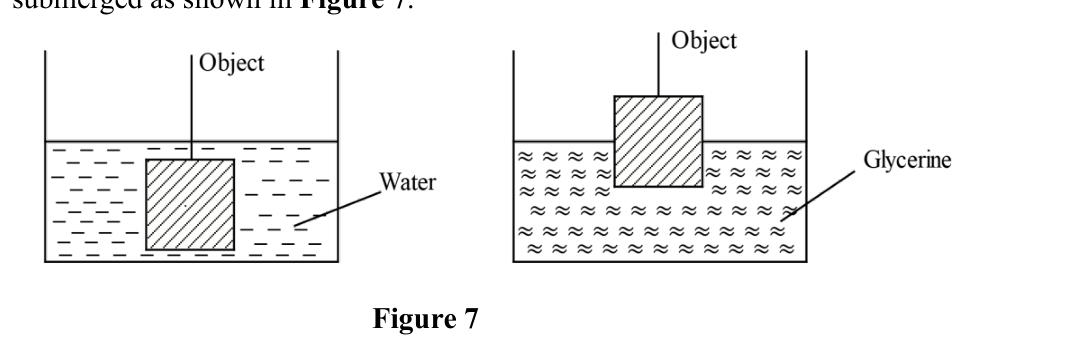
Explain this observation. (3 marks)
19. (a) A stone and a piece of paper are released from the same height in a vacuum. It is observed that they both hit the ground at the same time. Explain this observation. (2 marks)
(b) A car of mass 1 560 kg travelling at a velocity of 25 m s⁻¹ is brought to rest by a constant force of 3 000 N. Determine the: (i) change in momentum; (2 marks) (ii) time it takes for the car to come to rest. (2 marks)
(c) Jane measured the length of the palm of her hand as 18.7 cm. (i) Describe how the palm length may be used to estimate the length of a laboratory table top. (2 marks) (ii) Explain why the estimated length of the laboratory table top in (i) is not accurate. (2 marks)