232/3 · PHYSICS · Paper 3 (Practical) · Nov. 2024 · 2½ hours
Instructions: Answer all the questions in the spaces provided. You are supposed to spend the first 15 minutes of the 2½ hours allowed for this paper reading the whole paper carefully. Marks are given for a clear record of the observations actually made, their suitability, accuracy and the use made of them.
Question 1
You are provided with the following: micrometer screw gauge (may be shared); centre-zero galvanometer; resistor labelled R; jockey; resistance wire labelled N mounted on a half metre rule; resistance wire labelled Q mounted on a half metre rule; resistance wire labelled Y mounted on a metre rule with ends marked A and B; switch; connecting wires; a cell in a cell holder.
Proceed as follows:
(a) Using the micrometer screw gauge, measure and record the diameter of the wire labelled Q.
d = ………… mm; d = ………… m (1 mark)
(b) Set up the circuit as shown in Figure 1.
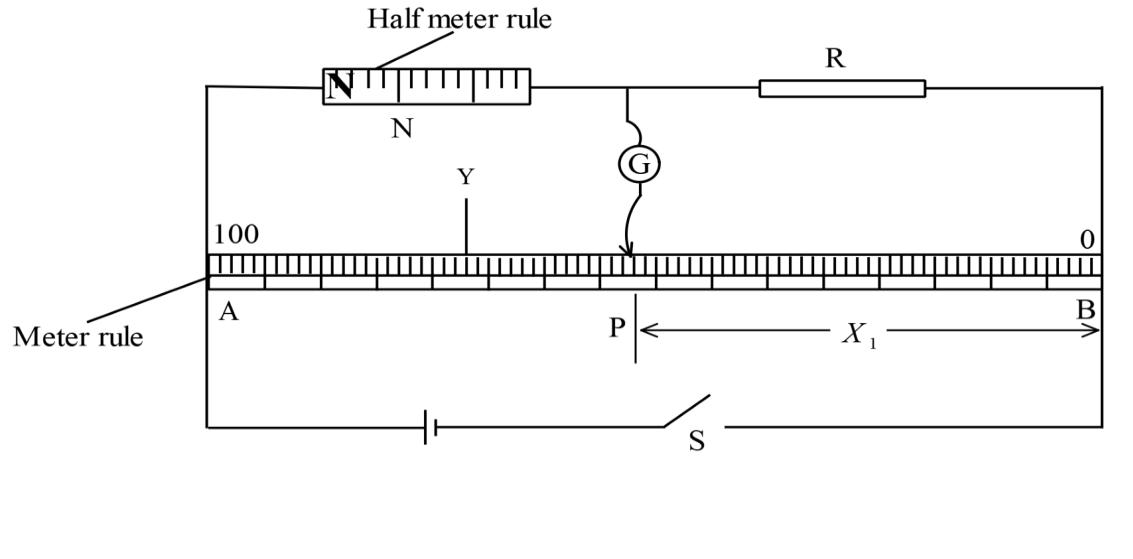
(i) Close the switch. Using the jockey, tap at various points on the wire Y to obtain a balance point P at which the galvanometer shows zero deflection. Measure and record the balance length PB = X₁.
X₁ = ………… cm (1 mark)
(ii) Determine the resistance N given that . (1 mark)
(c) (i) Open the switch and interchange R and N. Close the switch and obtain the new balance length X₂.
X₂ = ………… cm (1 mark)
(ii) Determine a second value of N given: . (1 mark)
(d) Determine the average value of . (1 mark)
(e) Without disconnecting the whole circuit, replace the resistor R with the wire labelled Q and adjust the length of N to cm as shown in Figure 2.
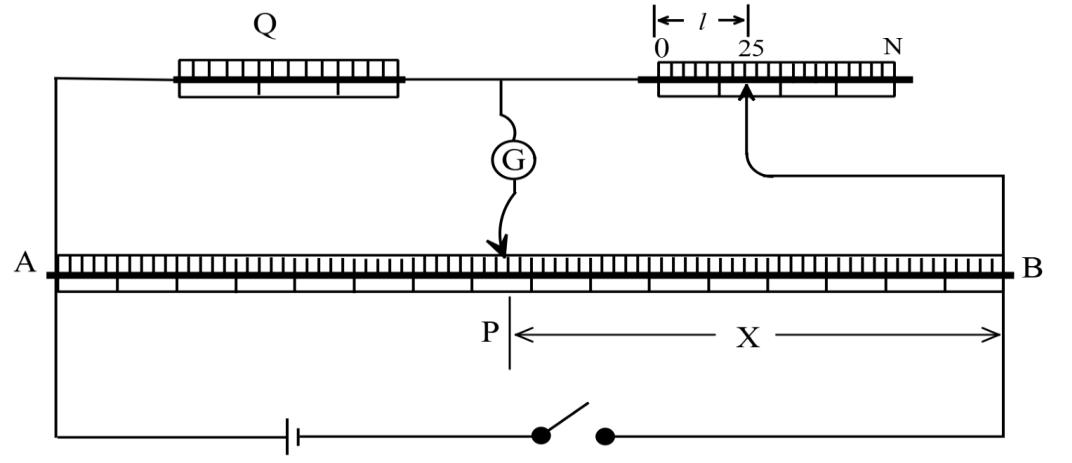
(i) Determine the balance length X and record it in Table 1.
(ii) Repeat part (e)(i) for other values of length of wire N shown in Table 1 and complete Table 1. (5 marks)
| (cm) | 25 | 30 | 35 | 40 | 45 | 50 |
|---|---|---|---|---|---|---|
| X (cm) | ||||||
| (cm⁻¹) | ||||||
| (cm⁻¹) |
(f) On the grid provided, plot a graph of (y-axis) against . (4 marks)
(g) Determine the slope S of the graph. (2 marks)
(h) Given that , determine the:
(i) value of Q; (2 marks)
(ii) constant ρ given that . (1 mark)
Question 2
You are provided with the following: micrometer screw gauge (may be shared); weighing balance (may be shared); match box (may be shared); piece of candle; water in a measuring cylinder labelled W; piece of white sewing thread; some tissue paper; liquid L in a measuring cylinder; stop watch; half metre rule; seven (7) steel balls placed in a beaker; plastic drinking straw.
Proceed as follows:
(a) (i) Wrap five of the steel balls with a small piece of tissue and place them on the weighing balance to measure the mass of the five balls and determine the mass m of one ball.
m = ………… kg (1 mark)
(ii) Using the micrometer screw gauge, measure and record the diameter d of one steel ball.
d = ………… mm; d = ………… m (1 mark)
(b) Determine the:
(i) volume v of the steel ball given that ; (1 mark)
(ii) density ρ of the steel ball. (2 marks)
(c) Wind the thread provided around the straw as shown in Figure 3 to make 10 closely packed turns. Mark with a pen the start and end of the 10 turns.
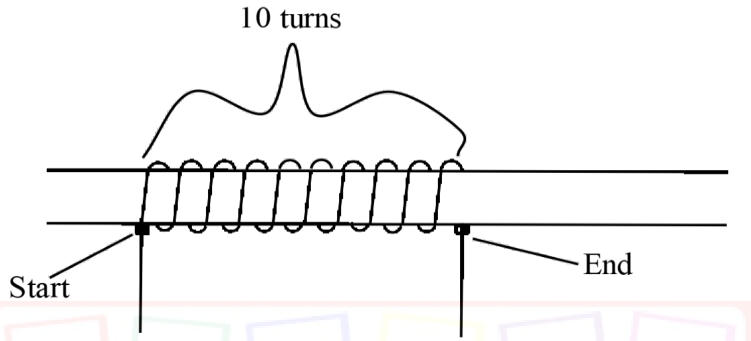
(i) Unwind the thread and spread it along the half metre rule to measure the length l between the two marked points at the start and the end.
l = ………… cm (1 mark)
(ii) Hence determine the diameter D of the straw given that the circumference C is given by . (2 marks)
(d) (i) Light the candle and deposit 2 or 3 drops of molten wax on the bench. Seal one end of the straw by dipping it in the molten wax for a few seconds until the wax at the end of the straw solidifies. (Ensure the seal is water tight.)
(ii) Put the seven steel balls provided into the straw and place it in water in the measuring cylinder so that it floats vertically. Measure the depth h₀ of the straw below the water (see Figure 4).
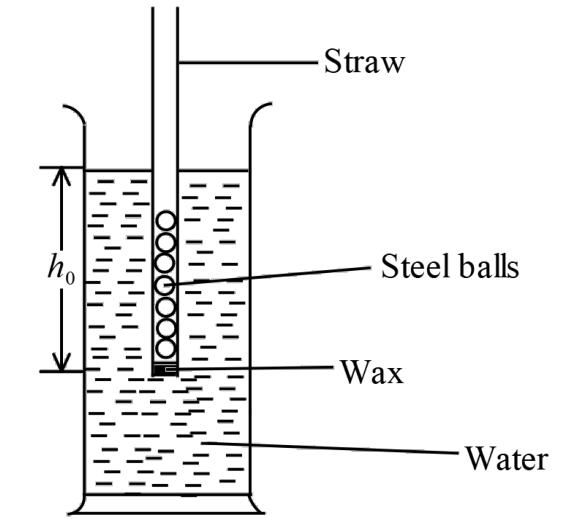
h₀ = ………… cm; h₀ = ………… m
(iii) Given that the volume of a cylinder of radius and height is given by , determine the volume of water displaced by the straw. (2 marks)
(e) Remove the straw with its contents from the water and wipe it dry using a tissue paper. Place the straw with the seven steel balls into liquid L so that it floats vertically.
(i) Measure the depth h₁ of the straw in the liquid.
h₁ = ………… cm; h₁ = ………… m (1 mark)
(ii) Determine the volume of liquid L displaced by the straw. (1 mark)
(iii) Determine constant n given that . (1 mark)
(f) Remove the straw from liquid L. Return the steel balls into the beaker. Place one steel ball at the centre of the surface of liquid L and release it so that it falls through the liquid.
(i) Using the stop watch, measure the time t the ball takes to fall from the 200 ml mark of the measuring cylinder to the 40 ml mark.
(ii) Repeat f(i) for one other ball and record in Table 2 the time t taken. (2 marks)
| Ball | Time taken |
|---|---|
| 1 | |
| 2 |
(iii) Determine the average time taken by the steel balls to fall through the liquid. (2 marks)
(g) (i) Measure the distance x between the 200 ml mark and the 40 ml mark.
x = ………… cm; x = ………… m (1 mark)
(ii) Determine the average velocity of the ball. (1 mark)
(iii) Determine constant Z given that . (1 mark)