232/2 · PHYSICS · Paper 2 (Theory) · Nov. 2024 · 2 hours
Instructions: The paper has two sections, A and B. Answer all the questions in both sections in the spaces provided. Non-programmable silent electronic calculators may be used.
Section A (25 marks)
1. Figure 1 shows the image formed by a plane mirror when an object is placed in front of the mirror.
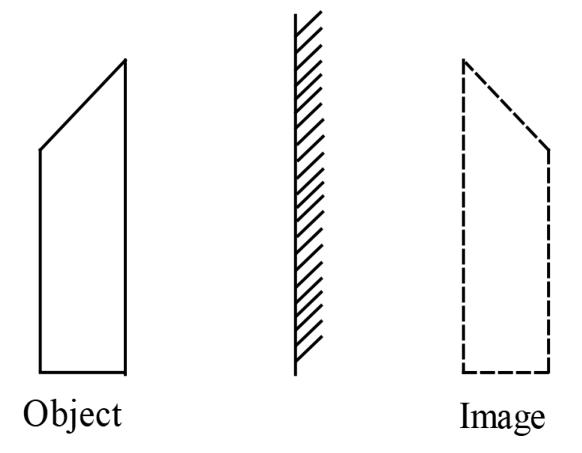
Apart from the image being virtual and of the same size as the object, state one other characteristic displayed in the figure. (1 mark)
2. A student observed that when removing a polyester sweater, a crackling sound was produced. Explain this observation. (2 marks)
3. Explain what happens to the potential difference of a charged parallel plate capacitor when the distance of separation between the plates is reduced. (3 marks)
4. State one advantage of using a circuit breaker instead of a fuse in a domestic wiring system. (1 mark)
5. A student is provided with a steel needle and a copper coin. Describe how the student can use a bar magnet to identify which of the two materials is magnetic. (2 marks)
6. Figure 2 shows an object 'O' and its image 'I' as formed by a concave mirror.
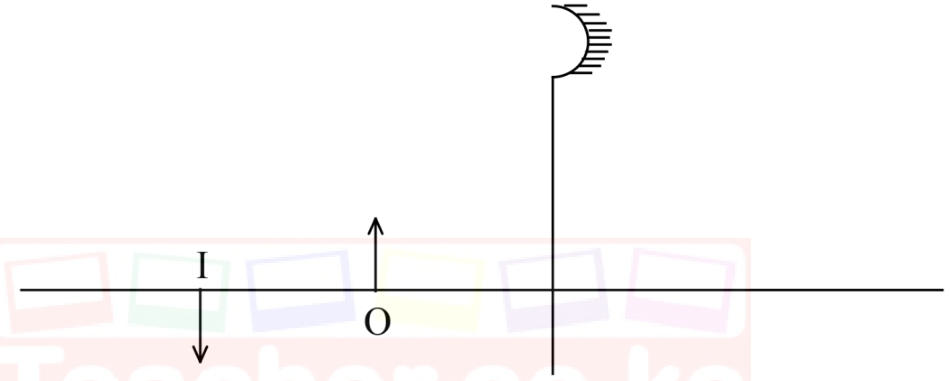
Complete the ray diagram and indicate the focal length of the mirror. (2 marks)
7. Using domain theory, explain how electric current produces a magnetic effect in an electromagnet. (3 marks)
8. State the meaning of the term periodic time of a wave. (1 mark)
9. Explain why sound energy travels faster in a metal block than in water. (2 marks)
10. State the meaning of the term refractive index of water. (1 mark)
11. Figure 3 shows a cell connected to a bulb and a switch.
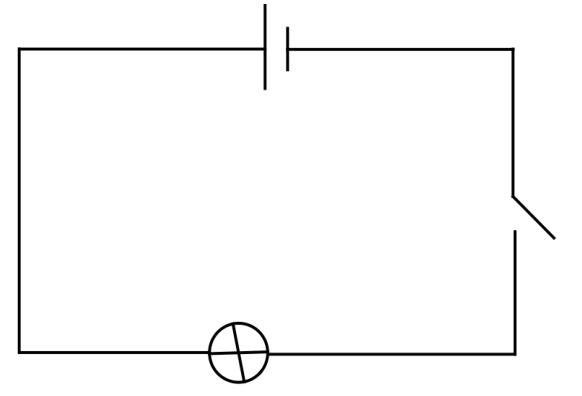
When the switch is closed, the bulb lights. Explain how the cell drives the electrons in the circuit. (2 marks)
12. An electric bulb is marked 60 W, 240 V. Determine the energy the bulb consumes in one minute. (2 marks)
13. (a) State what is meant by long sightedness as an eye defect. (1 mark)
(b) Explain how long sightedness can be corrected using a lens. (2 marks)
Section B (55 marks)
14. (a) Figure 4 shows an electromagnet set-up.
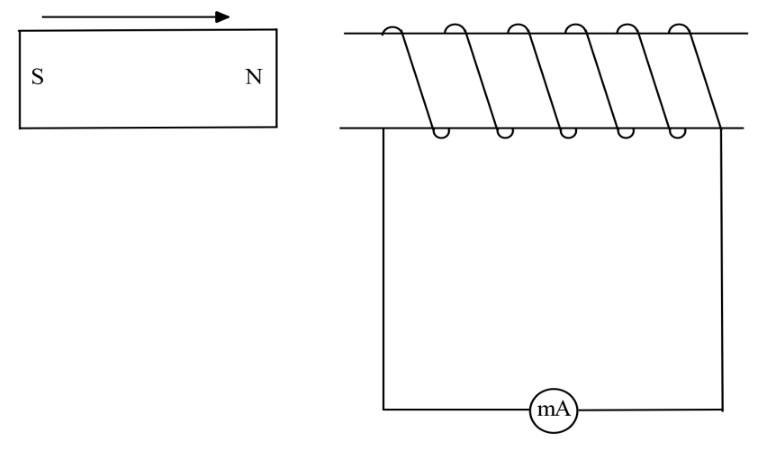
When the magnet is moved towards the coil as shown by the arrow, the milliammeter reads a maximum current of 0.1 mA.
(i) Explain how the current is generated in the circuit. (3 marks)
(ii) Using the same set-up, state how the current observed in the milliammeter can be increased. (1 mark)
(iii) On the figure, indicate with an arrow the direction of the induced current in the coil. (1 mark)
(iv) Explain why the current flows in the direction shown in part (iii). (3 marks)
(b) A family observed that after purchasing a refrigerator, the monthly electricity bill increased by Ksh 2000 in a 30 day month. Given that the cost of electricity per kWh is Ksh 400 and the fridge was used for 24 hours per day, determine the power rating of the fridge. (3 marks)
15. (a) (i) State three uses of the electron gun in the cathode ray oscilloscope. (3 marks)
(ii) State the reason why the inner wall of a cathode ray oscilloscope tube is coated with graphite. (1 mark)
(iii) Describe how a cathode ray oscilloscope can be used to measure the voltage of a cell. (3 marks)
(b) Figure 5 shows an x-ray tube.
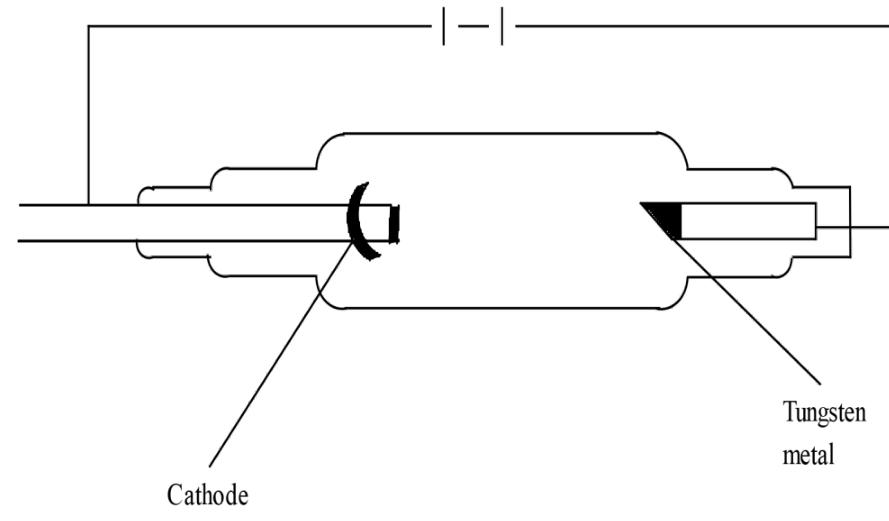
(i) On the figure, show with an arrow:
I. the direction of the electron beam in the tube; (1 mark)
II. the direction of the x-rays produced. (1 mark)
(ii) State two ways by which focusing of the electron beam is achieved in the tube. (2 marks)
16. (a) (i) State the meaning of the term photoelectric emission. (1 mark)
(ii) Explain how the energy of a photon is used by the electrons during photoelectric emission. (2 marks)
(b) Explain the meaning of the term stopping voltage as used in photoelectric effect. (2 marks)
(c) When a certain metal surface is illuminated with a light of wavelength m, it emits photoelectrons whose kinetic energy is J. (Planck's constant is Js and speed of light is m/s [sic: should be m/s].) Determine the:
(i) energy of a photon of the incident light; (3 marks)
(ii) work function of the metal surface. (3 marks)
17. (a) Explain how visible tracks of radiations are formed in the expansion cloud chamber when the moist air in the chamber expands. (3 marks)
(b) The following equation shows a radioactive decay series:
(i) State the name of the radiation emitted. (1 mark)
(ii) State what would be observed on the leaf of a positively charged electroscope when the radiation identified in (i) passes close to the cap of the electroscope. (3 marks)
(c) A certain radioactive substance has a half-life of 8 hours. 10 g of the sample has an activity of 90 counts per minute. Determine the:
(i) quantity of the sample that is active after 24 hours; (1 mark)
(ii) activity of the remaining sample after 24 hours. (1 mark)
18. (a) Use the energy band theory to explain why intrinsic semiconductors do not conduct at absolute zero temperature. (2 marks)
(b) Figure 6 shows a p–n junction diode connected to a source of e.m.f.
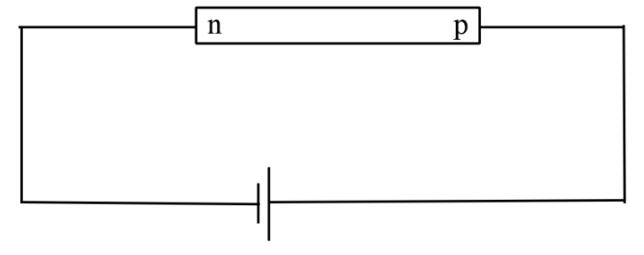
(i) State the type of biasing shown in the figure. (1 mark)
(ii) Explain what happens to the charge carriers at the junction. (3 marks)
(iii) In the space provided, sketch the current–voltage graph for the diode in the figure. (1 mark)
(c) Figure 7 shows a waveform generated by an alternating current source.
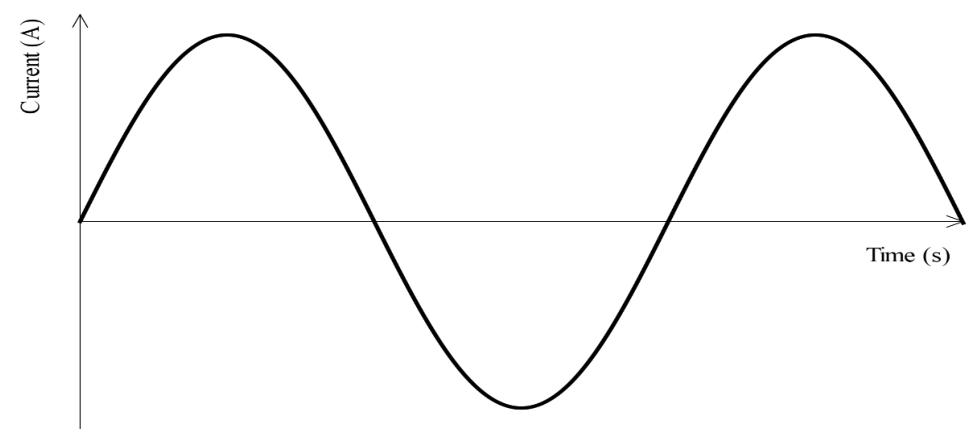
(i) On the axis provided, sketch the waveform obtained when a p–n junction diode is connected in series with the source.
(ii) Explain the shape of the waveform drawn in part (c)(i). (2 marks)