231/3 · BIOLOGY (Practical) · Paper 3 · Nov. 2025 · 1¾ hours
Instructions: Answer all the questions in the spaces provided. (The source is a phone scan; some words at the page edges are cut off.)
Question 1
You are provided with: specimen E; hydrogen peroxide; a beaker; a scalpel; 2 test tubes labelled A and B; a dropper; a source of heat; a white tile; a wooden splint.
Procedure
(i) Peel a portion of specimen E using the scalpel and cut out two equal portions of about 1 cm³ each.
(ii) Macerate/cut into smaller pieces one portion on a white tile and place the pieces in the test tube labelled A.
(iii) Boil the other portion in a beaker, macerate on a white tile and transfer it into the test tube labelled B.
(iv) To each test tube, add 3 drops of hydrogen peroxide and record the observations.
(a) Record the observations and conclusions for test tubes A and B. (4 marks)
| Test tube | Observations | Conclusion |
|---|---|---|
| A | ||
| B |
(b) State the aim of the experiment. (1 mark)
(c) Give the reason for macerating specimen E before adding hydrogen peroxide. (2 marks)
(d) (i) Name the organ in the human body where the reaction in test tube A occurs. (1 mark) (ii) State the significance of the reaction to the human body. (1 mark)
(e) Suggest two other factors that are likely to affect the rate of reaction in test tube A. (2 marks)
Question 2
You are provided with the following materials and photographs: specimen H; specimen J; a hand lens.
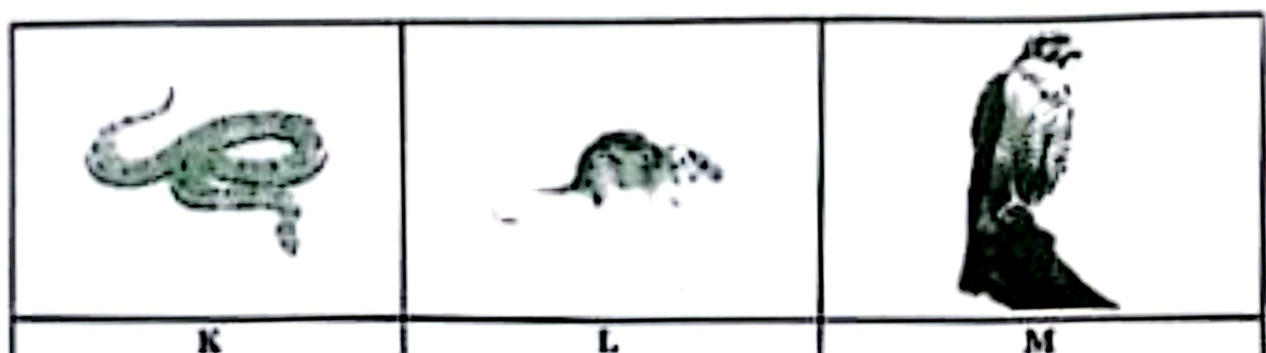
(a) Complete a table by classifying the specimens H, J and photograph M (Class and reasons), based on observable features only. (9 marks)
(b) Explain the ecological significance of the Kingdom to which specimen H belongs. (2 marks)
(c) Make a labelled diagram of the dorsal view of the abdomen of specimen J. (2 marks)
(d) Construct a food chain with four trophic levels involving the specimens provided and those presented in the photographs. (1 mark)
Question 3
You are provided with: specimen N; specimen P; a microscope slide; a light microscope; a cover slip; boiling water; a wooden splint.
(a) Other than the leaf margin, state one observable difference between specimens N and P. (1 mark)
(b) Explain the observable adaptations of specimen N to its habitat. (3 marks)
(c) Put the boiling water in a beaker and dip specimen N in the hot water. Using the wooden splint, turn the specimen to make observations on both surfaces while dipped in the water.
(i) State the difference in the observations made on the upper and lower surfaces of the specimen. (2 marks)
(ii) Account for the difference in the observations made in (c)(i). (3 marks)
(d) Peel off the epidermis from specimen P. Mount a portion on a slide, cover with a cover slip and observe under a light microscope.
(i) Make a labelled drawing of the observed image. (3 marks)
(ii) Describe how you would determine the magnification of the image. (1 mark)