231/1 · BIOLOGY · Paper 1 (Theory) · Nov. 2024 · 2 hours
Instructions: Answer all the questions in the spaces provided.
1. The following diagram shows an apparatus used in ecological studies.
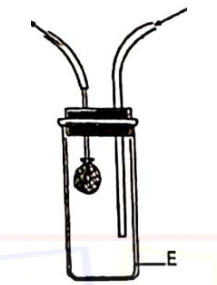
(a) Name the apparatus. (1 mark)
(b) Why is glass preferred in the making of the part labelled E? (1 mark)
2. (a) Name the Kingdom whose members are all microscopic. (1 mark)
(b) State two diseases caused by organisms belonging to the Kingdom named in 2(a). (2 marks)
3. During a microscopy practical, the following materials were provided: a temporary mount of an onion epidermis; a transparent ruler.
(a) State the aim of the experiment. (1 mark)
(b) Explain how the aim stated in 3(a) can be achieved. (3 marks)
4. The following diagram represents a specialized animal cell.
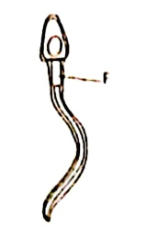
(a) Identify the cell. (1 mark)
(b) (i) Name the cell organelle that is likely to be found in abundance in the part labelled F. (1 mark)
(ii) Explain the answer in 4(b)(i). (2 marks)
5. Name two components of blood that are absent in the tissue fluid. (2 marks)
6. Name the structures in plants through which the processes of transpiration and guttation occur.
(a) Transpiration: ………… (1 mark)
(b) Guttation: ………… (1 mark)
7. Name two Classes of the Phylum Arthropoda that have a cephalothorax. (2 marks)
8. (a) Name the source of hydrochloric acid in the human alimentary canal. (1 mark)
(b) The following diagram shows a process along the mammalian digestive system.
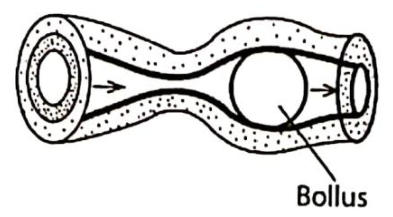
(i) Name the process. (1 mark)
(ii) State two roles of the process in digestion. (2 marks)
9. Name one blood disorder caused by gene mutation. (1 mark)
10. Name the stage in meiosis where each of the following processes occur:
(a) formation of spindle fibres; (1 mark)
(b) disappearance of nucleolus. (1 mark)
11. The following diagram represents part of the human male reproductive system.
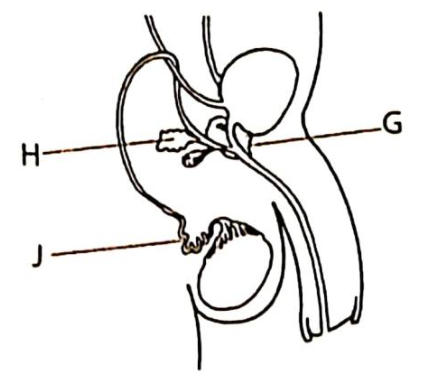
(a) Name the part labelled G. (1 mark)
(b) State one function of the structure labelled H. (1 mark)
(c) How is the structure labelled J adapted to its function? (2 marks)
12. How do the following structural modifications in plants minimize the rate of water loss?
(a) Leaf folding. (1 mark)
(b) Sunken stomata. (1 mark)
13. State two reasons for the absence of complex excretory organs in plants. (2 marks)
14. State the significance of each of the following characteristics in mammalian gaseous exchange structures and surfaces.
(a) Presence of rings of cartilage in the trachea. (1 mark)
(b) Numerous blood capillaries lining the lungs. (1 mark)
15. (a) What is the most appropriate method of estimating the population of black ants in a school playing field? (1 mark)
(b) Why are shorter food chains advantageous in an ecosystem? (2 marks)
16. (a) Using an example, define convergent evolution. (2 marks)
(b) Explain how natural selection is advantageous to living organisms. (3 marks)
17. (a) (i) Name the blood vessel that carries oxygenated blood from the heart to the rest of the body tissues. (1 mark)
(ii) State the role of the tricuspid valve in the mammalian heart. (1 mark)
(b) Why are people with blood group O referred to as universal donors? (2 marks)
18. The following diagram shows germination in two different seedlings labelled L and M.
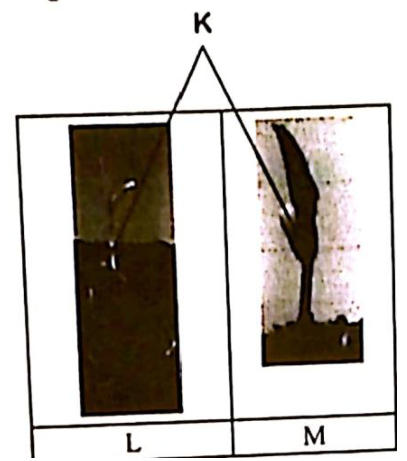
(a) (i) Identify the type of germination shown in seedling L. (1 mark)
(ii) Give a reason for the answer in 18(a)(i). (1 mark)
(b) State one common function of the parts labelled K in seedlings L and M. (1 mark)
19. The following diagram represents a longitudinal section through a phloem tissue.
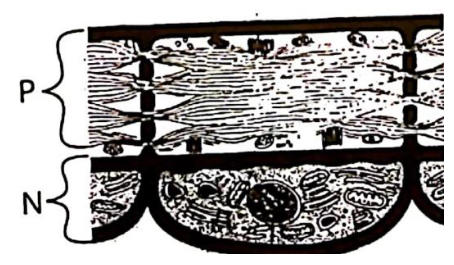
(a) Account for the high concentration of mitochondria in the part labelled N. (3 marks)
(b) State one structural adaptation of the part labelled P to its function. (2 marks)
20. The following word equation represents a metabolic reaction taking place in an animal tissue: Glucose → Lactic acid + Energy
(a) State the condition under which the reaction occurs. (1 mark)
(b) How does the size of an animal affect the rate of respiration? (3 marks)
21. (a) How can sexual reproduction in organisms lead to the evolution of new species? (3 marks)
(b) State the role of continental drift in the evolution of organisms. (2 marks)
22. The following diagram represents an experimental set-up used to investigate a certain biological process.
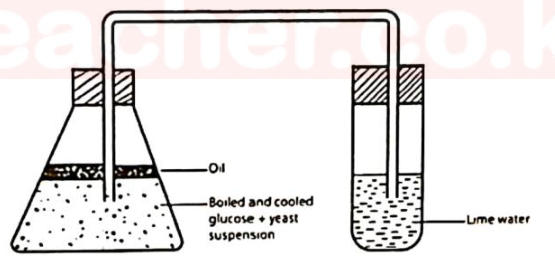
(a) (i) Identify the biological process that can be investigated using the set-up. (1 mark)
(ii) Give a reason for the answer in 22(a)(i). (1 mark)
(b) Write a word equation illustrating the reaction taking place in the experiment. (1 mark)
(c) Suggest a modification on the set-up that would increase the rate of reaction in the conical flask. (1 mark)
(d) Why is it necessary to cool glucose before adding yeast in the conical flask? (1 mark)
23. The following diagram represents a bone obtained from a mammalian axial skeleton.
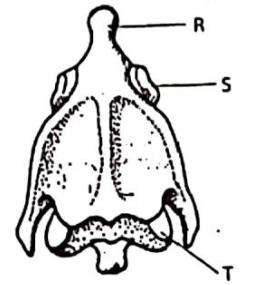
(a) Identify the:
(i) bone; (1 mark)
(ii) part labelled R. (1 mark)
(b) Name the bones that articulate at the points labelled S and T.
S ………… (1 mark) T ………… (1 mark)
24. The following food web shows a feeding relationship found in a certain ecosystem.
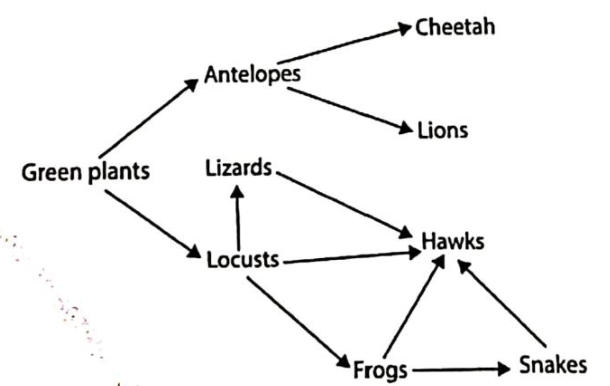
(a) From the food web, identify the:
(i) organism with the lowest biomass; (1 mark)
(ii) trophic level occupied by lizards. (1 mark)
(b) Name the type of feeding relationship between the:
(i) lion and the cheetah; (1 mark)
(ii) cheetah and the antelopes. (1 mark)
(c) Explain the role bacteria would play in this ecosystem. (2 marks)