231/2 · BIOLOGY (Theory) · Paper 2 · Nov. 2025 · 2 hours
Instructions: This paper consists of two sections, A and B. Answer all the questions in section A. In section B, answer question 6 (compulsory) and either question 7 or 8. (The source is a phone scan.)
Section A (40 marks)
1. The following diagram illustrates a light microscope.
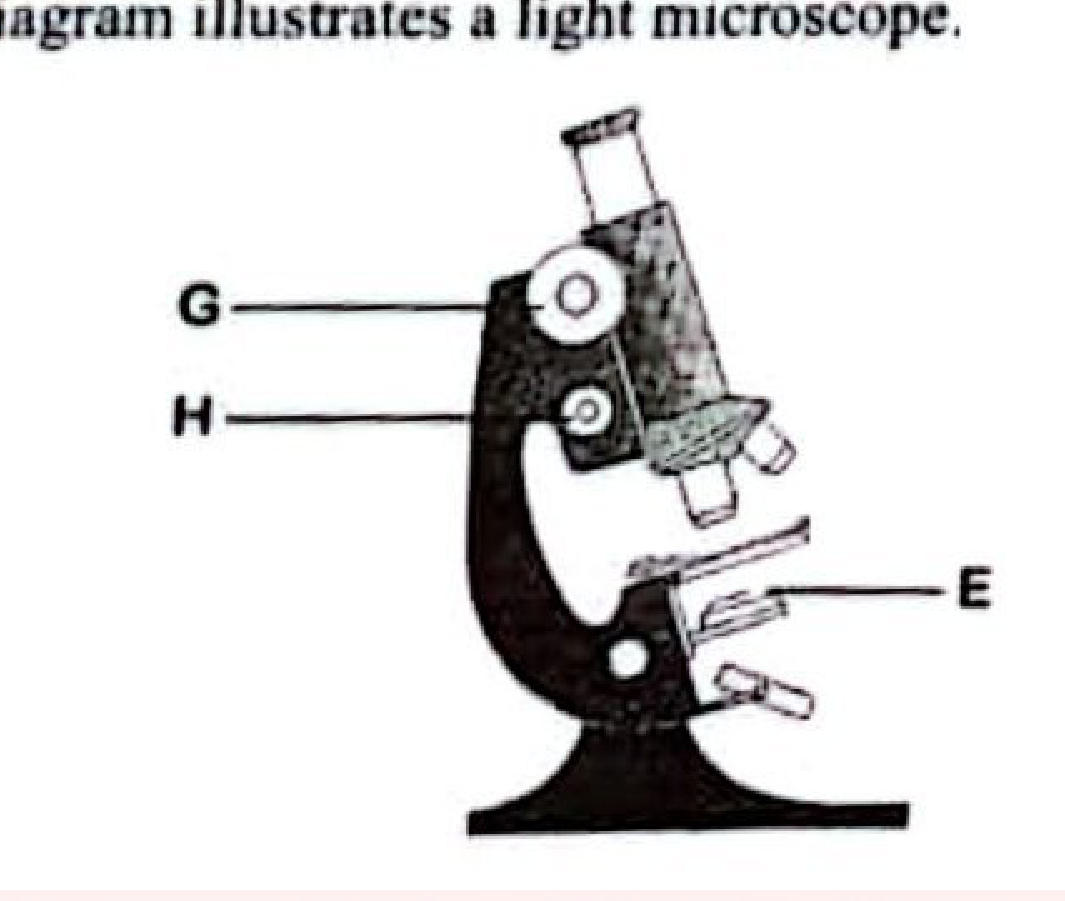
(a) Name the part labelled E. (1 mark)
(b) Label on the diagram, with a letter F, the part that reflects light to the specimen. (1 mark)
(c) State the function of the part labelled H. (1 mark)
(d) Explain the precautions that should be taken while using the part labelled G. (2 marks)
(e) Describe how one can determine the magnification of a specimen viewed under the microscope. (2 marks)
(f) During a microscopy lesson, two groups of students observed different numbers of cells from the same slide using identical microscopes. Suggest the likely cause of the difference. (1 mark)
2. In an experiment, students made some marks on the root of a germinating bean plant as shown in the following diagram.
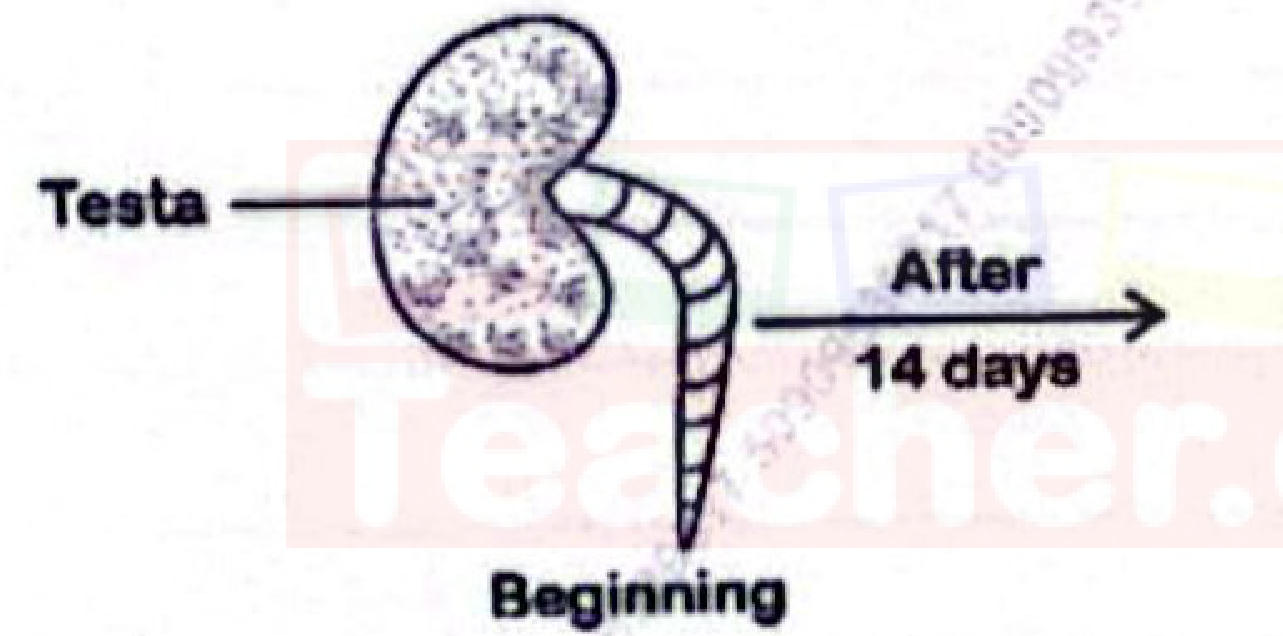
(a) State the aim of the experiment. (1 mark)
(b) (i) On the space provided on the right side of the diagram, sketch the appearance of the marks on the root after 14 days. (1 mark) (ii) Account for the appearance of the marks on the sketch made in (b)(i). (3 marks)
(c) State two materials the students would require to undertake the experiment. (2 marks)
(d) State the role of the testa during germination. (1 mark)
3. (a) In a certain variety of pea plants, the allele for smooth seed coat is dominant over the allele for wrinkled seed coat. Using letter R to represent the allele for smooth seed coat, determine: (i) the genotypic ratio of the F₁ generation if two heterozygous pea plants were crossed; (5 marks) (ii) the total number of seeds with wrinkled seed coats if the total number of all the F₁ seeds was 12 000. (2 marks)
(b) State the advantage of using pea plants over eucalyptus plants in genetic studies. (1 mark)
4. The following diagram represents a section of the mammalian skin.
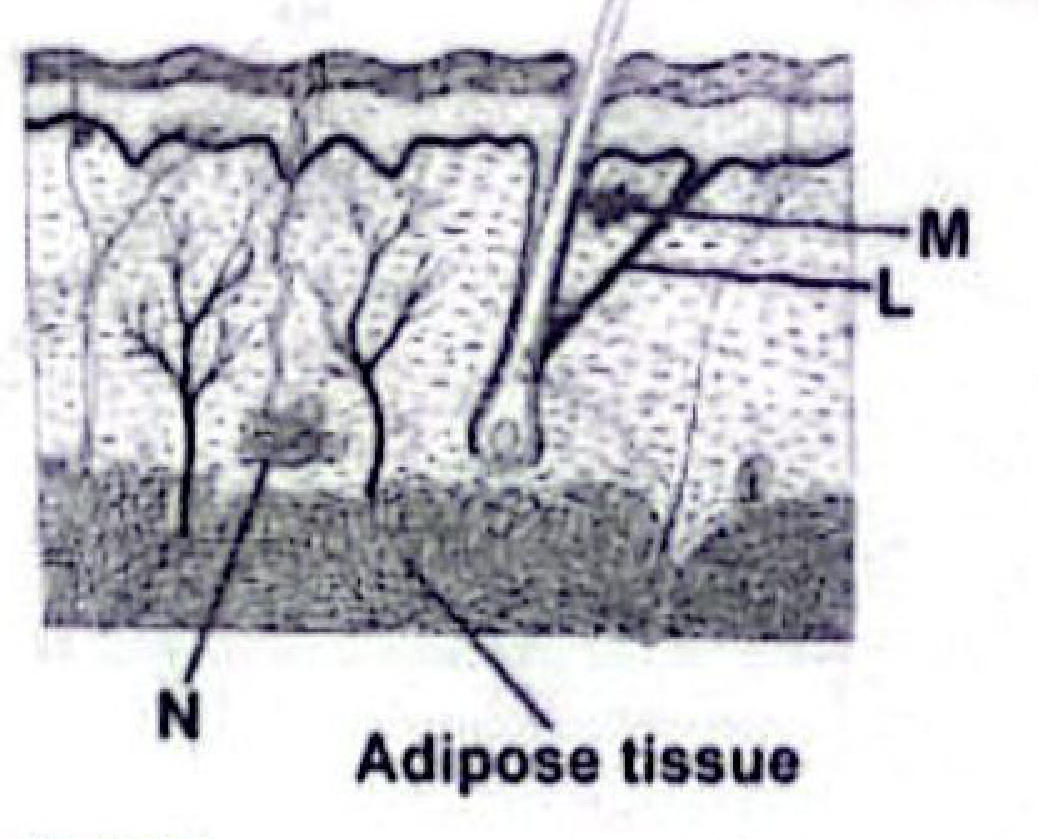
(a) Name the part labelled M. (1 mark)
(b) Explain the roles played by the parts labelled N and L in thermoregulation during hot weather conditions: (i) N; (3 marks) (ii) L. (3 marks)
(c) Explain why aquatic animals have a thicker adipose tissue. (1 mark)
5. The following diagram represents a section of the human female reproductive system.
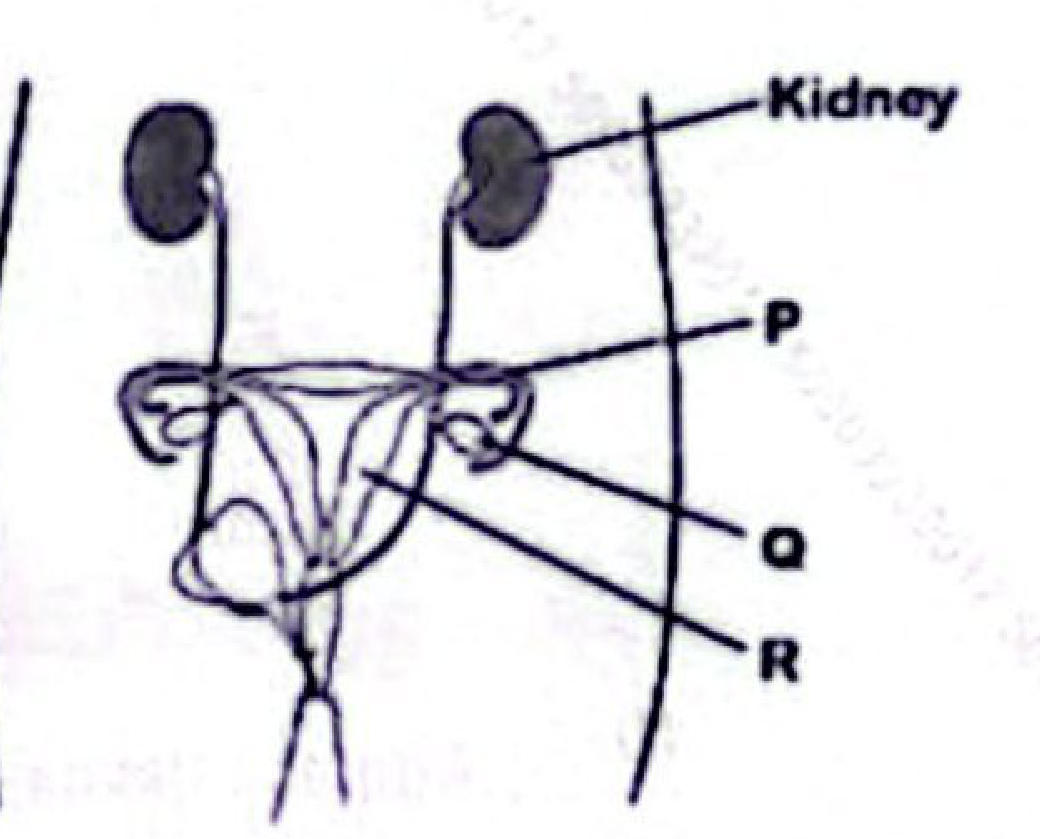
(a) Name the part labelled P. (1 mark)
(b) State two functions of the part labelled R. (2 marks)
(c) (i) Name the hormone secreted in the part labelled Q. (1 mark) (ii) State the roles of the hormone named in (c)(i). (2 marks)
(d) Explain why a pregnant woman would require more proteins in her diet. (2 marks)
Section B (40 marks)
Answer question 6 (compulsory) and either question 7 or 8.
6. In an investigation, blood flowing in two blood vessels, W and X, of a healthy adolescent was measured within a minute and recorded as shown below.
| Time (seconds) | 0 | 20 | 30 | 40 | 50 | 60 |
|---|---|---|---|---|---|---|
| Blood pressure in vessel W (mmHg) | 150 | 155 | 160 | 170 | 180 | 180 |
| Blood pressure in vessel X (mmHg) | 350 | 370 | 330 | 380 | 350 | 390 |
(a) On the same axes, plot a graph of blood pressure in both vessels against time. (7 marks)
(b) State the likely identity of the blood vessels W and X. (2 marks)
(c) Explain your answer in (b). (3 marks)
(d) (i) Compare the blood pressure in an adolescent boy and a sixty-year-old man. (1 mark) (ii) Explain your answer in (d)(i). (3 marks)
(The paper has no part (e) [sic].)
(f) Explain the role of blood in: (i) temperature regulation; (2 marks) (ii) disease control. (2 marks)
7. (a) Describe the role of the stomach in digestion. (5 marks)
(b) Describe the mechanisms that lead to the opening of the stomata during the day. (15 marks)
8. (a) Explain the forces involved in the uptake of water in terrestrial plants. (5 marks)
(b) While playing, a student was pricked by a thorn on the hand. The student screamed and quickly withdrew the hand from the thorn. Describe the activities that led to the withdrawal of the hand from the thorn. (15 marks)