231/2 · BIOLOGY · Paper 2 (Theory) · Nov. 2024 · 2 hours
Section A (40 marks)
Answer all the questions in this section in the spaces provided.
1. The following word equation represents a biological process that occurs in green plants:
Carbon(IV) oxide + water → Glucose + Product E
(a) Name the cell organelle where the illustrated process takes place in green plants. (1 mark)
(b) (i) Give the likely identity of product E. (1 mark)
(ii) Suggest ways in which the rate of production of E can be increased. (3 marks)
(c) Suggest one possible source of carbon(IV) oxide if the above process was artificially conducted in a school laboratory. (1 mark)
(d) Explain how the illustrated process is significant in nature. (2 marks)
2. In an experiment, the number of red blood cells present in three samples of blood labelled F, G and H was estimated. Different concentrations of salt solution were then separately added to the samples. After an hour, the number of red blood cells present in each sample was counted and recorded as shown in the table below.
| Blood sample | Salt solution % concentration added | Number of red blood cells |
|---|---|---|
| F | 1.0 | Number remained the same |
| G | 0.6 | Fewer cells observed |
| H | 0.4 | No cells observed |
(a) Name the physiological process being investigated in the experiment. (1 mark)
(b) Account for the results made in blood sample F. (2 marks)
(c) Account for the difference in appearance of red blood cells in samples F and G at the end of the experiment. (2 marks)
(d) With a reason, predict the possible observation that would be made if blood sample F was treated with a salt concentration of 2.6%. (2 marks)
(e) State the importance of the process being investigated above during urine formation. (1 mark)
3. A genetic investigation on a certain population established that, in human beings, premature baldness is controlled by a dominant gene, N, located on the Y chromosome.
(a) Work out the phenotypic ratio of the offspring of a couple comprising of a normal mother and a father with premature baldness. (5 marks)
(b) What is the probability that this couple would have a daughter with premature baldness? (1 mark)
(c) Name two sex-linked traits in human beings associated with the X-chromosome. (2 marks)
4. During an ecological study in a lake ecosystem, a group of students made the following observations on the feeding relationships among some organisms:
- Lobsters feed on algae
- Small fish feed on lobsters, worms and caterpillars
- Caterpillars feed on algae
- Worms feed on caterpillars
- Large fish feed on small fish
- Penguins feed on small fish, lobsters and worms
(a) From the students' observations, construct a food web for the ecosystem. (5 marks)
(b) From the food web constructed in 4(a), extract a food chain with the penguin as a secondary consumer. (1 mark)
(c) Explain how spillage of oil from water vessels is likely to affect this lake ecosystem. (2 marks)
5. The following diagram represents part of a cell structure as seen under an electron microscope.
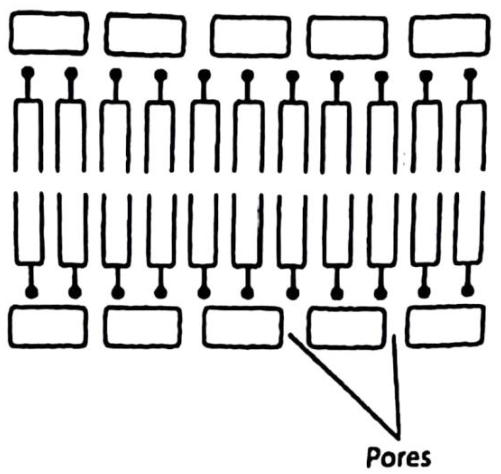
(a) (i) Identify the structure represented. (1 mark)
(ii) State two functions of the structure. (2 marks)
(iii) Suggest two ways in which the functioning of the structure can be impaired. (2 marks)
(b) Name two structures found in plant cells but not in animal cells. (2 marks)
(c) What is the purpose of staining cells before observing them under a light microscope? (1 mark)
Section B (40 marks)
Answer question 6 (compulsory) and either question 7 or 8.
6. An investigation was carried out to monitor trends of growth in a group of boys and girls for a period of 20 years. Their average weights were recorded at two years' intervals as shown in the table.
| Age (years) | 0 | 2 | 4 | 6 | 8 | 10 | 12 | 14 | 16 | 18 | 20 |
|---|---|---|---|---|---|---|---|---|---|---|---|
| Boys (kg) | 2.4 | 11.0 | 14.5 | 18.2 | 21.7 | 25.2 | 27.7 | 37.2 | 44.5 | 46.8 | 48.6 |
| Girls (kg) | 2.4 | 11.4 | 15.5 | 19.6 | 26.8 | 27.4 | 31.5 | 35.4 | 44.5 | 52.6 | 55.6 |
(a) On the same axes, draw line graphs of average weights of girls and boys against their ages. (8 marks)
(b) From the graph, determine the:
(i) weight of boys at the age of 13 years; (1 mark)
(ii) growth rate of girls between the 13th and 15th year. (3 marks)
(c) Account for the trend in the growth of girls between the 14th and 18th year. (2 marks)
(d) Apart from sex and age, state three other factors that affect the rate of growth in humans. (3 marks)
(e) Other than weight, state a parameter that can be used to establish growth in humans. (1 mark)
(f) Why do girls above 12 years require more iron in their diet than boys of the same age? (2 marks)
7. (a) Explain the effects of hypothyroidism in adults. (4 marks)
(b) Describe the hearing process in humans. (16 marks)
8. (a) Describe how urea is formed in humans. (5 marks)
(b) Describe the path followed by urea from the site of formation until it is eliminated from the body. (15 marks)