231/1 · BIOLOGY (Theory) · Paper 1 · Nov. 2025 · 2 hours
Instructions: Answer all the questions in the spaces provided. (The source is a phone scan; some labels are faint.)
1. (a) State the characteristic of living organisms illustrated in the following diagram. (1 mark)
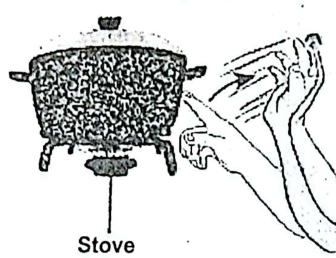
(b) State the significance of the illustrated characteristic to living organisms. (1 mark)
2. Explain how relaxation of the diaphragm muscles leads to exhalation. (3 marks)
3. The following diagram illustrates an organelle obtained from a cell.
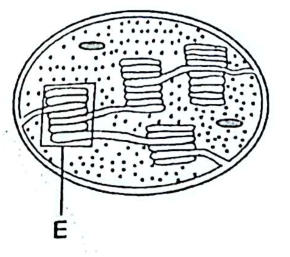
(a) Identify the organelle. (1 mark) (b) Name the part labelled E. (1 mark) (c) Explain how the part labelled E is adapted to its function. (2 marks)
4. The following diagram illustrates an organism belonging to a certain Class.
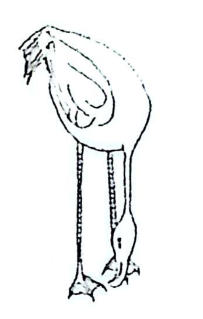
(a) Name the Class to which the organism belongs. (1 mark) (b) Suggest the likely habitat of the organism. (1 mark) (c) State two reasons for your answer in (b). (2 marks)
5. (a) Name the type of muscle found in the following parts of the body: (i) heart; (1 mark) (ii) alimentary canal. (1 mark)
(b) State two roles of the muscle named in (a)(ii). (2 marks)
6. The following diagrams show two organisms belonging to two different Divisions.
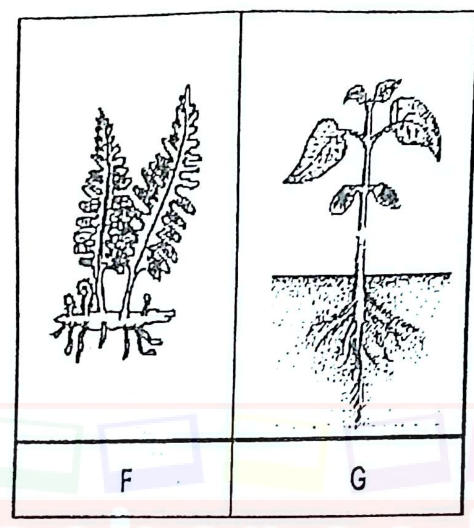
(a) Name the Division to which each organism belongs: F; G. (1 mark)
(b) Explain why organism G is considered more advanced than F. (2 marks)
7. The following diagram illustrates cells found in a mammalian body.
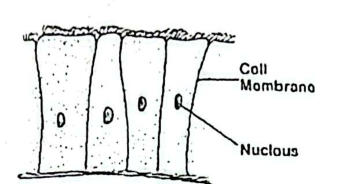
(a) (i) Identify the type of cells illustrated. (1 mark) (ii) Name two parts of the mammalian body where the cells are found. (2 marks)
(b) State the function of the cells in any one of the parts named in (a)(ii). (1 mark)
8. The following diagram illustrates a stage of development of a human foetus.
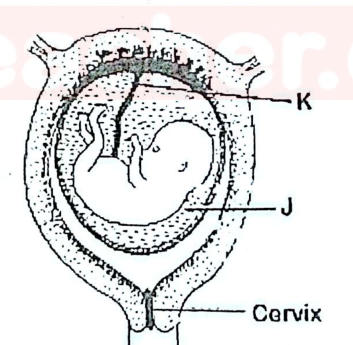
(a) State the function of J. (1 mark) (b) How is the part labelled K adapted to its function? (2 marks)
9. Explain why sugary foods are harmful to teeth. (3 marks)
10. Form 3 students constructed the following food web for organisms in a certain ecosystem.
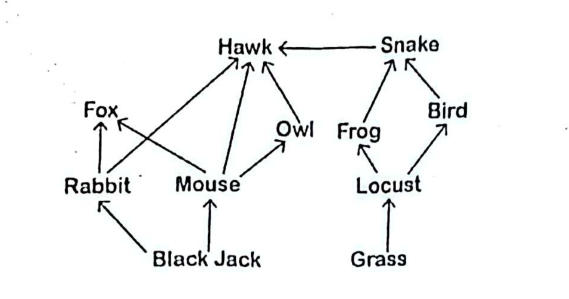
(a) (i) Identify the organism which is both a tertiary and a secondary consumer. (1 mark) (ii) Construct a food chain ending with the organism named in (a)(i) as a tertiary consumer. (2 marks)
(b) Name the mode of feeding exhibited by the snake. (1 mark)
11. Complete the following table on respiratory diseases and their causative agents. (2 marks)
| Disease | Causative agent |
|---|---|
| Tuberculosis | |
| Bordetella pertussis |
12. Complete the following table to show the differences between mitosis and meiosis. (2 marks)
| Mitosis | Meiosis | |
|---|---|---|
| (i) Cells where it occurs | ||
| (ii) Number of daughter cells produced |
13. The following photograph shows a feeding relationship observed in a certain plant.
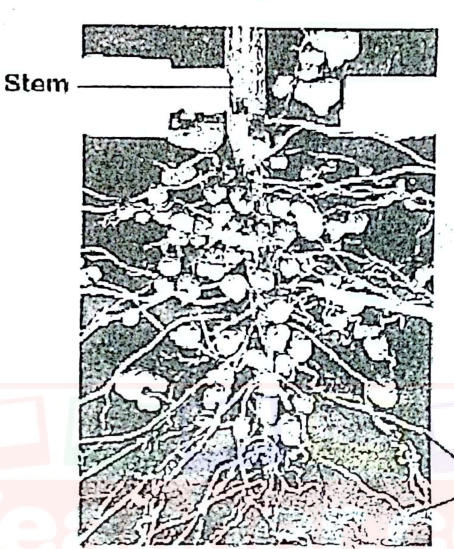
(a) (i) Name the feeding relationship illustrated in the photograph. (1 mark) (ii) Explain your answer in (a)(i). (2 marks)
(b) Give one example of a similar feeding relationship in animals. (1 mark)
14. The following diagram illustrates a flower obtained from a certain plant.
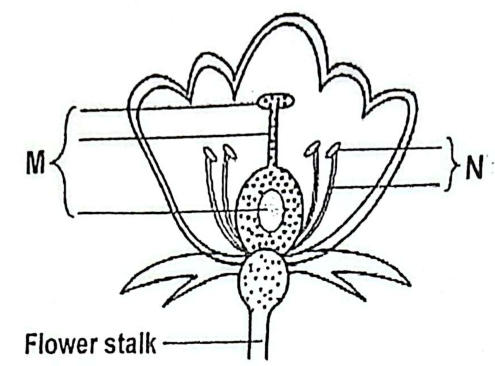
(a) State the collective name given to the floral parts labelled M and N. (3 marks)
(b) (i) Suggest the likely mode of pollination for the flower. (1½ marks) (ii) Give a reason for your answer in (b)(i). (1½ marks)
15. (a) Explain how low light intensity may bring about changes in the phenotype of some plants. (3 marks)
(b) Draw diagrams to illustrate the difference between a dicotyledonous and a monocotyledonous leaf. (1 mark)
16. The following diagram illustrates embryos of chicken, humans and fish at different stages of development.
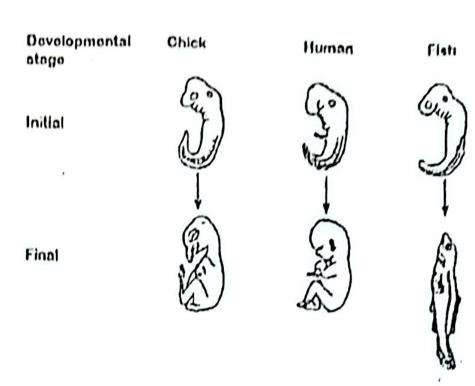
(a) Name the type of evidence of organic evolution illustrated. (1 mark)
(b) Explain why the tail has been retained throughout the evolution of fish but not in humans and chicken. (2 marks)
(c) State one other component likely to be common in the blood of the three organisms that implies they have a common origin. (1 mark)
17. The following diagram illustrates an organism belonging to a certain Class.
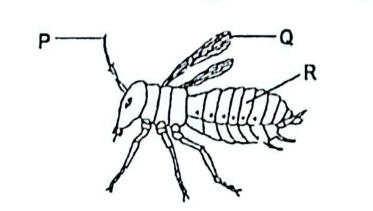
(a) State how the parts labelled P, Q and R contribute to the success of the organism. (3 marks)
(b) Account for the difference in the pattern of growth in a mouse and the organism illustrated. (2 marks)
18. (a) Explain how spilling of oil in a fish pond affects the flow of energy in the pond. (3 marks)
(b) The following organisms were found in a certain ecosystem: tilapia, insect larvae, green algae, eagle. Sketch a pyramid of numbers for the organisms in the ecosystem. (1 mark)
19. In an experiment, students placed soaked viable bean seeds in a vacuum flask containing wet cotton, then inserted a thermometer in the flask and left the set-up for 5 days in the laboratory.
(a) State two processes that the students were investigating in the experiment. (2 marks)
(b) State two observations that the students made after five days. (2 marks)
20. (a) Name the antigen and antibody present in the blood plasma of an individual with blood group A⁺. (2 marks)
(b) Suggest the possible recipient of the individual's blood. (1 mark)
21. (a) Name the physiological process that facilitates: (i) uptake of water from the soil through root hairs; (1 mark) (ii) reabsorption of sodium ions from the kidney tubules. (1 mark)
(b) Explain why grass withers when it is continually sprayed with salty water. (3 marks)
22. The following diagram illustrates a mammalian vertebra.
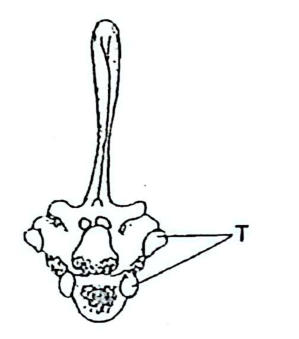
(a) Identify the type of vertebra illustrated. (1 mark)
(b) Name the bone that articulates with the vertebra at the parts labelled T. (1 mark)
(c) Using observable features, explain how the vertebra is adapted to its function. (2 marks)