443/2 · AGRICULTURE · Paper 2 · Nov. 2024 · 2 hours
Instructions: The paper has three sections, A, B and C. Answer all the questions in Sections A and B, and any two questions from Section C.
Section A (30 marks)
1. State four differences between Bactrian and Dromedary species of camels. (2 marks)
2. Give four signs of broodiness in chicken. (2 marks)
3. State four ways of controlling predators in a fish pond. (2 marks)
4. Give four reasons why bees swarm. (2 marks)
5. Give four reasons for placing newly born piglets in a creep area. (2 marks)
6. Give four reasons for hanging green vegetable leaves in a deep litter poultry house. (2 marks)
7. State four signs of heat in rabbits. (2 marks)
8. State four maintenance practices for a barbed wire fence. (2 marks)
9. Name four tick borne diseases of cattle. (2 marks)
10. Give four reasons why calves should be fed on colostrum after birth. (2 marks)
11. State four ways in which a farmer can generate power on the farm. (2 marks)
12. State four physical characteristics of merino sheep. (2 marks)
13. State four signs of mastitis that are detected using a strip cup. (2 marks)
14. State four advantages of a two-stroke engine. (2 marks)
15. Name two types of mowers. (2 marks)
Section B (20 marks)
Answer all the questions in this section.
16. The following photograph shows an animal infested with an external parasite.
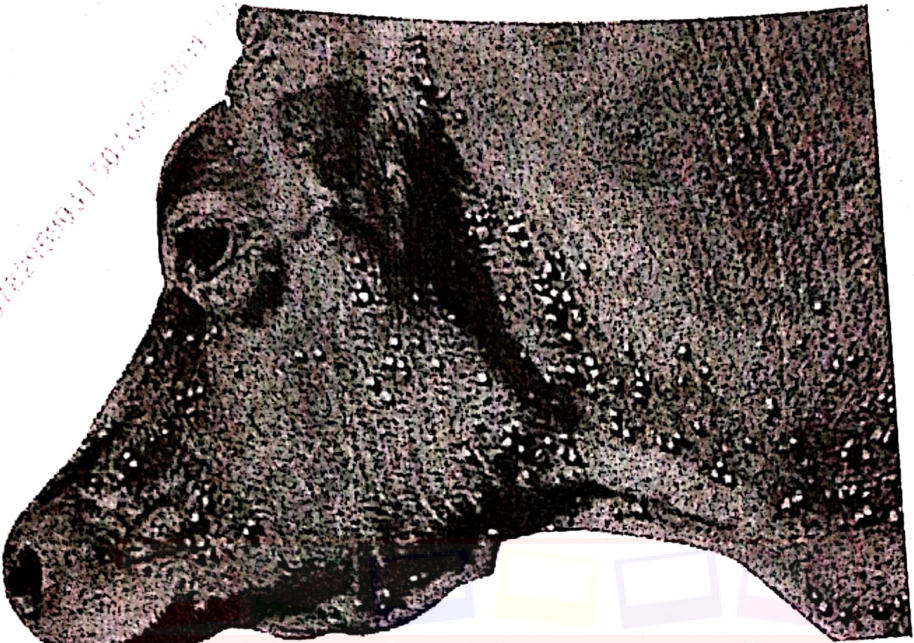
(a) Identify the parasite. (1 mark)
(b) State three effects of the parasite on livestock products. (3 marks)
(c) Give one effective way of getting rid of the parasites on the animal body. (1 mark)
17. The following diagram shows the digestive system of a type of livestock.
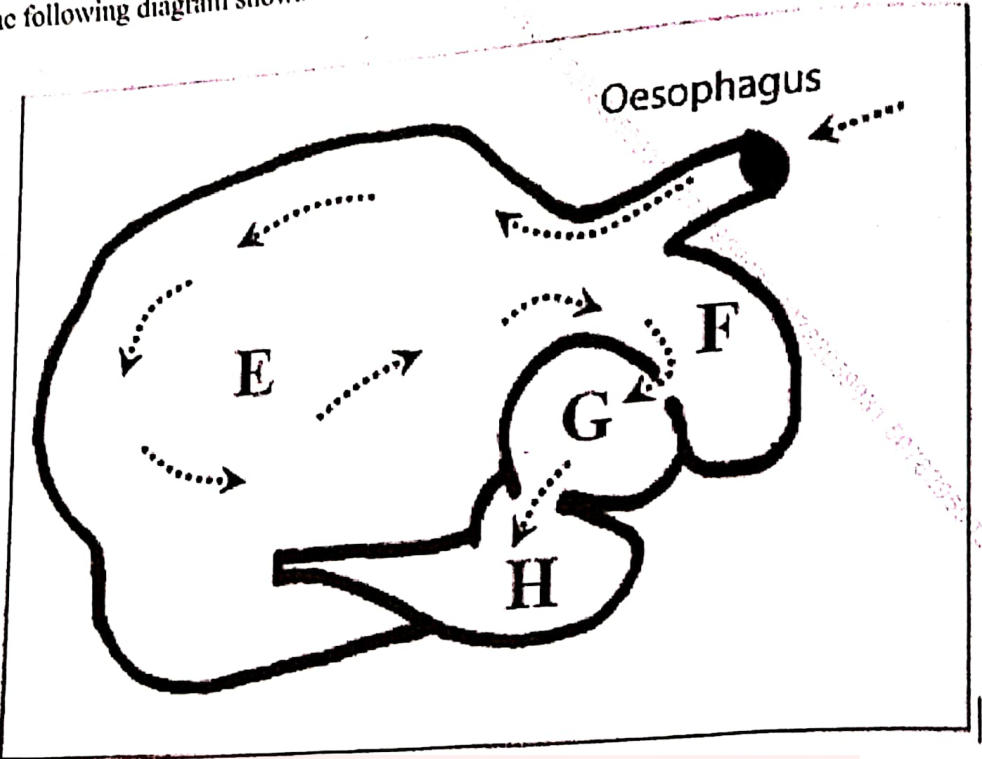
(a) (i) Identify the type of livestock. (1 mark)
(ii) Give a reason for the answer in (a)(i). (1 mark)
(b) State one function of the part labelled: E; H. (2 marks)
(c) Give one structural difference between the parts labelled F and G. (1 mark)
18. The following picture shows birds in a poultry house.
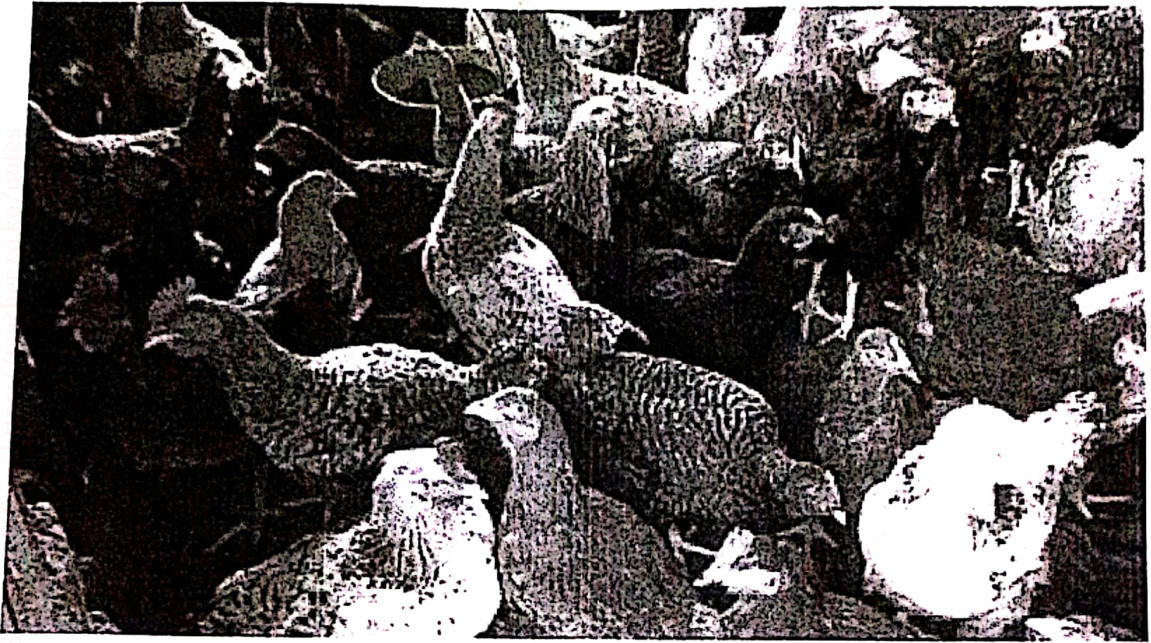
(a) Identify the poultry rearing system. (1 mark)
(b) The farmer observed that the birds were stressed.
(i) State two likely causes of the stress. (2 marks)
(ii) Explain two ways in which the farmer can control the stress. (2 marks)
19. The following diagrams show some farm equipment used in livestock rearing.
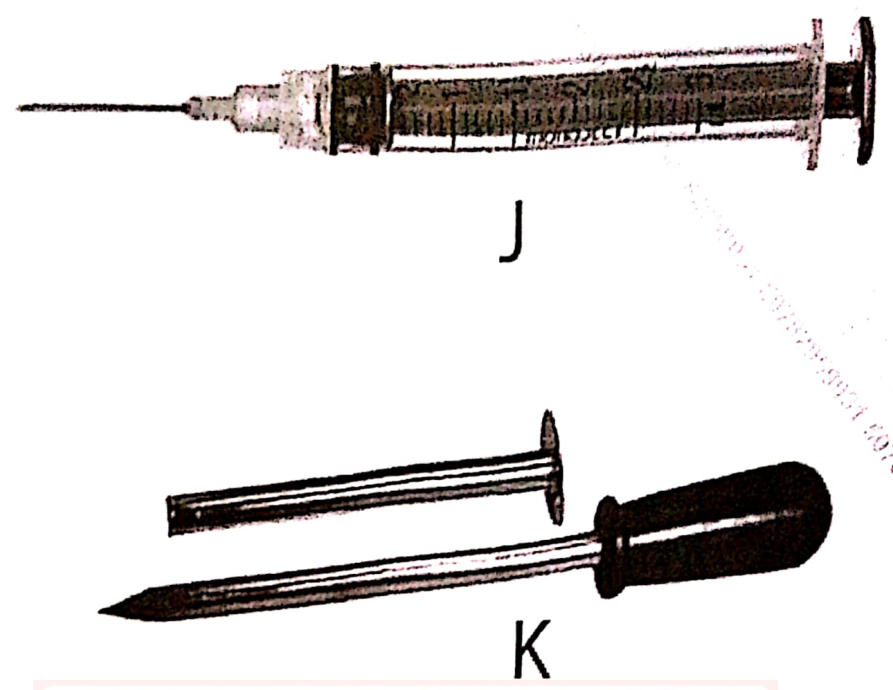
(a) Identify the equipment labelled: J; K. (2 marks)
(b) Give one function of the equipment labelled J. (1 mark)
(c) Name the condition that necessitates the use of the equipment labelled K in livestock rearing. (1 mark)
(d) State one maintenance practice for the equipment labelled K. (1 mark)
Section C (40 marks)
Answer any two questions from this section.
20. (a) A farmer wants to prepare 1000 kg of chick mash containing 20% DCP using maize grain (10% DCP) and fish meal (40% DCP). Using Pearson's square method, calculate the quantity of maize and fish meal the farmer requires. (5 marks)
(b) Describe five control measures of the intermediate host of liver flukes. (5 marks)
(c) Describe swine fever disease under the following sub-headings:
(i) causal organism; (1 mark)
(ii) symptoms of attack; (5 marks)
(iii) control measures. (4 marks)
21. (a) Explain how the milking process should be handled to ensure clean milk production on the farm. (10 marks)
(b) Give five reasons why Kenyan dairy farmers prefer embryo transplant in cattle breeding. (5 marks)
(c) Describe five ways of increasing digestibility in livestock nutrition. (5 marks)
22. (a) Describe the function of any five parts of a milking shed. (10 marks)
(b) (i) Describe how a calf is trained to drink milk from a bucket. (5 marks)
(ii) Give five advantages of artificial calf rearing. (5 marks)