312/1 · GEOGRAPHY · Paper 1 · Mar. 2022 (KCSE 2021) · 2¾ hours
Instructions: This paper consists of two sections, A and B. Answer all the questions in section A. Answer question 6 and any other two questions from section B.
Section A
1. (a) Apart from dew, name three other forms of precipitation. (3 marks)
(b) State two conditions necessary for the formation of dew. (2 marks)
2. The diagram below represents crustal rocks that have undergone the process of faulting. Use it to answer question 2(a).
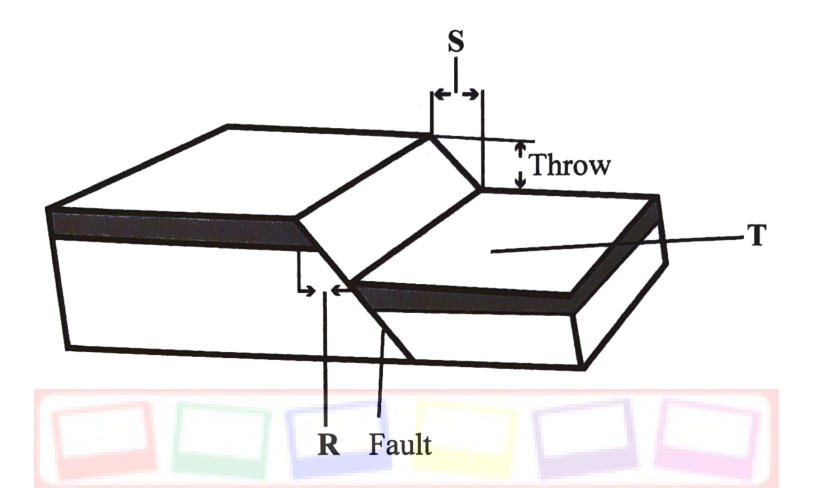
(a) Name the parts marked R, S and T. (3 marks)
(b) Give two processes by which rift valleys are formed. (2 marks)
3. (a) Name the two layers of discontinuity in the internal structure of the earth. (2 marks)
(b) Give three characteristics of the SIMA layer. (3 marks)
4. (a) What is an iceberg? (2 marks)
(b) List three erosional features found in glaciated lowlands. (3 marks)
5. (a) Identify two types of soil by texture. (2 marks)
(b) State three ways in which humus contributes to the quality of soil. (3 marks)
Section B
Answer question 6 and any other two questions from this section.
6. Study the map of Nyeri 1:50,000 (sheet 120/4) provided and answer the following questions.
The topographical map is supplied separately in the exam and is not on file here; question 6 needs the map.
(a) (i) Identify the two types of scales used in the map. (2 marks) (ii) Give the six-figure grid reference of the trigonometrical station 120T27 in the north-western part of the area covered by the map. (2 marks)
(b) (i) Measure the length of the all-weather road loose surface (E583) from Easting 57 to Easting 66. Give your answer in kilometres. (2 marks) (ii) Draw a rectangle 12 cm by 16 cm to represent the area enclosed by Eastings 64 and 67, and Northings 51 and 55. (1 mark) On it, mark and name: Nyeri hill forest; River Chania; trigonometrical station 120T19; Kagundu School. (4 marks)
(c) Describe the distribution of natural vegetation in the area covered by the map. (8 marks)
(d) Citing evidence from the map, identify three economic activities carried out in the area covered by the map. (6 marks)
7. (a) (i) Give three components of the solar system. (3 marks) (ii) State three weaknesses of the Passing Star theory. (3 marks)
(b) (i) What is the local time at Kinshasa 15°E when the local time at Malindi 40°E is 12.00 noon? (3 marks) (ii) Give two reasons why the earth has a spherical shape. (2 marks) (iii) State three effects of the revolution of the Earth around the Sun. (3 marks)
(c) (i) Apart from the core, list the other four main layers of the earth's structure. (4 marks) (ii) State three characteristics of the inner core of the earth. (3 marks) (iii) Explain why the interior of the earth is hot. (4 marks)
8. (a) (i) Name two saline lakes that are found in Kenya. (2 marks) (ii) Give four reasons why some lakes in the Rift Valley are saline. (4 marks)
(b) (i) Apart from cirque lakes, list two other lakes that are formed through glaciation. (2 marks) (ii) Describe the formation of a cirque lake. (5 marks)
(c) Explain four positive effects of lakes on human activities. (8 marks)
(d) Your class is planning to carry out a field study on economic uses of a nearby lake. (i) Give two reasons why they would require a route map. (2 marks) (ii) List two methods of data collection they are likely to use. (2 marks)
9. (a) (i) What is Karst scenery? (2 marks) (ii) Give four conditions necessary for the development of Karst scenery. (4 marks)
(b) The diagram below shows surface features in a limestone area.
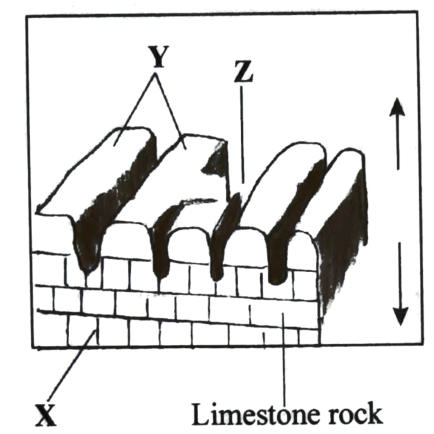
(i) Name the features marked X, Y and Z. (3 marks) (ii) Describe how the following Karst features are formed: I. stalagmite; (5 marks) II. polje. (5 marks)
(c) Explain three reasons why there are few settlements on Karst scenery. (6 marks)
10. (a) (i) Name the three major deserts in Africa. (3 marks) (ii) Give two reasons why wind action is distinct in hot deserts. (2 marks)
(b) Describe the processes through which wind transports its load. (6 marks)
(c) Describe how the following desert features are formed: I. oasis; (4 marks) II. wadi. (4 marks)
(d) Explain the significance of desert features to human activities. (6 marks)