233/2 · CHEMISTRY (Theory) · Paper 2 · Dec. 2022 · 2 hours
Instructions: Answer all the questions in the spaces provided. Non-programmable silent electronic calculators and KNEC mathematical tables may be used. All working must be clearly shown where necessary.
1. (a) Aluminium and phosphorus form oxides with general formula M₂O₃. Complete Table 1 by writing the properties of the oxides. (3 marks)
| Property | Al₂O₃ | P₂O₃ |
|---|---|---|
| Structure | ||
| Bonding | ||
| Acid/base character |
(b) The grid in Figure 1 shows part of the Periodic Table. Use it to answer the questions that follow.

(i) Give the total number of elements that can be placed in: I. period 1; (½ mark) II. period 5. (½ mark)
(ii) Place each of the following elements in the grid: I. element X, whose atomic number is 14; II. element Y, with the highest first ionisation energy; III. element Z, with the lowest first ionisation energy; IV. element L, whose ion L²⁻ has electron arrangement 2.8; V. element D, whose ion D⁴⁻ has electron arrangement 2.8.8; VI. element Q, a halogen with the highest atomic radius; VII. element R, a period 3 element that exists as a monoatomic gas. (7 marks)
2. The general formula of alkanols is .
(a) Draw the structure and give the name of the alkanol with . (2 marks)
(b) Table 2 gives the boiling points of some alkanols.
| 2 | 3 | 4 | |
|---|---|---|---|
| Boiling point (°C) | 78.5 | 97.2 | 117.0 |
(i) On the grid provided, draw the graph of boiling point against number of carbon atoms, . (3 marks)
(ii) From the graph, determine the boiling point of the alkanol with . (1 mark)
(iii) The boiling point of the alkanol with is much higher than that of butane. Explain. (C = 12.0; H = 1.0; O = 16.0) (2 marks)
(c) Alkanols are used as fuel.
(i) Give another use of alkanols. (1 mark)
(ii) Write an equation for the combustion of the alkanol with . (1 mark)
(iii) Use the bond energies in Table 3 to calculate the enthalpy change of combustion of the alkanol with . (3 marks)
| Bond | C–C | C–H | C–O | O–H | O=O | C=O |
|---|---|---|---|---|---|---|
| Energy (kJ/mol) | 348 | 412 | 360 | 463 | 496 | 743 |
3. (a) Use the following cell notation to answer the questions that follow:
(i) State what the symbol / represents. (1 mark)
(ii) Write the equation for the cell reaction. (1 mark)
(iii) Given that the value for Pb²⁺(aq)/Pb(s) is −0.13 V, calculate the value for Al³⁺(aq)/Al(s). (2 marks)
(iv) State one use of electrochemical cells. (1 mark)
(b) Figure 2 shows a cell used to electrolyse water.
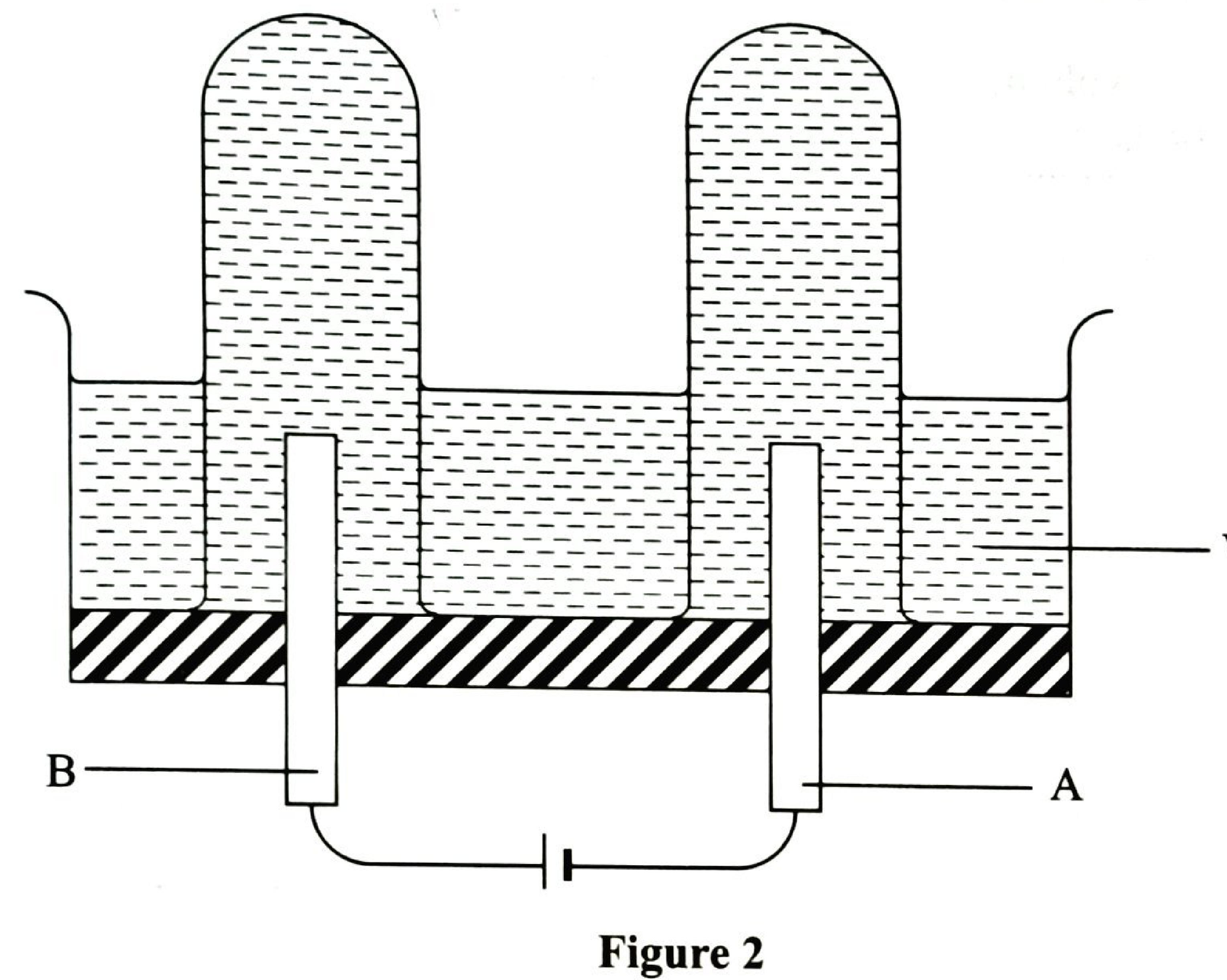
(i) State why it is necessary to add dilute sulphuric(VI) acid to the water. (1 mark)
(ii) State the electrode at which oxygen is produced and give a reason. (1 mark)
(iii) Write an equation for the formation of oxygen. (1 mark)
(iv) After electrolysing the water for 88 seconds, the volume of oxygen gas collected was 21.0 cm³. Determine the: I. volume of hydrogen gas collected; (1 mark) II. amount of current used. (1 Faraday = 96 500 C; molar gas volume = 24 000 cm³) (3 marks)
4. (a) State and explain how a catalyst affects: (i) the rate of a reaction; (2 marks) (ii) the yield of the products. (1 mark)
(b) Rates of reactions are measured using various methods. In the decomposition of hydrogen peroxide, the rate is measured by recording the volume of oxygen gas produced with time. Other than measuring the volume of gas produced, describe a method that can be used to measure the rates of each of the following reactions:
(i) sodium thiosulphate with hydrochloric acid: ; (2 marks)
(ii) acidified potassium manganate(VII) with iron(II) sulphate: . (1 mark)
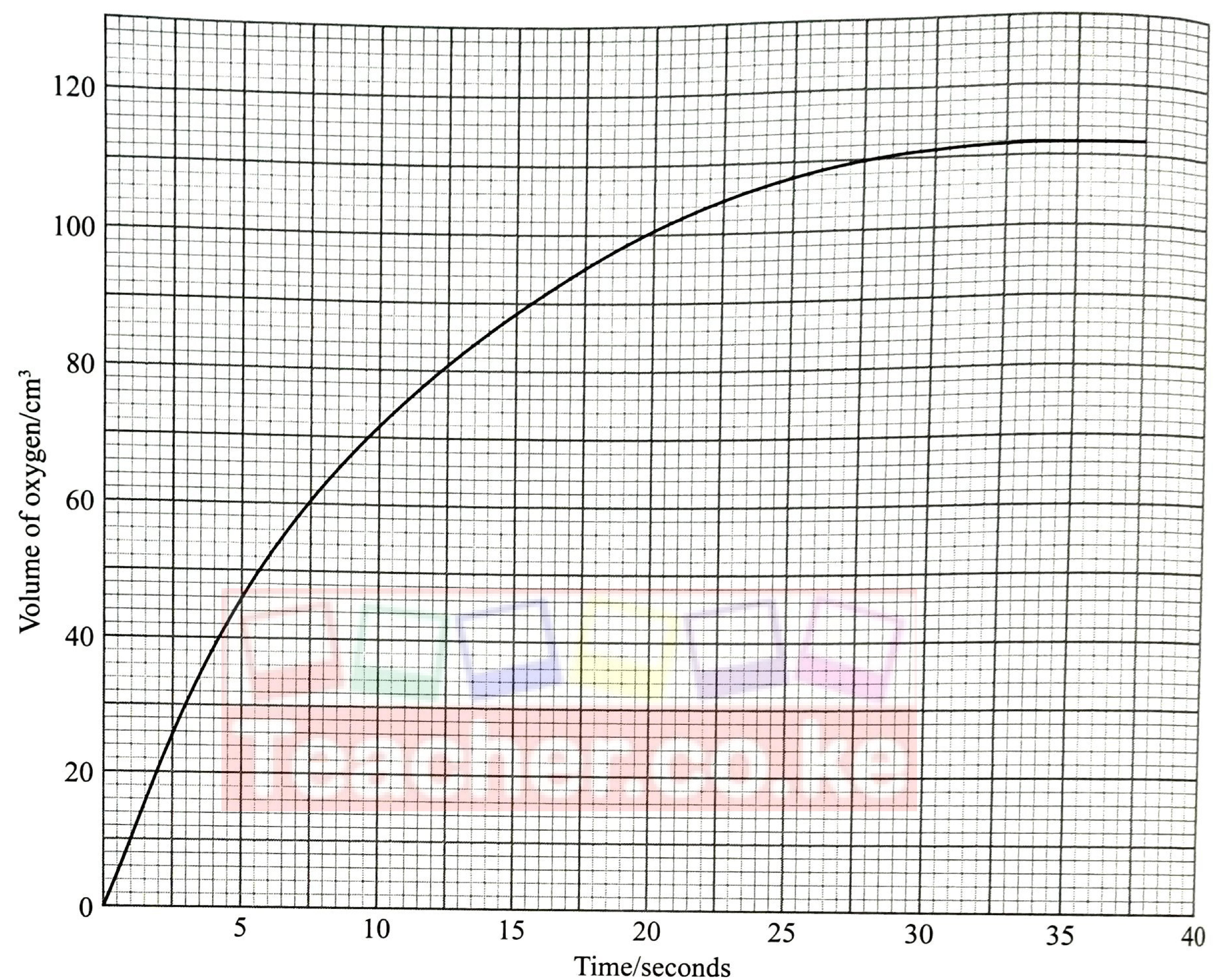
(c) In an experiment, the rate of decomposition of 50 cm³ of hydrogen peroxide in the presence of manganese(IV) oxide was measured. Figure 3 shows a graph of the results obtained.
(i) Write an equation for the reaction. (1 mark)
(ii) Using the graph, determine the maximum number of moles of oxygen produced. (Molar gas volume at room temperature and pressure = 24 dm³) (2 marks)
(iii) Calculate the concentration in moles per litre of the hydrogen peroxide. (2 marks)
(iv) Determine the rate of decomposition at the 18th second. (1 mark)
(v) State and explain one factor that would increase the rate of decomposition of 50 cm³ of the hydrogen peroxide. (1 mark)
5. (a) Explain how concentrated sulphuric(VI) acid can be prepared from sulphur(VI) oxide gas and distilled water. (2 marks)
(b) Concentrated sulphuric(VI) acid acts as a dehydrating and a drying agent.
(i) Give an example of a gas that can be dried using concentrated sulphuric(VI) acid. (1 mark)
(ii) Complete the following equations to show how concentrated sulphuric(VI) acid acts as a dehydrating agent: I. (1 mark) II. (1 mark)
(iii) State the observations made when concentrated sulphuric(VI) acid dehydrates: I. C₁₂H₂₂O₁₁; (1 mark) II. CoCl₂·6H₂O. (1 mark)
(c) State the properties of concentrated sulphuric(VI) acid which are illustrated by the following reactions:
(i) (1 mark)
(ii) (1 mark)
(d) When a mixture of 5 cm³ ethanol, 1 cm³ concentrated sulphuric(VI) acid and 5 cm³ ethanoic acid was heated in a beaker, a pleasant-smelling compound was formed. (i) State the role of the concentrated sulphuric(VI) acid. (1 mark) (ii) Write the formula of the pleasant-smelling compound. (1 mark)
6. Various types of cells are used to electrolyse concentrated sodium chloride. One of them is the mercury cell.
(a) Name another type of cell used. (1 mark)
(b) The mercury cell uses titanium or graphite as anode and mercury as cathode. State why steel is not used for the anode. (1 mark)
(c) At the anode, chloride ions and not hydroxide ions are oxidised. Give a reason. (1 mark)
(d) Describe, using equations, how sodium hydroxide and hydrogen are produced in the cell. (3 marks)
(e) Give two reasons why it is necessary to recycle the mercury used in the cell. (2 marks)
(f) The products of electrolysis of concentrated sodium chloride find extensive use in industries. State the role of chlorine and sodium hydroxide in the paper industry: (i) chlorine; (1 mark) (ii) sodium hydroxide. (1 mark)
7. (a) (i) Give the formulae of two ionic compounds that can be used to prepare lead(II) sulphide salt. (1 mark)
(ii) Two moles of aqueous ammonia reacted with one mole of phosphoric(V) acid. Write an equation for the reaction that took place. (1 mark)
(b) Solid copper(II) sulphate is available either as an anhydrous or a hydrated salt. Figure 4 shows enthalpy changes involved when water is added to each solid.
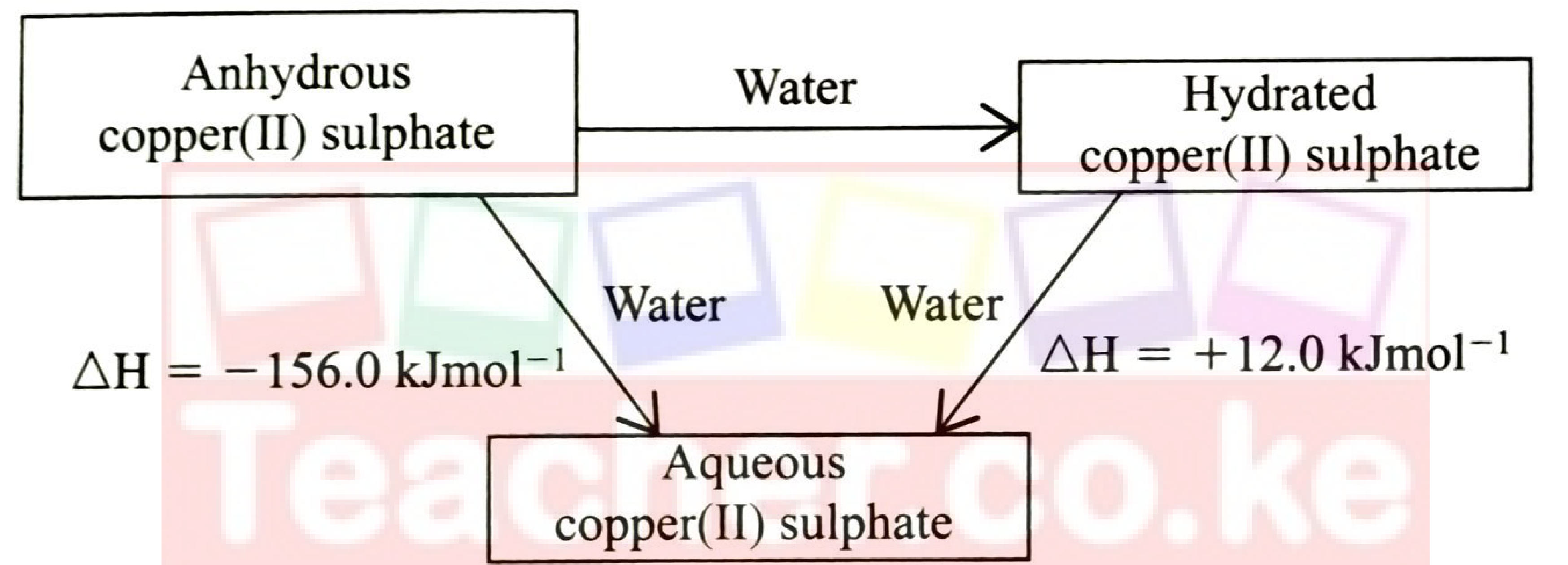
(i) Calculate the enthalpy change for the process . (1 mark)
(ii) Describe how each of the following can be prepared starting with aqueous copper(II) sulphate: I. hydrated copper(II) sulphate; (2 marks) II. anhydrous copper(II) sulphate. (1 mark)
(c) Aluminium hydroxide is used as an antacid.
(i) Name another compound that is used as an antacid. (1 mark)
(ii) The concentration of hydrochloric acid in the stomach is 0.01 M. If an antacid containing aluminium hydroxide is used, calculate the mass of the antacid required to neutralise 100.0 cm³ of the stomach acid. (Al = 27.0; O = 16.0; H = 1.0) (3 marks)