233/2 · CHEMISTRY (Theory) · Paper 2 · Nov. 2023 · 2 hours
Instructions: Answer all the questions in the spaces provided. Non-programmable silent electronic calculators and KNEC mathematical tables may be used. All working must be clearly shown where necessary.
1. Table 1 gives some properties of the elements in period 3 of the periodic table.
| Element | Na | Mg | Al | Si | P | S | Cl | Ar |
|---|---|---|---|---|---|---|---|---|
| Atomic number | 11 | 12 | 13 | 14 | 15 | 16 | 17 | 18 |
| Atomic radius (nm) | 0.186 | 0.160 | 0.143 | 0.117 | 0.110 | 0.104 | 0.099 | 0.097 |
(a) Give the formula and name of the compound formed by the reaction between Al and S. Formula (1 mark); Name (1 mark)
(b) Explain the variations in the atomic radius of the elements across the period. (2 marks)
(c) Select the element with the highest ionisation energy. Give a reason. (2 marks)
(d) Write the electron arrangement of phosphorus in PCl₃. (1 mark)
(e) Select an element that forms an ion with the smallest ionic radius. Give a reason. (2 marks)
(f) Table 2 gives the melting points (°C) of some of the elements.
| Element | Na | Mg | Cl | Ar |
|---|---|---|---|---|
| Melting point (°C) | 98 | 650 | −101 | −189 |
Explain, in terms of structure and bonding, the differences in the melting points of: (i) Na and Mg; (2 marks) (ii) Cl and Ar. (2 marks)
2. (a) Complete the following equation: (1 mark)
(b) Pent-1-yne, , reacts with bromine to form compounds B and C as shown in Figure 1.

Draw the structures of compounds B (1 mark) and C. (1 mark)
(c) Study the flow chart in Figure 2 and answer the questions that follow.
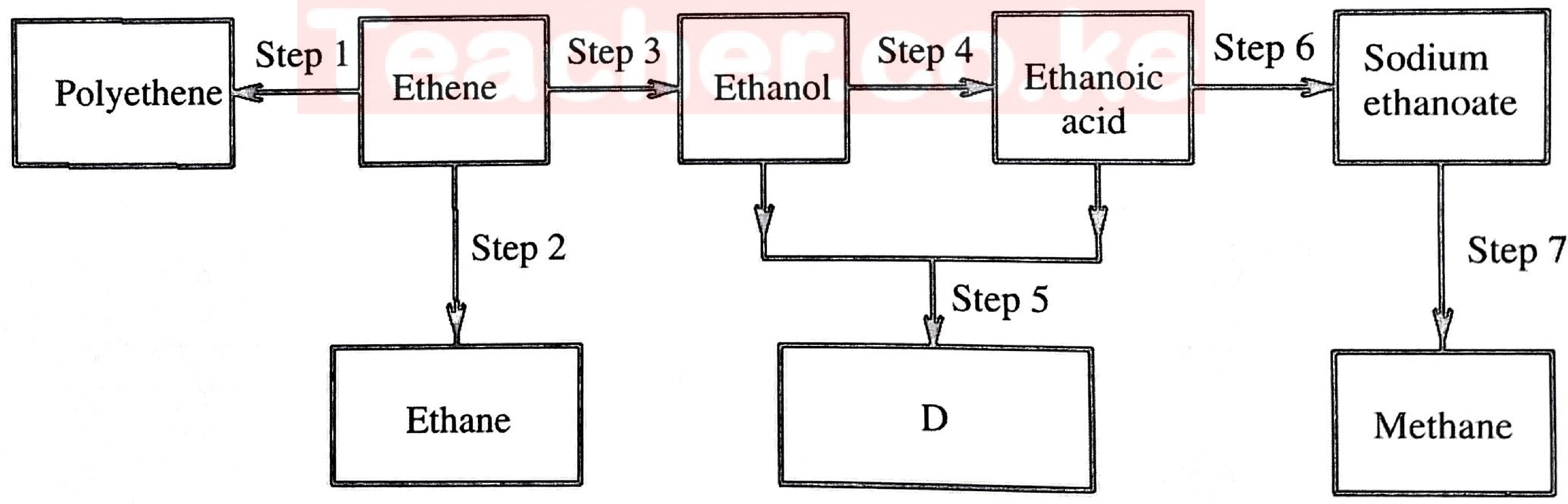
(i) Give the reagents and conditions used in: I. Step 2; (1 mark) II. Step 7. (1 mark)
(ii) Write an equation for the reaction that takes place in: I. Step 1; (1 mark) II. Step 3. (1 mark)
(iii) Name the type of reaction that takes place in: I. Step 4; (1 mark) II. Step 2. (1 mark)
(iv) I. Draw the structure of organic compound D. (1 mark) II. Give the name of compound D. (1 mark)
3. (a) Explain how an increase in temperature affects the rate of a chemical reaction. (2 marks)
(b) Consider the following gaseous reaction:
Explain how an increase in pressure affects the rate of this reaction. (2 marks)
(c) At high temperatures, NO₂ and CO gases react as shown in the following equation:
The reaction was monitored by measuring the changes in the concentration of NO(g) with time. Table 3 shows the data obtained.
| Time (s) | 0 | 50 | 100 | 150 | 200 | 250 | 300 |
|---|---|---|---|---|---|---|---|
| Concentration of NO × 10³ (mol per litre) | 0 | 16 | 22 | 26 | 29 | 31 | 32 |
(i) Plot on the grid provided a graph of concentration of NO (vertical axis) against time. (3 marks)
(ii) Use the graph to determine the rate of the reaction: I. in the time interval 25 seconds and 75 seconds; (2 marks) II. at the 175th second. (2 marks)
(iii) Give a reason why the rate of the reaction decreases with time. (1 mark)
4. (a) Figure 3 shows how the temperature of lead changes as it is heated.
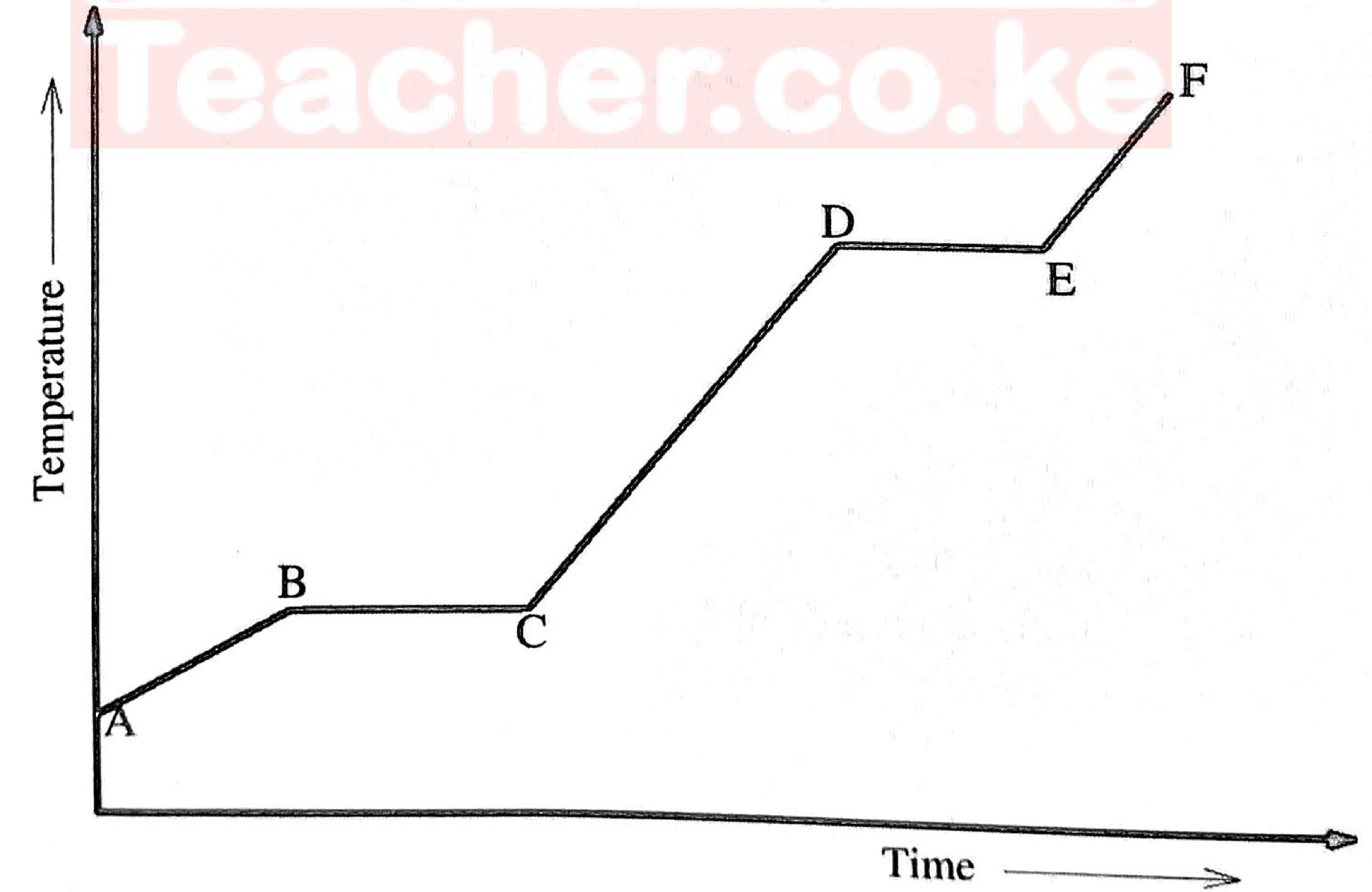
(i) Label on the diagram the states present in the regions: I. CD; (1 mark) II. EF. (1 mark)
(ii) Explain why the temperature remains constant in regions: I. BC; (1 mark) II. DE. (1 mark)
(b) Figure 4 shows an energy cycle diagram for processes involving potassium bromide.
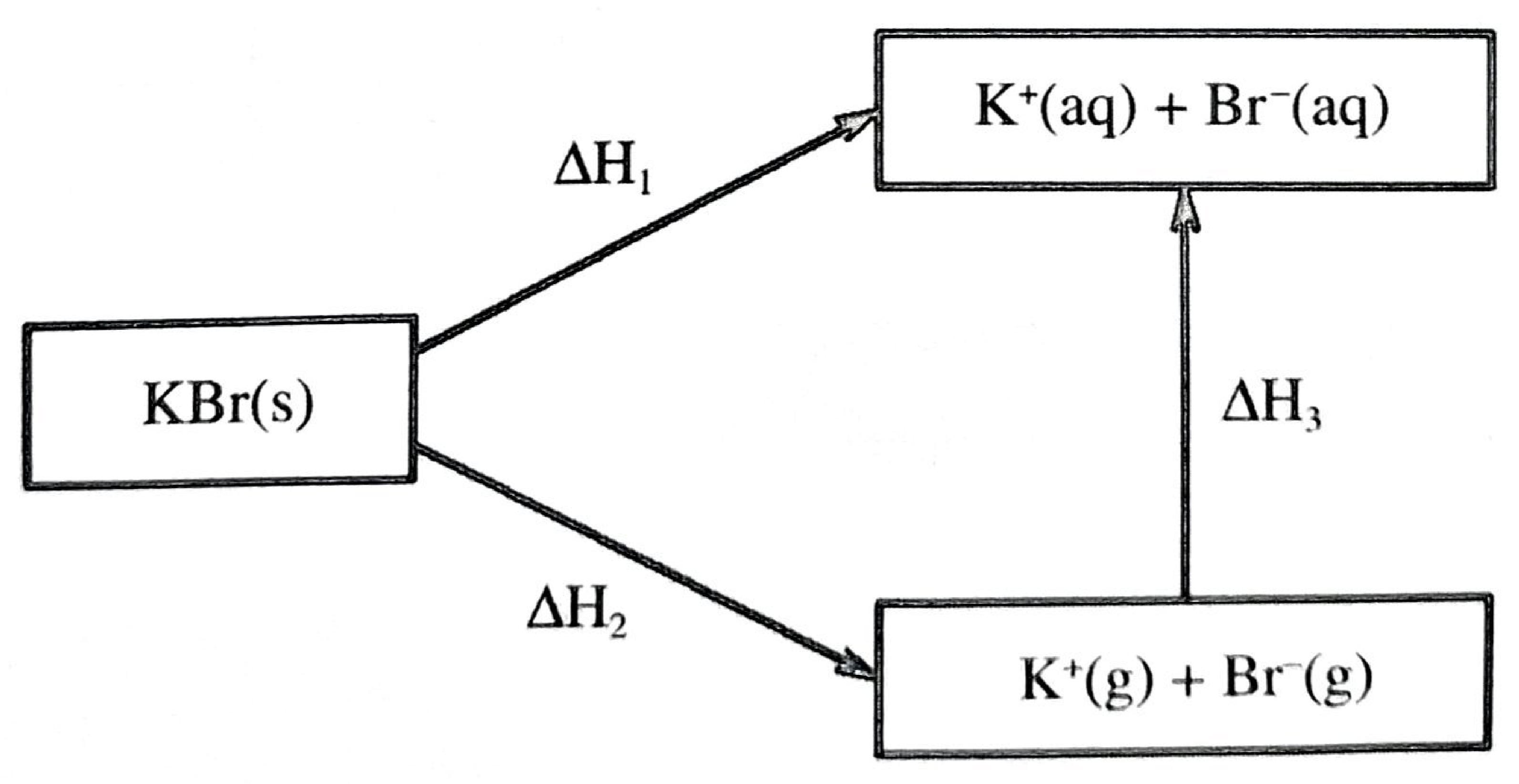
(i) Name the following enthalpy changes: I. ΔH₁; (1 mark) II. ΔH₂; (1 mark) III. ΔH₄ [sic — ΔH₃]. (1 mark)
(ii) Write an expression showing how ΔH₃ can be obtained from ΔH₁ and ΔH₂. (1 mark)
(c) Using the thermochemical data given in Table 4, calculate the enthalpy change for the reaction . (2 marks)
| Process | ΔH (kJ mol⁻¹) |
|---|---|
| 590 | |
| −1111 | |
| 158 |
5. (a) Use the standard electrode potentials in Table 5 to answer this question.
| Number | Electrode reaction | E° (V) |
|---|---|---|
| I | 0.00 | |
| II | −0.76 | |
| III | −0.14 | |
| IV | +0.34 | |
| V | −0.44 | |
| VI | −0.13 | |
| VII | +0.52 | |
| VIII | +0.80 |
(i) Select two electrodes which when connected give the cell with the lowest e.m.f. (1 mark)
(ii) Arrange the metals Ag, Fe and Sn in order of their reactivity with dilute hydrochloric acid, starting with the most reactive. Give a reason. (2 marks)
(iii) An electrochemical cell is made up of electrode numbers IV and VII. I. Calculate the e.m.f. of the cell. (1 mark) II. Write an equation for the cell reaction. (1 mark)
(iv) Draw a labelled diagram of an electrochemical cell that is used to measure the standard electrode potential for tin (Sn), electrode number III. (3 marks)
(b) The products of electrolysis of sodium chloride depend on the conditions used. Give the products obtained under each set of conditions in Table 6. (2 marks)
| Conditions | Product at anode | Product at cathode |
|---|---|---|
| Dilute aqueous sodium chloride | ||
| Concentrated aqueous sodium chloride |
(c) Aqueous chromium(III) sulphate was electrolysed using inert electrodes. The equation for the reaction is . Calculate the time in seconds required to deposit 2.6 g chromium using a current of 5.5 amperes. (1 Faraday = 96 500 coulombs; Cr = 52.0) (2 marks)
6. (a) (i) State Charles' law of gases. (1 mark)
(ii) Table 7 shows the data obtained in an experiment using 0.012 moles of neon gas.
| Temperature (K) | Volume (dm³) | Pressure (atm) |
|---|---|---|
| 250 | 0.005 | 50 |
| 300 | 0.006 | 50 |
Show that the data is consistent with Charles' law. (2 marks)
(b) (i) State Graham's law of diffusion of gases. (1 mark)
(ii) Given that 1 mole of a gas occupies a volume of 24.0 dm³ at 298 K, calculate the density in grams per litre of: I. oxygen gas (O = 16); (1 mark) II. hydrogen gas (H = 1.0). (1 mark)
(iii) Determine the rate of diffusion of hydrogen gas compared to that of oxygen gas at 298 K. (2 marks)
(c) Ammonia gas was prepared in the laboratory by warming a mixture of solid ammonium chloride and solid calcium hydroxide. The equation for the reaction is:
The gas was dried and then collected. The volume of ammonia collected was 1340 cm³ measured at 312 K and 1 atmosphere pressure. (N = 14.0; Cl = 35.5; H = 1.0; volume of one mole of gas at 298 K = 24 dm³)
(i) Calculate the volume that ammonia gas will occupy at 298 K and 1 atmosphere pressure. (2 marks)
(ii) Determine the mass of ammonium chloride that reacted. (2 marks)
7. (a) Give the names of the processes represented by the following equations:
(i) (1 mark)
(ii) (1 mark)
(b) Sodium carbonate is manufactured through a series of reactions involving sodium chloride, ammonia and carbon(IV) oxide.
(i) Ammonia is obtained by reacting hydrogen and nitrogen in the Haber process. State how the other two materials are obtained: I. sodium chloride; (1 mark) II. carbon(IV) oxide. (1 mark)
(ii) Concentrated sodium chloride solution saturated with ammonia is passed into a carbonation tower in which carbon(IV) oxide is bubbled through. Reactions in the tower involve formation of ammonium hydrogen carbonate, which then reacts with sodium chloride to form sodium hydrogen carbonate. Write the equations for the formation of: I. ammonium hydrogen carbonate; (1 mark) II. sodium hydrogen carbonate. (1 mark)
(iii) Describe how the: I. sodium hydrogen carbonate is separated; (1 mark) II. sodium hydrogen carbonate is converted to sodium carbonate. (1 mark)
(iv) One of the uses of sodium carbonate is in the removal of water hardness. I. Explain how sodium carbonate removes water hardness. (1 mark) II. State one other industrial use of sodium carbonate. (1 mark)