233/1 · CHEMISTRY · Paper 1 (Theory) · Nov. 2024 · 2 hours
Instructions: Answer all the questions in the spaces provided. Non-programmable silent electronic calculators and KNEC mathematical tables may be used. All working must be clearly shown where necessary.
1. Name the apparatus that can be used to:
(a) measure volume of solutions more accurately than a measuring cylinder; (1 mark)
(b) lower a burning piece of magnesium ribbon into a gas jar; (1 mark)
(c) store and keep substances free from moisture. (1 mark)
2. A radioactive isotope decays by either emission of alpha (α) or beta (β) particles.
(a) Explain why alpha particles have a higher ionising power compared to beta particles. (1 mark)
(b) Explain how alpha and beta particles can be distinguished in terms of their penetrating powers. (1 mark)
3. Three bottles containing zinc nitrate, aluminium nitrate or lead(II) nitrate have their labels missing. Describe a chemical test that can be carried out using aqueous sodium sulphate and aqueous ammonia to label the bottles correctly. (3 marks)
4. Consider the following equilibrium reaction for a mixture of gases in a gas syringe.
(NO₂ is brown; N₂O₄ is yellow.)
(a) Give a reason why the enthalpy change is negative (exothermic reaction). (1 mark)
(b) State and explain the observations made when the pressure in the syringe is increased.
Observation (1 mark)
Explanation (1 mark)
5. Ammonia gas can be prepared using ammonium sulphate and sodium hydroxide.
(a) Write an equation for the reaction. (1 mark)
(b) Draw a labelled diagram of a set-up of the apparatus that can be used to prepare and collect a sample of dry ammonia. (2 marks)
6. Some properties of four metals and their oxides are shown in Table 1.
| Metal | Reaction with water | Colour of oxide |
|---|---|---|
| A | Reacts slowly with steam | Green |
| B | Reacts rapidly with steam | Brown |
| C | Reacts rapidly with cold water | White |
| D | Does not react | Black |
(a) Arrange the metals in order of their reactivity starting with the most reactive. (1 mark)
(b) State the observation that would be made when metal B is heated with:
(i) oxide of D; (1 mark)
(ii) oxide of C. (1 mark)
7. In an experiment to determine the water of crystallization in sodium carbonate, Na₂CO₃·XH₂O, the data in Table 2 was obtained:
| Mass (g) | |
|---|---|
| Mass of crucible | 57.20 |
| Mass of crucible + salt before heating | 78.60 |
| Mass of crucible + salt after heating | 67.00 |
Calculate the:
(a) mass of dry salt after heating; (½ mark)
(b) mass of water; (½ mark)
(c) value of X. (2 marks)
8. A polymer was formed using compound M which has the following structure.
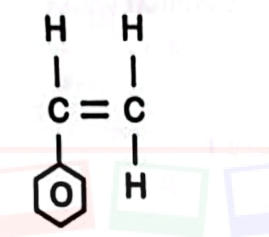
(a) Name compound M. (1 mark)
(b) Draw a section of the polymer showing three repeat units. (1 mark)
(c) Give one advantage of using this polymer over a natural polymer. (1 mark)
9. Figure 1 shows a set-up that was used to investigate the products of a burning candle.
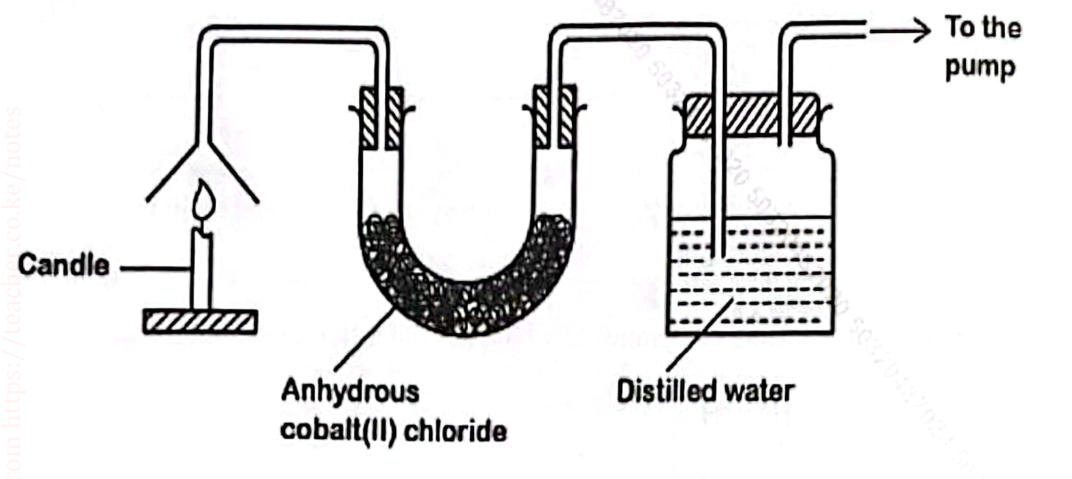
(a) State and explain:
(i) the observations made in the U-tube; (1 mark)
(ii) how the pH of distilled water changes with time. (1 mark)
(b) State the role of the pump. (1 mark)
10. In an experiment to determine the molar heat of neutralisation, 100 cm³ of 1.0 M sodium hydroxide was added to 100 cm³ of 1.0 M hydrochloric acid. The data obtained is shown in Table 3.
| Temperature (°C) | |
|---|---|
| Initial temperature of hydrochloric acid | 20.4 |
| Maximum temperature of the mixture | 26.5 |
(a) Calculate the:
(i) heat change; (1 mark)
(ii) molar heat of neutralisation of hydrochloric acid. (1 mark)
(Specific heat capacity of the solution = 4.2 J g⁻¹ deg⁻¹; density of the solution = 1.0 g cm⁻³)
(b) The molar heat of neutralisation obtained in 10(a)(ii) differs from that obtained using aqueous ammonia and hydrochloric acid. Explain. (1 mark)
11. Iron is extracted from its ore in a blast furnace. The raw materials used are: iron ore, coke, air and limestone.
(a) State the role of each of the following in the extraction process.
(i) Limestone. (1 mark)
(ii) Coke. (1 mark)
(b) State and explain why the iron obtained is not suitable for making bridges. (1 mark)
12. Table 4 shows some properties of three substances. Complete the table by filling in the types of forces and structures in each substance. (3 marks)
| Substance | Melting point (°C) | Boiling point (°C) | Conductivity (solid) | Conductivity (molten) | Type of forces | Structure |
|---|---|---|---|---|---|---|
| X | −101 | −35 | Poor | Poor | ||
| Y | 650 | 1110 | Good | Good | ||
| Z | 714 | 1142 | Poor | Good |
13. Describe how the presence of sulphite ions in aqueous sodium sulphite can be confirmed using:
(a) aqueous barium nitrate and dilute nitric(V) acid; (2 marks)
(b) acidified potassium dichromate(VI). (1 mark)
14. Use the bond energies in Table 5 to calculate the enthalpy change for the combustion of ethene. (4 marks)
| Bond | C=C | O=O | C–H | C=O | O–H |
|---|---|---|---|---|---|
| Bond energy (kJ mol⁻¹) | 612 | 412 | 496 | 743 | 463 |
(As printed. The usual values are O=O 496 and C–H 412; the marking scheme uses the table as printed and the answer is the same either way.)
15. Hydrogen gas can be prepared by electrolysis of acidified water.
(a) Explain why the water is acidified before electrolysis. (1 mark)
(b) Calculate the volume of hydrogen gas produced when a current of 12 amperes is used for 2 hours. (Faraday = 96 500 coulombs; volume of 1 mole of gas = 24 000 cm³) (2 marks)
16. Ethanol can be prepared from glucose (C₆H₁₂O₆) according to the following equation:
(a) Explain why temperatures of more than 30 °C are not used. (1 mark)
(b) The concentration of ethanol in the product is about 12%. State how the concentration of ethanol in the product can be increased. (1 mark)
(c) State one use of ethanol in hospitals. (1 mark)
17. The following steps are followed when carrying out paper chromatography of a dye.
- The solvent is placed in a beaker.
- A baseline is drawn with a pencil on the paper.
- The sample is spotted on the baseline.
- The paper is carefully placed in the beaker with the baseline above the surface of the solvent.
- The beaker is covered and allowed to stand for some time.
Give a reason for the following:
(a) the baseline is drawn with a pencil; (1 mark)
(b) the paper is carefully placed in the beaker with the baseline above the surface of the solvent; (1 mark)
(c) the beaker is covered. (1 mark)
18. 6.12 g of hydrogen peroxide were dissolved in 100 cm³ of water. The peroxide was allowed to decompose in the presence of a catalyst and oxygen gas produced collected.
(a) Name a suitable catalyst for the reaction. (1 mark)
(b) Calculate the:
(i) number of moles of hydrogen peroxide in the solution (H = 1.0; O = 16.0); (1 mark)
(ii) volume of oxygen gas produced (volume of 1 mole of gas = 24 000 cm³). (1 mark)
19. Describe how a sample of ammonium nitrate can be prepared starting with ammonia as the only nitrogen containing compound. (3 marks)
20. The set-up in Figure 2 is used to prepare carbon(II) oxide from ethanedioic acid. The equation for the reaction is:
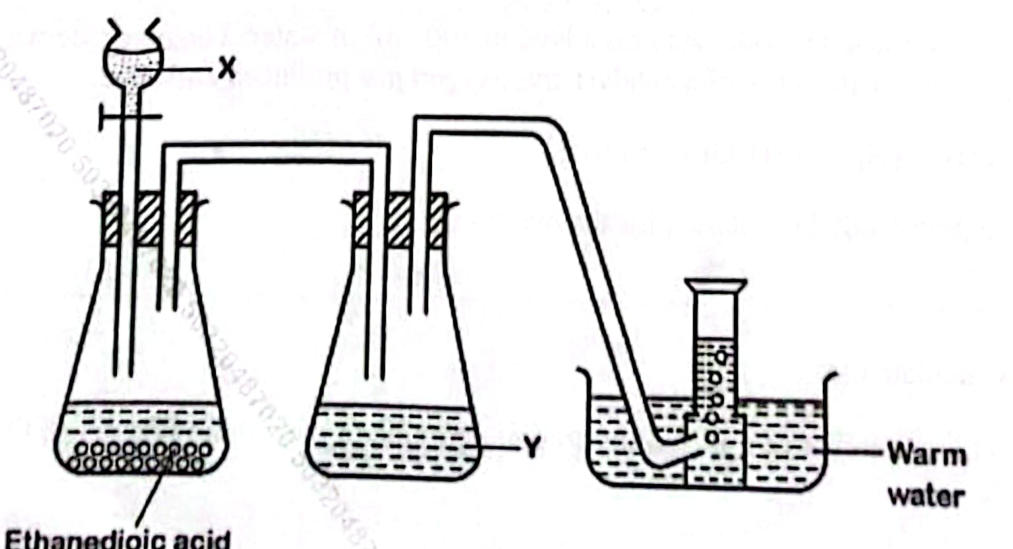
(a) Identify X and Y and give the role of each. (2 marks)
(i) X: … Role …
(ii) Y: … Role …
(b) State a property of the gas that allows it to be collected as shown. (1 mark)
21. 2.0 g of hydrogen gas was reacted with 2.0 g of oxygen gas to form water. (H = 1.0; O = 16.0). Calculate the:
(a) mass of water produced; (2 marks)
(b) mass of unreacted gas. (1 mark)
22. Activation energy is the energy required to initiate a reaction.
(a) Explain why reactions differ in their activation energies. (1 mark)
(b) Figure 3 shows energy against progress of reaction carried out in the presence of a catalyst.
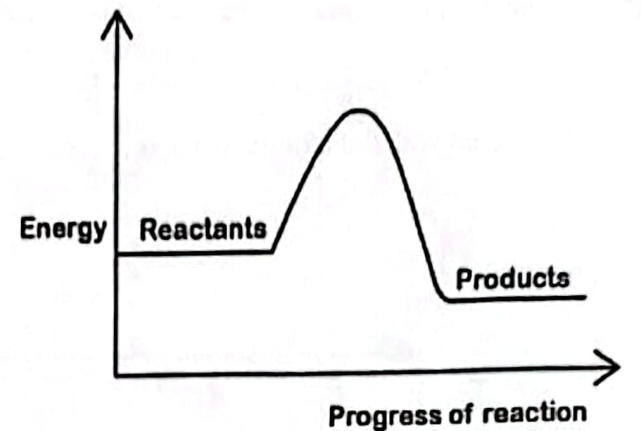
(i) Sketch on the same axis the curve obtained if the reaction was carried out without a catalyst. Give a reason. (2 marks)
23. (a) Complete Table 6 by filling in the missing information for phosphorus and iron. (2 marks)
| Ions | Number of electrons | Number of protons | Number of neutrons |
|---|---|---|---|
| ³¹₁₅P³⁻ | |||
| ⁵⁶Fe²⁺ | 30 | ||
| ˣᵧOⁿ | 10 | 8 | 9 |
(b) Determine the value of x, y and n in ˣᵧOⁿ. (1 mark)
24. (a) Using oxidation numbers, identify the oxidising and reducing agents in the following reaction and give a reason. (2 marks)
(b) Write an ionic equation for the following reaction. (1 mark)
25. The flow chart in Figure 4 shows some reactions.
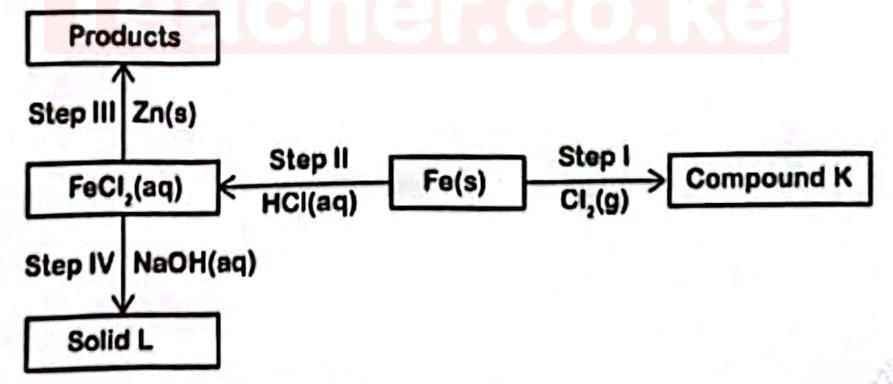
(a) Name compound K. (1 mark)
(b) Give the formula of solid L. (1 mark)
(c) Write the ionic equation for the reaction for step III. (1 mark)
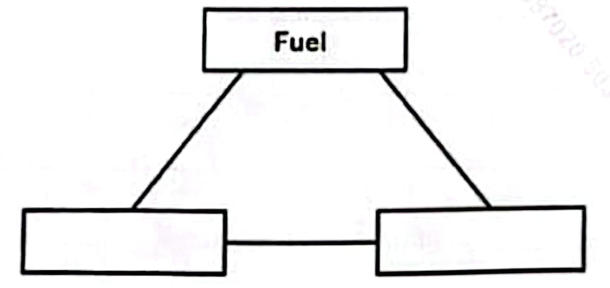
26. Starting and sustaining a fire requires three ingredients. Complete the fire triangle in Figure 5 by filling in the missing ingredients. (2 marks)
27. Helium is used in weather balloons. A balloon was filled with 100 g of helium at 25 °C and 1 atmosphere pressure. Determine the volume of the balloon at: (He = 4.0; volume of one mole of gas = 24 dm³)
(a) 25 °C and 1 atmosphere pressure; (1 mark)
(b) 10 °C and 0.85 atmosphere pressure. (2 marks)