233/2 · CHEMISTRY · Paper 2 (Theory) · Nov. 2024 · 2 hours
Instructions: Answer all the questions in the spaces provided. Non-programmable silent electronic calculators and KNEC mathematical tables may be used. All working must be clearly shown where necessary.
1. Figure 1 shows part of the periodic table of elements. The letters are not the actual symbols of elements.
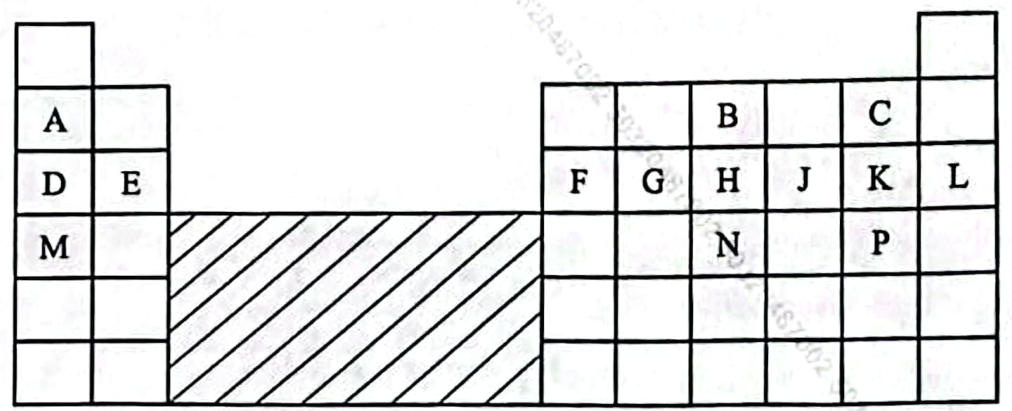
(a) Element Q belongs to period 5 and group VI. Place the element in the correct position in Figure 1. (1 mark)
(b) Consider the following ions: J²⁻, K⁻ and M⁺.
(i) Write the electron arrangements for each. (2 marks)
I. J²⁻ II. K⁻ III. M⁺
(ii) Select the ion with the largest ionic radius. Give a reason. (2 marks)
(c) Complete Table 1 by filling in the formula of the compound formed and the type of bond between the elements shown.
| Element | Formula of compound | Type of bond |
|---|---|---|
| A and B | ||
| G and C |
(3 marks)
(d) Explain the following observations.
(i) Electrical conductivity of element F is higher than that of element E. (1 mark)
(ii) Element M is a stronger reducing agent than element D. (1 mark)
(iii) The melting point of element H is lower than that of element N. (1 mark)
2. Figure 2 shows the steps in the Contact process.
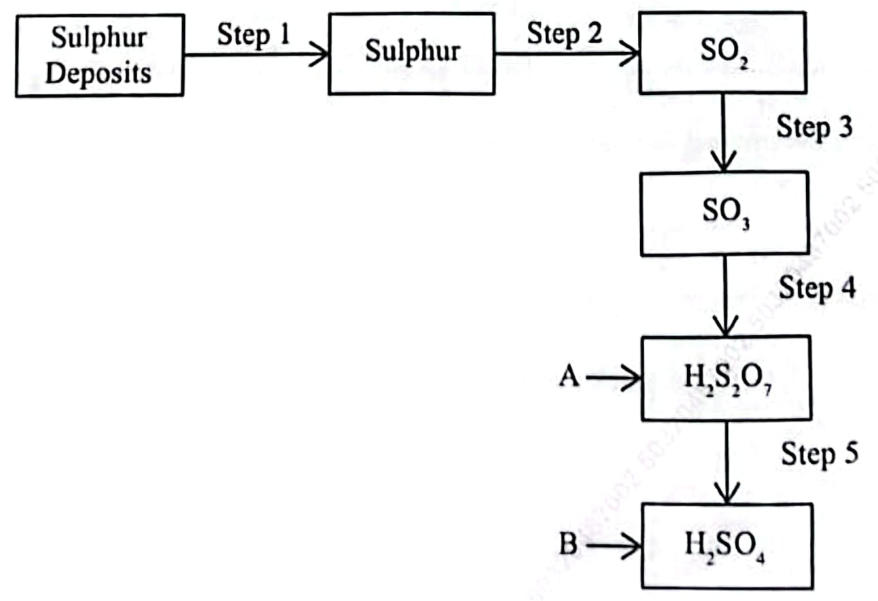
(a) Step 1 is known as the Frasch process. Describe how the process is carried out. (3 marks)
(b) State the optimum conditions used in step 3. (3 marks)
(c) Identify substance:
(i) A; (1 mark)
(ii) B. (1 mark)
(d) Name the process that occurs in step 2. (1 mark)
(e) When concentrated sulphuric(VI) acid is added to glucose, a black solid is formed.
(i) Identify the black solid. (1 mark)
(ii) State the property of concentrated sulphuric(VI) acid illustrated in this reaction. (1 mark)
3. The formulae of three organic compounds, each having two carbon atoms, are: A C₂H₄, B C₂H₂, C C₂H₆. The compounds belong to different homologous series.
(a) State what is meant by the term homologous series. (1 mark)
(b) Compound B is the first member of its homologous series. Write the formula of the fifth member of the same series. (1 mark)
(c) Explain why compound A is described as being unsaturated. (1 mark)
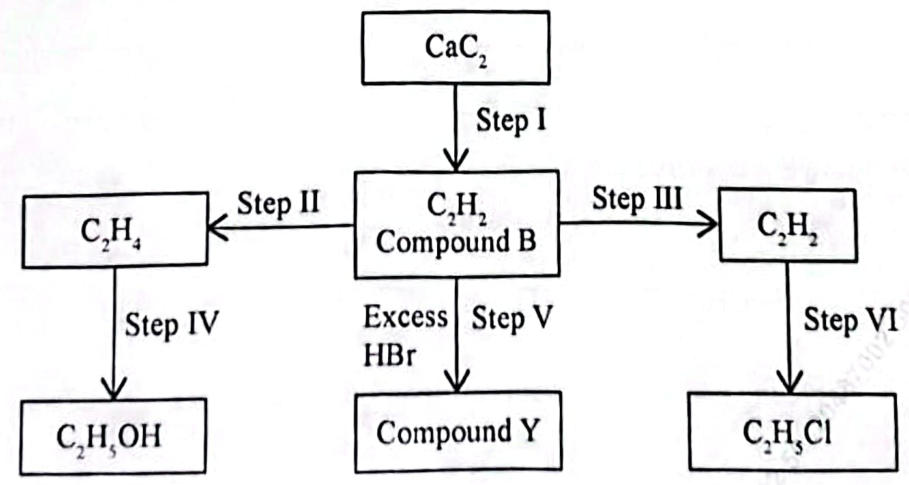
(d) The flowchart in Figure 3 shows reactions involving compound B.
(i) Give the name of the reagent used in:
I. Step I; (1 mark)
II. Step II. (1 mark)
(ii) Identify the type of reaction that takes place in:
I. Step IV; (1 mark)
II. Step VI. (1 mark)
(iii) State the conditions necessary for carrying out:
I. Step III; (1 mark)
II. Step VI. (1 mark)
(iv) Draw the structure of compound Y. (1 mark)
(e) The following is a structure of a soap: CH₃(CH₂)ₙCOO⁻Na⁺
(i) Give the name of the main raw material used in making soaps. (1 mark)
(ii) Given two soaps, one with n = 16 and the other with n = 10, explain which one of the soaps is more effective in washing clothes. (2 marks)
4. Table 2 shows standard reduction potentials for given half cells.
| Half cell reaction | E°, Volts | |
|---|---|---|
| I | Ni²⁺ + 2e → Ni | −0.25 |
| II | Cd²⁺ + 2e → Cd | −0.40 |
| III | Al³⁺ + 3e → Al | −1.66 |
| IV | MnO₄⁻ + 8H⁺ + 5e → Mn²⁺ + 4H₂O | +1.52 |
| V | Fe²⁺ + 2e → Fe | −0.44 |
| VI | Ag⁺ + e → Ag | +0.80 |
(a) (i) Draw a labelled diagram of an electrochemical cell using half cells II and III. (2 marks)
(ii) Calculate the e.m.f of the cell. (1 mark)
(iii) Write the equation for the electrochemical cell. (1 mark)
(b) Table 3 shows colours of aqueous ions: manganese(II), almost colourless; manganate(VII), purple; nickel(II), green.
State the observations made when a nickel rod is left standing in a beaker containing aqueous potassium manganate(VII). Explain. (2 marks)
(c) (i) One of the uses of electrolysis is in electroplating. State one other use. (1 mark)
(ii) Silver is used to electroplate metals such as iron. State two properties of silver that make it suitable for this application. (2 marks)
(iii) Figure 4 shows a set-up of an electrolytic cell used to electroplate an iron rod using silver.
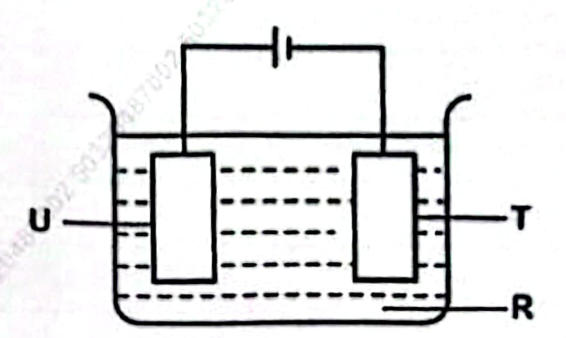
Identify R, T and U in Figure 4. (3 marks)
5. (a) Explain how each of the following affects the rate of reaction:
(i) decrease in temperature; (1½ marks)
(ii) increase in surface area. (1½ marks)
(b) Using a 250 ml volumetric flask, a burette and 12.0 M hydrochloric acid, describe how a standard solution containing 250 cm³ of 0.5 M hydrochloric acid can be prepared. (3 marks)
(c) 5.0 g of zinc powder was reacted with 25.0 cm³ of 0.5 M hydrochloric acid. The volume of gas produced was measured every 10 seconds. Table 4 shows the data obtained.
| Time (s) | 0 | 10 | 20 | 30 | 40 | 50 | 60 | 70 | 80 |
|---|---|---|---|---|---|---|---|---|---|
| Volume of hydrogen gas (cm³) | 0 | 52 | 86 | 110 | 128 | 136 | 140 | 140 | 140 |
(i) On the grid provided, plot a graph of volume of hydrogen gas against time. (3 marks)
(ii) From the graph, determine the rate of reaction at:
I. 5 seconds; (1 mark)
II. 37 seconds. (1 mark)
(iii) Give a reason for the difference in the rates calculated in (c)(ii) I and II. (1 mark)
(iv) State one observation that would be made if the experiment was repeated using 5.0 g of zinc powder and 25.0 cm³ of 0.25 M hydrochloric acid. (1 mark)
6. (a) State the meaning of the term standard molar heat of combustion. (1 mark)
(b) Table 5 gives the standard enthalpies for three reactions.
| Reaction | Equation | ΔH, kJ mol⁻¹ |
|---|---|---|
| I | −286 | |
| II | −911 | |
| III | −1517 |
Silicon and hydrogen react as shown in the following equation:
Calculate the enthalpy change for this reaction using the information in Table 5. (3 marks)
(c) Determine the amount of energy change when 1 kg of water is formed. (H = 1.0; O = 16.0) (1 mark)
(d) Heating value of a fuel is the amount of heat energy released when 1 g of a substance undergoes combustion. Calculate the heating value of carbon and hydrogen using the following information.
(C = 12.0; H = 1.0; O = 16.0)
(i) Carbon. (1 mark)
(ii) Hydrogen. (1 mark)
(e) Metals V, W and X displace copper from its compounds. Describe an experiment that can be carried out to arrange the three metals in order of their reactivity with copper using aqueous copper(II) sulphate and a thermometer. (3 marks)
7. (a) There are two types of water hardness. One type is permanent hardness caused by the presence of calcium and magnesium ions.
(i) I. Give the name of the other type of water hardness. (1 mark)
II. Name the ion responsible for the type of water hardness named above. (1 mark)
(ii) State one natural source of calcium ions in river water. (1 mark)
(iii) Describe how ion exchange can be used to remove permanent hardness in water. (2 marks)
(b) Figure 5 shows solubility curves of KNO₃ and KCl in grams per 100 g of water.
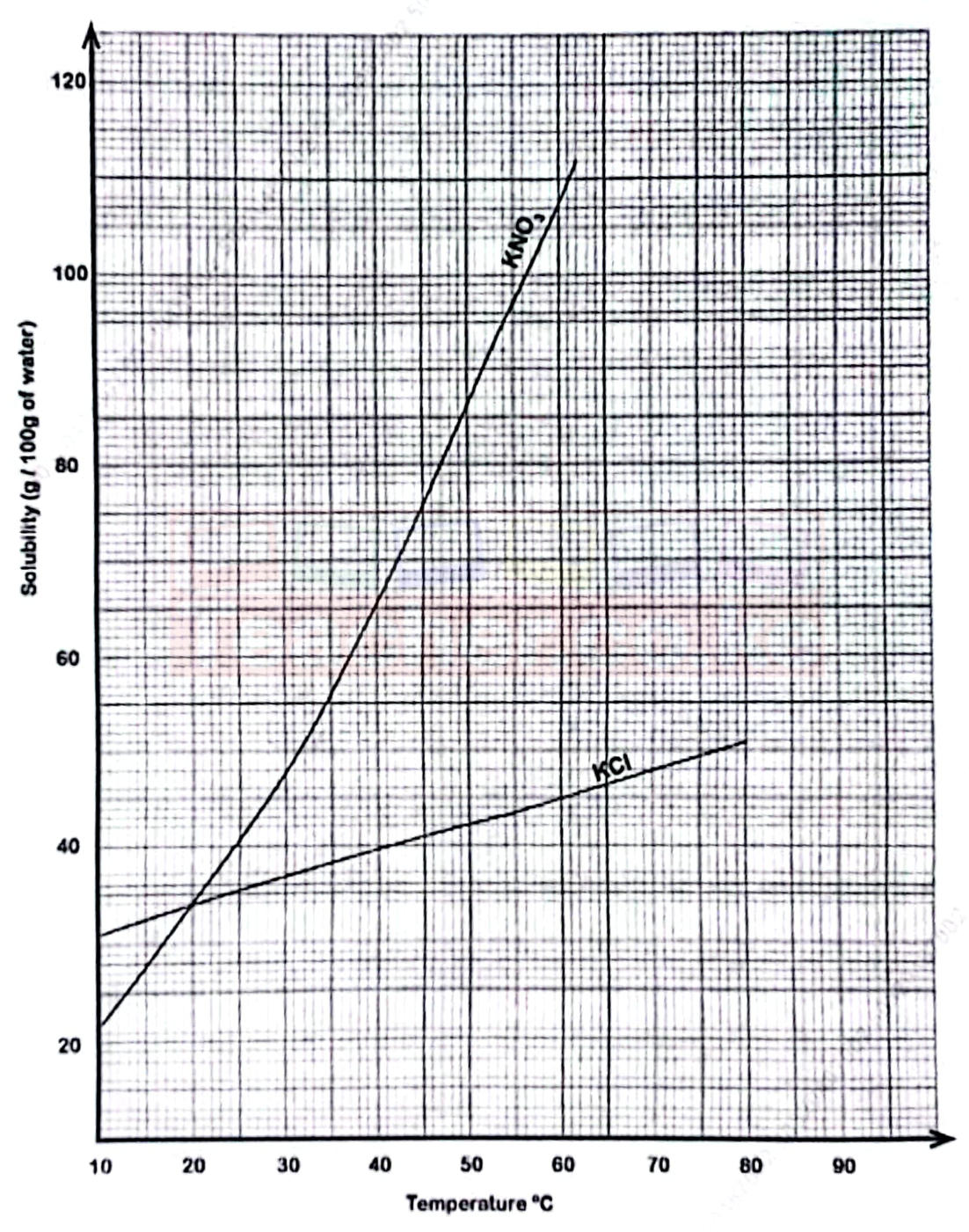
(i) State the temperature at which the solubility of potassium chloride is the same as that of potassium nitrate. (1 mark)
(ii) A solution that contains 40 g of potassium chloride in 100 g of H₂O is cooled slowly from 75 °C.
I. State the temperature at which crystals start to form. (1 mark)
II. Determine the mass of potassium chloride that will form if the solution is cooled to 15 °C. (1 mark)
(iii) 40 g of potassium nitrate is dissolved in 50 g of water at room temperature. If the mixture is slowly heated, determine the lowest temperature at which all the solid dissolves. (2 marks)