233/1 · CHEMISTRY (Theory) · Paper 1 · Dec. 2022 · 2 hours
Instructions: Answer all the questions in the spaces provided. Non-programmable silent electronic calculators and KNEC mathematical tables may be used. All working must be clearly shown where necessary.
1. (a) State one property that can be used to distinguish between a proton and a neutron. (1 mark)
(b) An ion of element Y has the formula .
(i) Write the electron arrangement of the ion. (1 mark)
(ii) Identify the group and period in the Periodic Table to which the element belongs. (2 marks)
2. (a) Complete Table 1 by writing the formula and naming the structure of the chlorides of the elements. (2 marks)
| Element | Sodium | Magnesium | Silicon | Phosphorus |
|---|---|---|---|---|
| Formula of chloride | ||||
| Structure of chloride |
(b) Select from Table 1 an acidic chloride and write the equation for its reaction with water. (1 mark)
3. (a) Write a thermochemical equation for the formation of carbon(II) oxide. (1 mark)
(b) Use the energy level diagram in Figure 1 to answer the questions that follow.
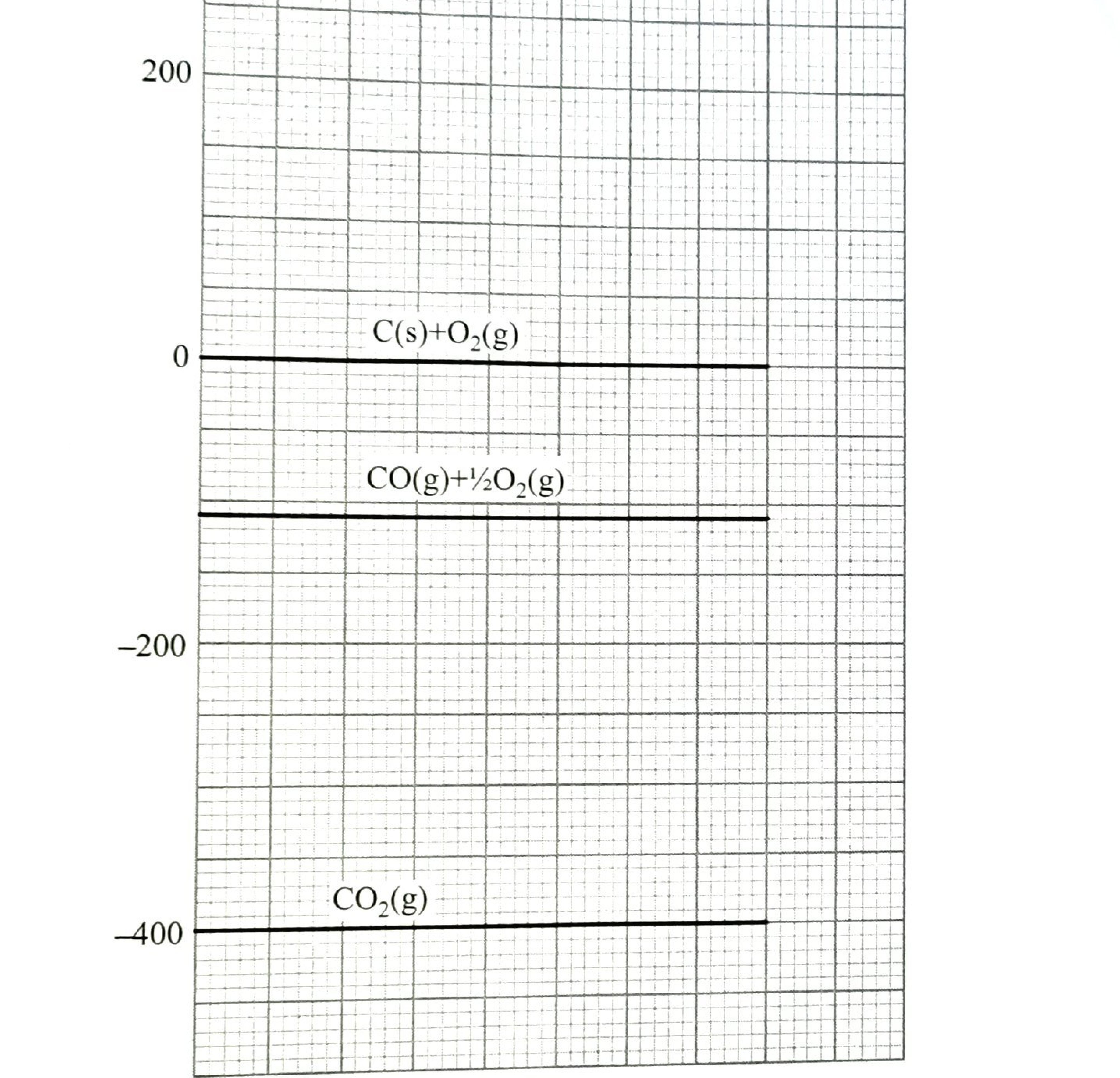
Determine the enthalpy change of: (i) formation of carbon(II) oxide; (1 mark) (ii) combustion of carbon(II) oxide. (1 mark)
4. (a) Give a reason why painting or galvanising iron sheets protects them from rusting. (1 mark)
(b) Explain the advantage of galvanising over painting of iron sheets. (2 marks)
5. (a) The structure of compound A is:
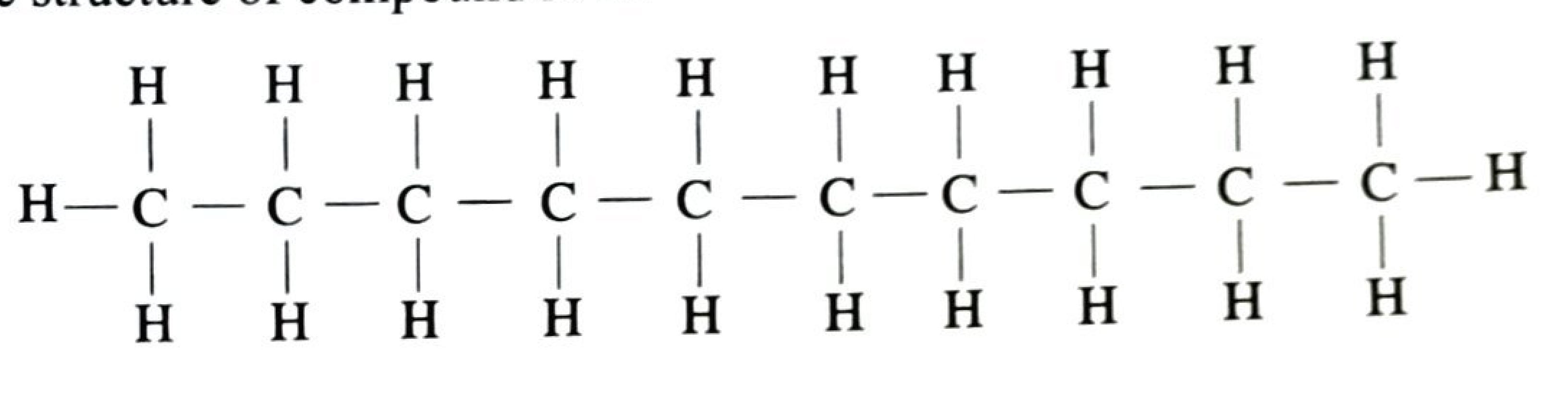
Give its: (i) name; (1 mark) (ii) empirical formula. (1 mark)
(b) Draw the structure of an alkanoic acid whose molecular formula is C₅H₁₀O₂. (1 mark)
6. The following equilibrium exists in a closed system:
(N₂O₄ pale yellow; NO₂ brown.) State and explain two conditions under which the intensity of the brown colour of the equilibrium mixture can be increased. (3 marks)
7. (a) Determine the oxidation numbers of: (i) hydrogen in CaH₂; (1 mark) (ii) oxygen in OF₂. (1 mark)
(b) Write an ionic equation for the reaction between aqueous sodium hydrogen carbonate and ethanoic acid. (1 mark)
8. The mass of one molecule of a hydrocarbon is g. (Avogadro's number mol⁻¹; C = 12.0; H = 1.0)
(a) Determine its: (i) molecular mass; (1 mark) (ii) molecular formula. (1 mark)
(b) Draw a structure of the hydrocarbon in 8(a). (1 mark)
9. (a) Water reacts with hydrogen ions. (i) Write the formula of the product formed. (½ mark) (ii) Name the type of bond formed. (½ mark)
(b) The melting point of iodine is higher than that of chlorine. Explain. (2 marks)
10. A sample of ammonia gas can be prepared by heating a mixture of ammonium bromide and barium hydroxide.
(a) Write an equation for the reaction. (1 mark)
(b) State why the gas cannot be dried using anhydrous calcium chloride. (1 mark)
(c) Name a suitable drying agent. (1 mark)
11. In an experiment to test for hardness of water from different boreholes, soap solution was added to 1000 cm³ of water and the volume of soap solution required for lather to start forming was recorded. The results are given in Table 2.
| Water sample (1000 cm³) | Soap solution before boiling (cm³) | Soap solution after boiling (cm³) |
|---|---|---|
| 1 | 25 | 3 |
| 2 | 12 | 8 |
| 3 | 10 | 10 |
| 4 | 3 | 3 |
| 5 | 25 | 24 |
(a) Select water samples that show: (i) temporary hardness; (½ mark) (ii) no hardness; (½ mark) (iii) both temporary and permanent hardness. (½ mark)
(b) Describe how water hardness can be removed using an ion-exchange resin. (1½ marks)
12. Products of electrolysis at the electrodes for aqueous solutions depend on three factors. Two of these factors are concentration of electrolyte and nature of electrode.
(a) State another factor that affects the products of electrolysis. (1 mark)
(b) Complete Table 3 to show the products of electrolysis for dilute calcium chloride and concentrated calcium chloride at the anode and cathode. (2 marks)
| Electrolyte | Anode | Cathode |
|---|---|---|
| Dilute calcium chloride | ||
| Concentrated calcium chloride |
13. (a) Carbon exhibits different boiling points. Explain. (1 mark)
(b) It takes 44 seconds for nitrogen(IV) oxide gas to effuse through an opening. Calculate how long it will take for an equal volume of chlorine gas to effuse through the same opening. (N = 14.0; O = 16.0; Cl = 35.5) (2 marks)
14. (a) Give an example of a natural polymer made of: (i) cellulose material; (½ mark) (ii) a hydrocarbon. (½ mark)
(b) Part of the structure of perspex is:
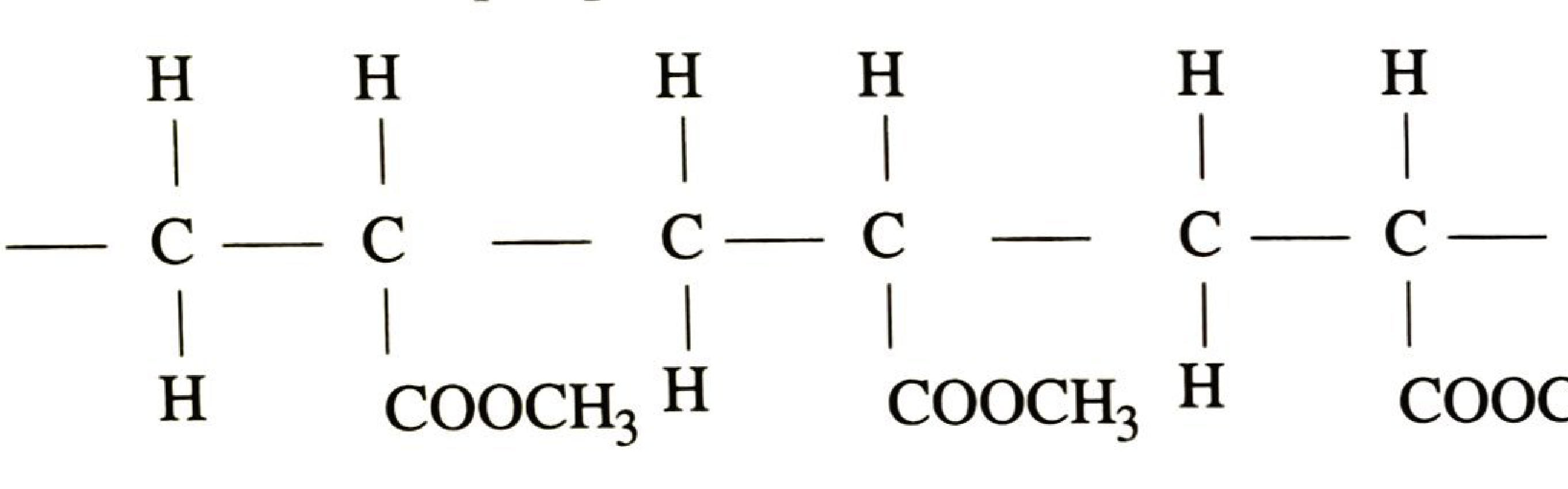
(i) Draw the structure of the monomer of perspex. (1 mark)
(ii) Give two properties of perspex that make it suitable for use in making lenses. (1 mark)
15. Two allotropes of carbon are graphite and diamond.
(a) Explain why the density of diamond is higher than that of graphite. (1 mark)
(b) Give one use of each of the allotropes and relate the use to the properties of the allotrope: I. graphite; (1 mark) II. diamond. (1 mark)
16. (a) The graph in Figure 2 shows the radioactive decay curve of a radioactive isotope.
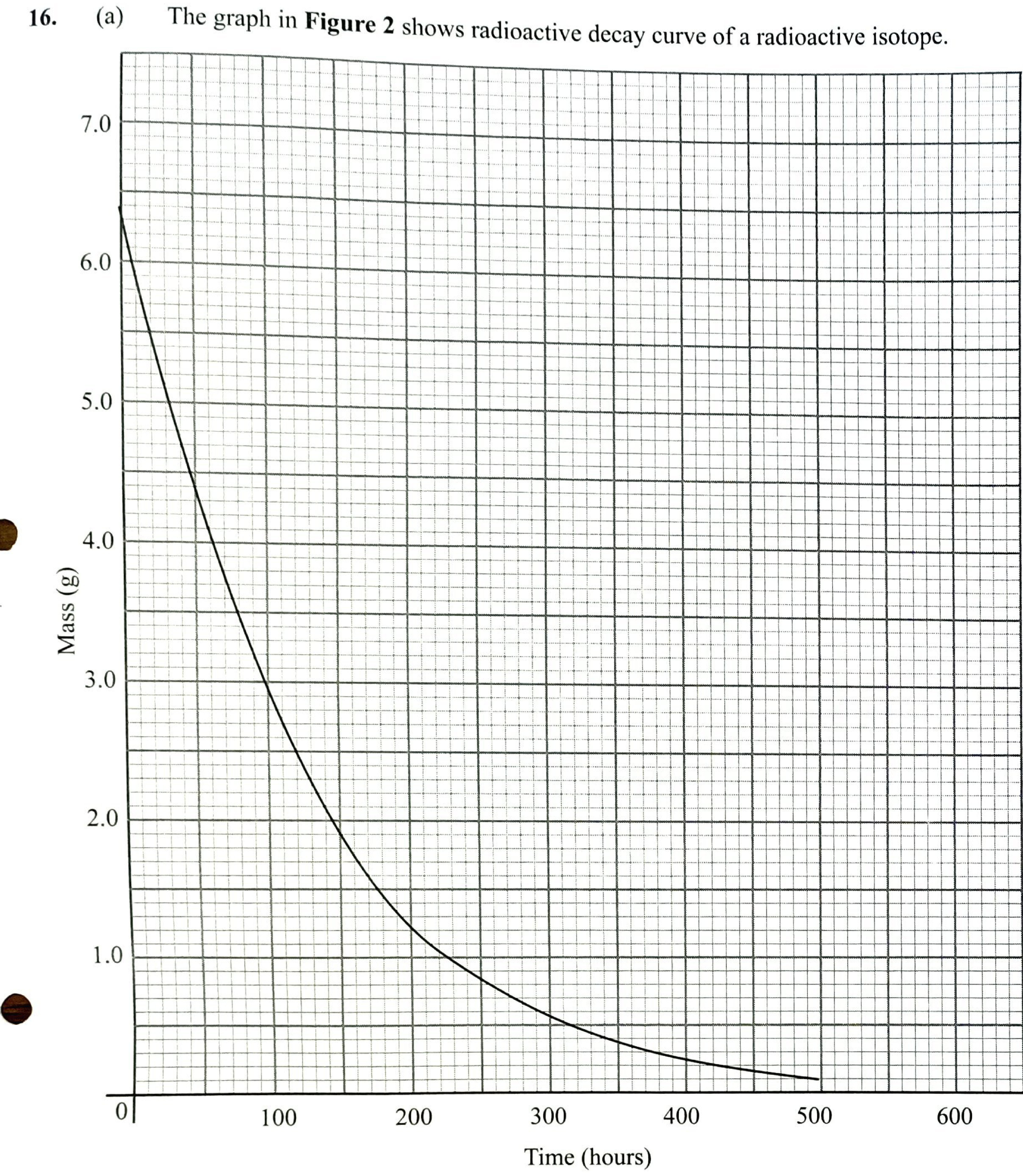
Use the graph to determine the: (i) half-life of the radioactive isotope; (1 mark) (ii) rate of decay at time 150 hours. (1 mark)
(b) The half-lives of two radioactive isotopes A and B are 8 days and 5.2 years respectively. Given that both of them emit beta radiation, explain why A would be more suitable in the treatment of a disease. (1 mark)
17. The formula of a hydrated salt of manganese is MnSO₄·H₂O. Given that the salt contains 24.7% manganese, determine the value of . (Mn = 55.0; S = 32.0; O = 16.0; H = 1.0) (3 marks)
18. Describe the correct procedure of heating a liquid in a test tube using a Bunsen burner. (3 marks)
19. The melting and boiling points of naphthalene are 80 °C and 218 °C respectively. A sample of naphthalene was cooled from 250 °C to 25 °C. Sketch and label the cooling curve that would be obtained. (3 marks)
20. Draw a labelled diagram of a set-up that can be used to prepare a dry sample of chlorine gas using potassium manganate(VII) and concentrated hydrochloric acid. (3 marks)
21. Table 4 gives the boiling points of three liquids.
| Liquid | Boiling point (°C) |
|---|---|
| Hexane | 68.7 |
| Butanol | 99.5 |
| Water | 100.0 |
Describe how the following mixtures can be separated: (a) hexane and butanol; (1½ marks) (b) hexane and water. (1½ marks)
22. Complete Table 5 by writing the observations made when aqueous ammonia and aqueous sodium sulphate are added to solutions containing calcium, aluminium and iron(II) ions. (3 marks)
| Ions present | Aqueous ammonia | Aqueous sodium sulphate |
|---|---|---|
| Ca²⁺ | ||
| Al³⁺ | ||
| Fe²⁺ |
23. (a) Iron is extracted from haematite ore. If the ore contains oxides of silicon and aluminium, explain how these impurities are removed. (2 marks)
(b) The extraction process of iron produces waste gases. State how these waste gases can be used to lower the operational cost of the extraction process. (1 mark)
24. When chlorine is bubbled into a sample of water, the solution smells strongly of chlorine. If aqueous sodium hydroxide is added to the solution, the smell of chlorine disappears. The following equation shows the reaction that occurs:
With reference to the equation, explain why the: (a) solution smells strongly of chlorine; (1 mark) (b) addition of sodium hydroxide removes the smell. (2 marks)
25. Figure 3 shows how nitric(V) acid can be obtained.
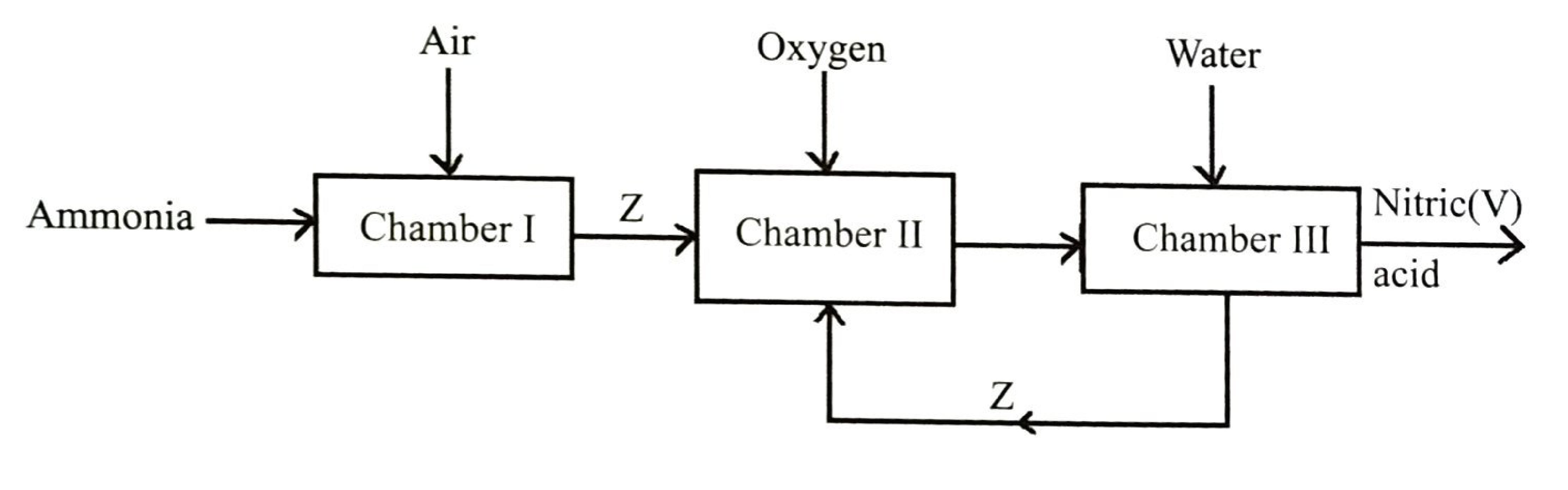
(a) Identify the chamber in which a catalyst is used. (1 mark)
(b) Name substance Z. (1 mark)
(c) Write an equation for the reaction that takes place in Chamber III. (1 mark)
26. The formula of the complex ion formed when aqueous zinc sulphate reacts with excess aqueous sodium hydroxide is given as . Explain how the value of is determined. (2 marks)
27. Copper can be obtained from copper(II) oxide using carbon(II) oxide or coke.
(a) Name another reagent that can be used to obtain copper from copper(II) oxide. (1 mark)
(b) The equation for the reaction with carbon(II) oxide is . Calculate the maximum mass of copper that would be obtained using 200 dm³ of carbon(II) oxide. (Cu = 63.5; molar volume of gas = 24.0 dm³) (2 marks)