233/2 · CHEMISTRY (Theory) · Paper 2 · Mar. 2022 (KCSE 2021) · 2 hours
Instructions: Answer all the questions in the spaces provided. Non-programmable silent electronic calculators and KNEC mathematical tables may be used. All working must be clearly shown where necessary.
1. (a) Table 1 gives the properties of two compounds, A and B.
| A | B |
|---|---|
| white, crystalline, efflorescent | white, crystalline, deliquescent |
State and explain the observation made when each of the compounds is left exposed in air: (i) compound A; (2 marks) (ii) compound B. (2 marks)
(b) In an experiment to determine the formula of hydrated magnesium sulphate, a sample was heated in a crucible until a constant mass was obtained. The results are shown in Table 2.
| Mass (g) | |
|---|---|
| Mass of crucible | 25.62 |
| Mass of crucible + solid before heating | 28.08 |
| Mass of crucible + solid after heating | 26.82 |
Using the information in Table 2, determine the formula of the hydrated salt (MgSO₄·H₂O). (Mg = 24.0; S = 32.0; O = 16.0; H = 1.0) (3 marks)
(c) Figure 1 shows analysis of an alloy containing two metals.
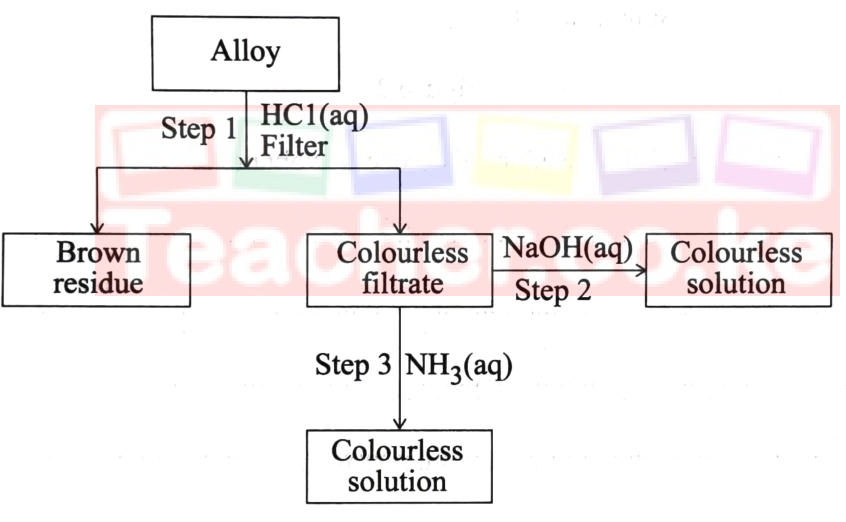
(i) Give the name of another product formed in step 1. (1 mark)
(ii) Write the formula of the complex ion present in the colourless solution obtained in step 2. (1 mark)
(iii) Identify the metals in the alloy. (2 marks)
2. The flow chart in Figure 2 shows the processes involved in the manufacture of sulphuric(VI) acid.
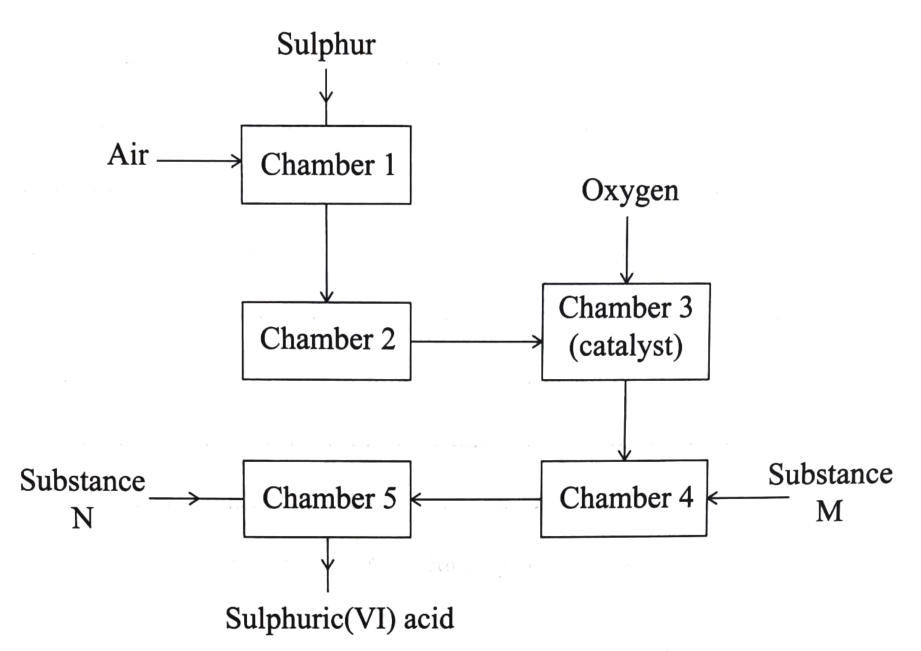
(a) Explain how the sulphur used in this process is obtained. (2 marks)
(b) Give one advantage of using air in chamber 1 instead of using oxygen gas. (1 mark)
(c) Identify substances: (i) M; (1 mark) (ii) N. (1 mark)
(d) (i) In chamber 2, drying and purification take place. Give a reason why this is necessary. (1 mark)
(ii) The reaction in chamber 3 is highly exothermic. I. Explain why a high temperature is required for the reaction in chamber 3. (1 mark) II. State how the heat produced in chamber 3 can be utilised in this process. (1 mark)
(e) Give a reason why this method of manufacture is known as the "contact process". (1 mark)
(f) Emission of gases in the sulphuric(VI) acid plant may lead to environmental pollution. (i) State the evidence that could be used to show that the plant causes pollution. (1 mark) (ii) Explain how the pollution identified in 2(f)(i) can be controlled. (1 mark)
3. (a) Chemical reactions occur as a result of collisions of particles. Give a reason why not all collisions are effective. (1 mark)
(b) State and explain how the following factors affect the rate of reaction: (i) surface area of reactants; (1 mark) (ii) pressure. (1 mark)
(c) In an experiment to determine the rate of a reaction, marble chips were added to excess 2 M hydrochloric acid: . The volume of carbon(IV) oxide produced was measured at 25 °C and recorded every 30 seconds.
| Time (s) | 0 | 30 | 60 | 90 | 120 | 150 | 180 | 210 | 240 |
|---|---|---|---|---|---|---|---|---|---|
| Volume of CO₂ (cm³) | 0 | 62 | 92 | 113 | 124 | 130 | 132 | 133 | 133 |
(i) On the grid provided, plot a graph of volume of carbon(IV) oxide (vertical axis) against time. (3 marks)
(ii) Using the graph, determine the rate of reaction at the: I. 45th second; (1 mark) II. 105th second. (1 mark)
(iii) Give a reason for the difference in the two rates. (1 mark)
(iv) Using the graph, determine the mass of marble chips that reacted. (Ca = 40.0; C = 12.0; O = 16.0; molar gas volume at r.t.p. = 24 000 cm³) (2 marks)
4. (a) Sea water contains approximately 3% sodium chloride. Describe how sodium chloride is obtained from sea water. (3 marks)
(b) The solubility of sodium chloride is 36.2 g in 100 g of water at room temperature. Determine the concentration in moles per litre of a saturated aqueous sodium chloride solution at room temperature. (Na = 23.0; Cl = 35.5; density of water = 1.0 g cm⁻³) (2 marks)
(c) Ammonia is highly soluble in water.
(i) Explain how aqueous ammonia is prepared starting with ammonia gas. (2 marks)
(ii) On the axes provided (solubility against temperature), sketch a curve showing how the solubility of ammonia gas varies with temperature. (1 mark)
(iii) Give a reason for the shape of the curve. (1 mark)
(d) Water hardness is due to the presence of magnesium and calcium ions. Explain how these ions get into sources of water. (2 marks)
5. (a) Figure 3 shows part of the Periodic Table.
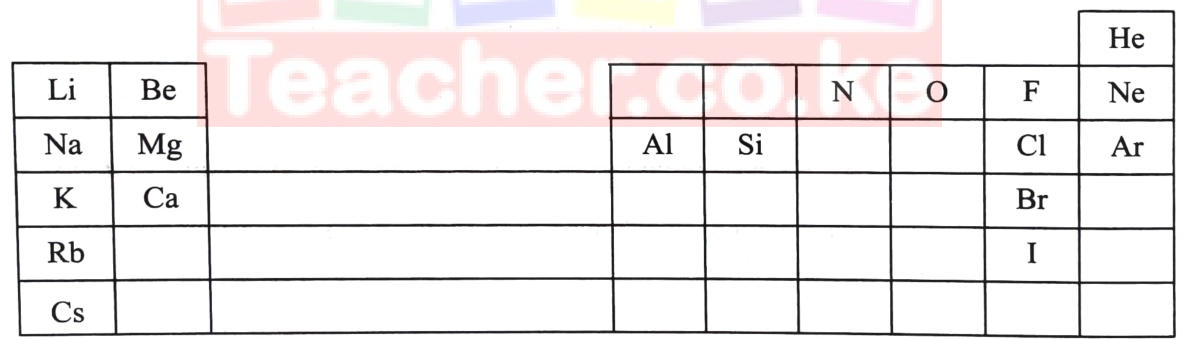
(i) Select from the table the most reactive: I. metal; (½ mark) II. non-metal. (½ mark)
(ii) Select an element with the highest first ionisation energy. (1 mark)
(iii) I. Name the method used to obtain argon from its source. (1 mark) II. Give one industrial use of argon. (1 mark)
(iv) Explain each of the following observations: I. The melting point of lithium is higher than that of potassium. (1 mark) II. The melting point of chlorine is lower than that of iodine. (1 mark)
(v) The following ions have the same number of electrons: N³⁻, Mg²⁺, O²⁻, Na⁺. Arrange them in order of increasing ionic size. Give a reason for the order. (2 marks)
(b) Use Table 4 to answer the questions that follow.
| Property | H | I | J | K |
|---|---|---|---|---|
| Melting point (°C) | 993 | 113 | −38.9 | −85 |
| Boiling point (°C) | 1695 | 183 | 357 | −60 |
| Electrical conductivity at room temperature | does not conduct | does not conduct | conducts | does not conduct |
| Electrical conductivity in molten state | conducts | does not conduct | conducts | does not conduct |
(i) Identify the substance which is a gas at room temperature. Give a reason. (1 mark)
(ii) Name the particles responsible for electrical conductivity in substance: I. H; (1 mark) II. J. (1 mark)
(iii) Identify the type of forces that hold the particles together in: I. H; (1 mark) II. K. (1 mark)
6. Figure 4 shows a flow chart involving reactions of some organic compounds.
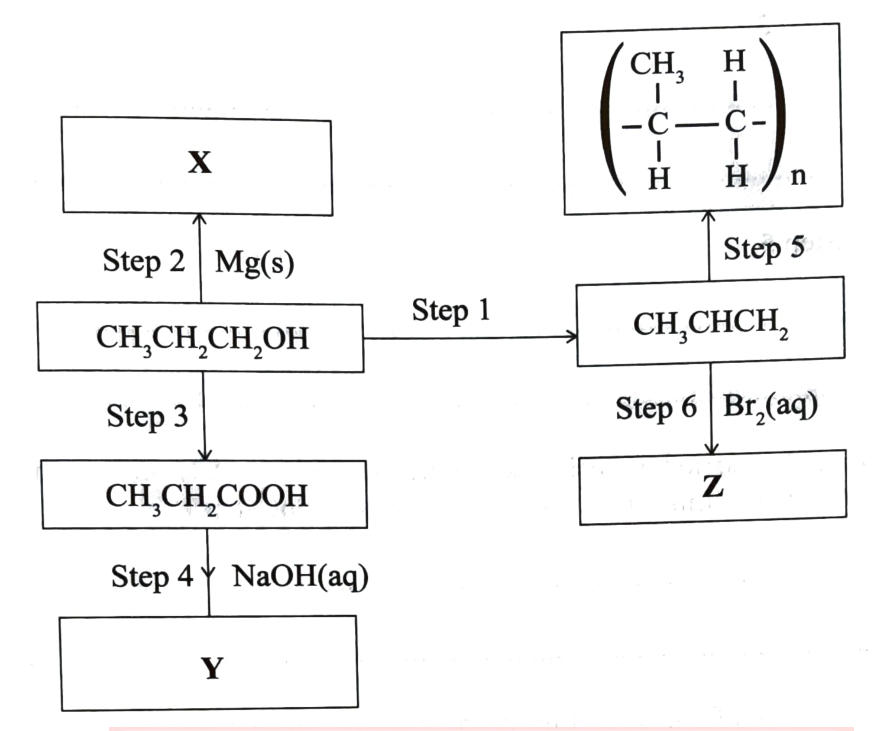
(a) Write the formula and give the names of compounds: (i) X; (2 marks) (ii) Y. (2 marks)
(b) Give the reagents and conditions necessary for carrying out: (i) step 3; (1 mark) (ii) step 5. (1 mark)
(c) Step 1 can be carried out using concentrated sulphuric(VI) acid and heat. Name another reagent and conditions that can be used to carry out step 1. (1 mark)
(d) Give the name of the type of reaction that takes place in: (i) step 1; (1 mark) (ii) step 5. (1 mark)
(e) (i) Write an equation for the reaction in step 6. (1 mark) (ii) State the observations made in step 6. (1 mark)
7. (a) Using the oxidation numbers of chlorine, explain why the following is a redox reaction: (2 marks)
(b) Use the following standard reduction potentials to answer the questions that follow.
| Half-cell reaction | (V) | |
|---|---|---|
| I | −0.36 | |
| II | +1.69 | |
| III | +0.77 | |
| IV | −0.76 | |
| V | [corrected] | +1.51 |
| VI | +0.68 | |
| VII | −0.44 | |
| VIII | +0.34 |
[corrected] The paper prints the manganate ion in V as MnO₄²⁻; with 5 electrons and Mn²⁺ formed it must be MnO₄⁻ (manganate(VII)).
(i) The half cells I and II are combined to form an electrochemical cell. I. Write an equation for the cell reaction. (1 mark) II. Calculate the e.m.f. of the cell. (1 mark)
(ii) Draw a labelled diagram for the electrochemical cell formed using half cells III and IV. (3 marks)
(iii) State and explain the observations made when a few drops of acidified potassium manganate(VII) are added to hydrogen peroxide. (3 marks)
(iv) Coating iron with zinc is a more effective way of corrosion prevention than coating it with copper. Explain. (2 marks)