233/1 · CHEMISTRY (Theory) · Paper 1 · Mar. 2022 (KCSE 2021) · 2 hours
Instructions: Answer all the questions in the spaces provided. Non-programmable silent electronic calculators and KNEC mathematical tables may be used. All working must be clearly shown where necessary.
1. (a) Draw a labelled diagram showing the atomic structure of . (2 marks)
(b) The atomic number of phosphorus is 15. Draw a dot (•) and cross (×) diagram for the compound formed when phosphorus reacts with chlorine, atomic number 17. (1 mark)
2. (a) State the condition under which a Bunsen burner produces a luminous flame. (1 mark)
(b) Write an equation for the reaction that takes place in a luminous flame, assuming the laboratory gas is butane. (1 mark)
(c) One of the regions in the non-luminous flame is the unburnt gas region. Describe how the presence of this region can be shown using a wooden splint. (1 mark)
3. (a) The elements sodium, magnesium and aluminium belong to groups I, II and III respectively. Select the element with the highest electrical conductivity and give a reason. (1 mark)
(b) Complete Table 1 to show the products of electrolysis for concentrated sodium chloride and molten sodium chloride. (2 marks)
| Compound | Anode | Cathode |
|---|---|---|
| Concentrated sodium chloride | ||
| Molten sodium chloride |
4. A small piece of sodium metal was placed in a beaker containing pure water.
(a) State two observations made during the reaction. (1 mark)
(b) State and explain another observation made when a drop of phenolphthalein is added to the mixture in the beaker. (1 mark)
(c) Explain why it is not advisable to carry out this experiment using potassium metal. (1 mark)
5. Describe how a pure sample of copper(II) nitrate crystals can be prepared using recycled copper wire. (3 marks)
6. The following apparatus and chemicals are used to investigate the percentage of air used when iron rusts: iron filings, 100 ml measuring cylinder, trough and water.
(a) Draw a set-up of the experiment. (2 marks)
(b) Write an expression to show how the percentage of air used is calculated at the end of the experiment. (1 mark)
7. Figure 1 shows a graph of atomic radius of some group I and group II elements.
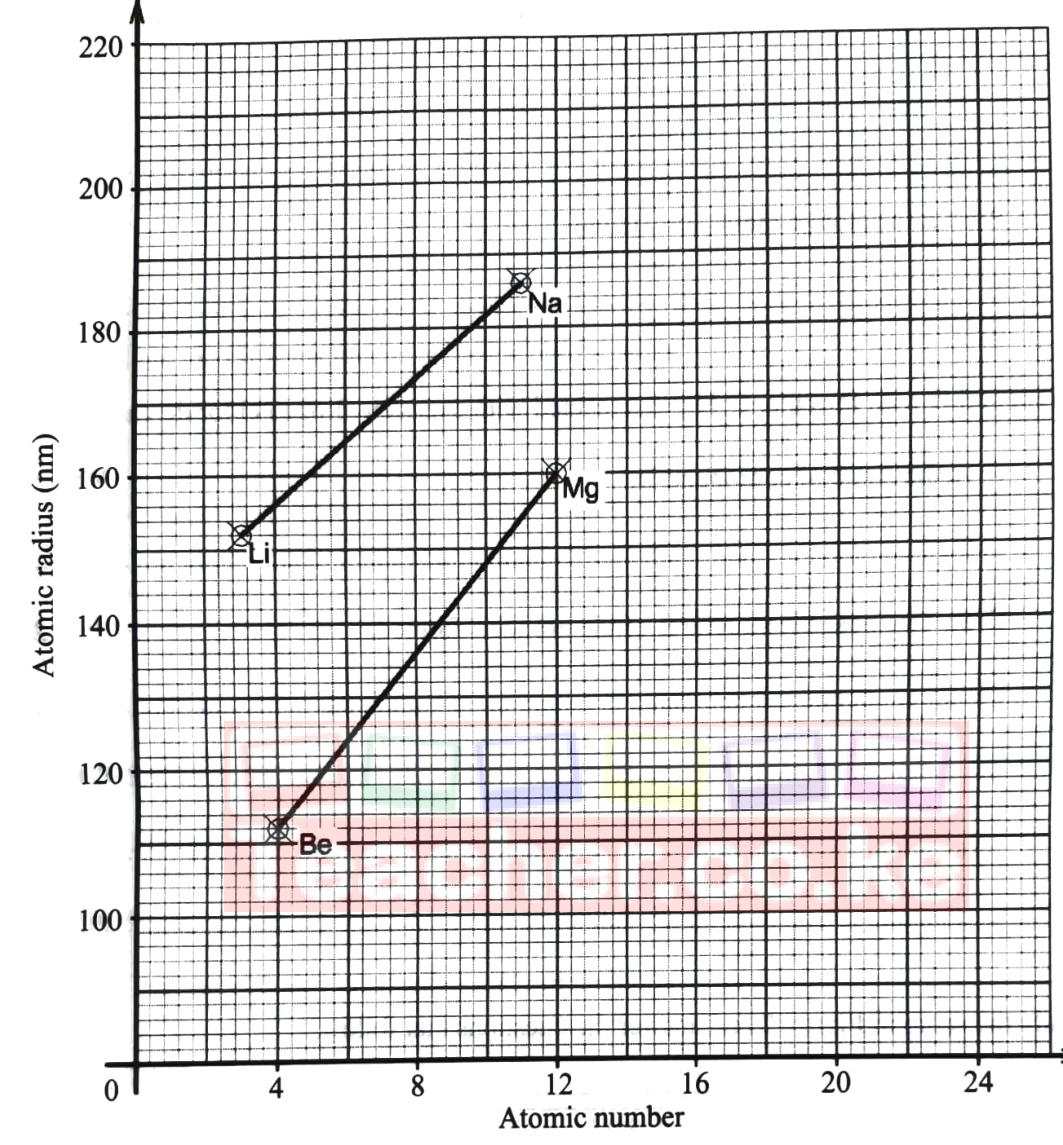
(a) Explain why the atomic radius of sodium is higher than that of: (i) lithium; (1 mark) (ii) magnesium. (1 mark)
(b) Predict the atomic radius of calcium. (1 mark)
8. Compound D, with formula C₃H₄, was reacted with excess hydrogen chloride gas.
(a) Give the name of compound D. (1 mark)
(b) Draw two possible structures of the products formed. (2 marks)
9. Study the set-up in Figure 2 and answer the questions that follow.
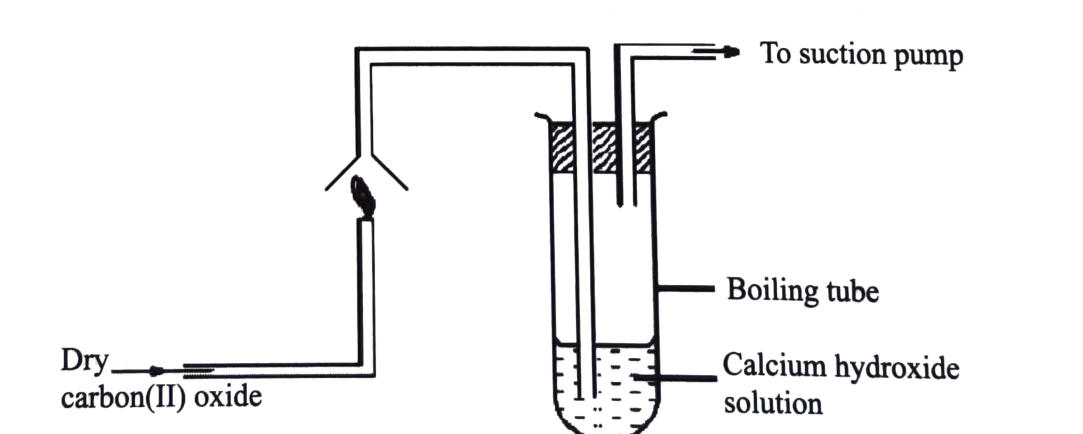
(a) State the precaution that should be taken in carrying out the experiment. Give a reason. (1 mark)
(b) State the observations made in the boiling tube. (2 marks)
10. Consider the following reaction: . The enthalpy change is −92.4 kJ per mole of nitrogen.
(a) Give the enthalpy change per mole of ammonia. (1 mark)
(b) State and explain how each of the following affects the yield of ammonia: (i) increase in temperature; (1 mark) (ii) finely divided iron. (1 mark)
11. Study the flow chart in Figure 3 and answer the questions that follow.
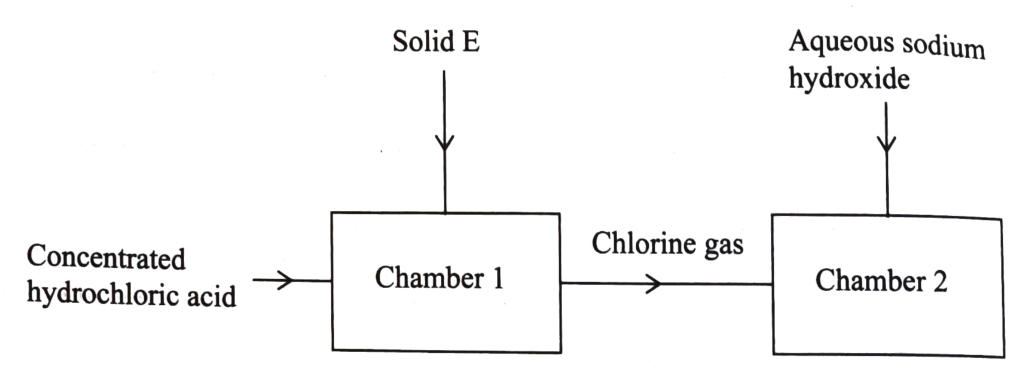
(a) Identify solid E. (1 mark)
(b) Name the type of reaction that takes place in chamber 1. (1 mark)
(c) Write an equation for the reaction that takes place in chamber 2. (1 mark)
12. Compounds H and J have the following structures:
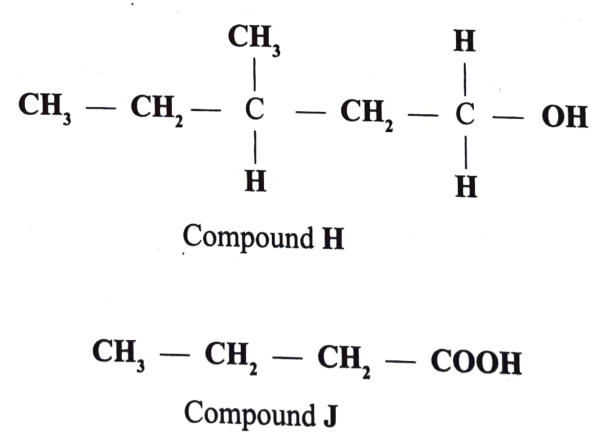
(a) Give the names of: (i) compound H; (1 mark) (ii) compound J. (1 mark)
(b) State the conditions necessary for H and J to react. (1 mark)
13. Rhombic sulphur is one of the allotropes of sulphur.
(a) Draw the structure of rhombic sulphur. (1 mark)
(b) Describe the observations made when rhombic sulphur is heated from room temperature until it boils. (1 mark)
14. The molar enthalpy of solution for potassium sulphate (K₂SO₄) is +23.8 kJ.
(a) On the axes provided (energy against reaction progress), draw a labelled energy level diagram for the dissolution of potassium sulphate in water. (2 marks)
(b) Calculate the enthalpy change when 5.22 g of potassium sulphate is completely dissolved in water. (K = 39.0; S = 32.0; O = 16.0) (1 mark)
15. (a) State Gay-Lussac's law. (1 mark)
(b) 180 cm³ of nitrogen(II) oxide gas was reacted with 400 cm³ of oxygen gas. (i) Write an equation for the reaction. (1 mark) (ii) Calculate the total volume of the gases at the end of the reaction. (3 marks)
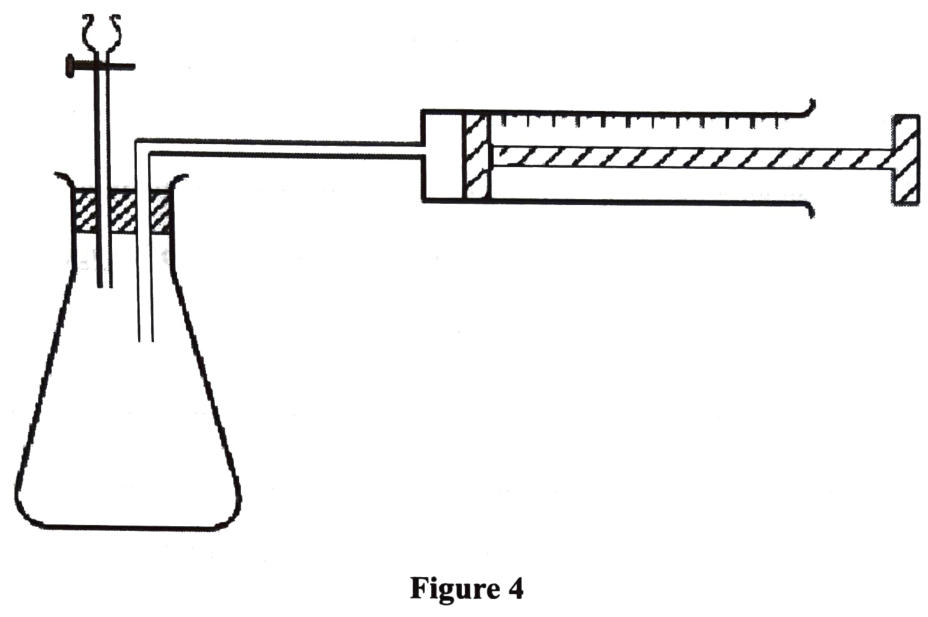
16. Describe how the set-up in Figure 4 can be used to distinguish between 50.0 cm³ of 0.2 M hydrochloric acid and 50.0 cm³ of 0.2 M ethanoic acid using pieces of 6 cm length of magnesium ribbon and a stop watch. (3 marks)
17. Describe how dilute nitric(V) acid and blue litmus papers can be used to distinguish between solid samples of sodium carbonate and sodium sulphite. (3 marks)
18. (a) Describe how propanone can be used to extract a pure sample of sunflower oil. (2 marks)
(b) State why sodium hydroxide solution is not suitable for the extraction of sunflower oil. (1 mark)
19. 31.5 cm³ of concentrated nitric(V) acid was diluted to 500 cm³. 10.0 cm³ of the dilute acid required 25.0 cm³ of 0.4 M sodium hydroxide for neutralisation.
(a) Calculate the concentration of the: (i) dilute acid; (1 mark) (ii) concentrated acid. (1 mark)
(b) State the correct method for diluting the concentrated nitric(V) acid. (1 mark)
20. Figure 5 shows part of a radioactive decay series.
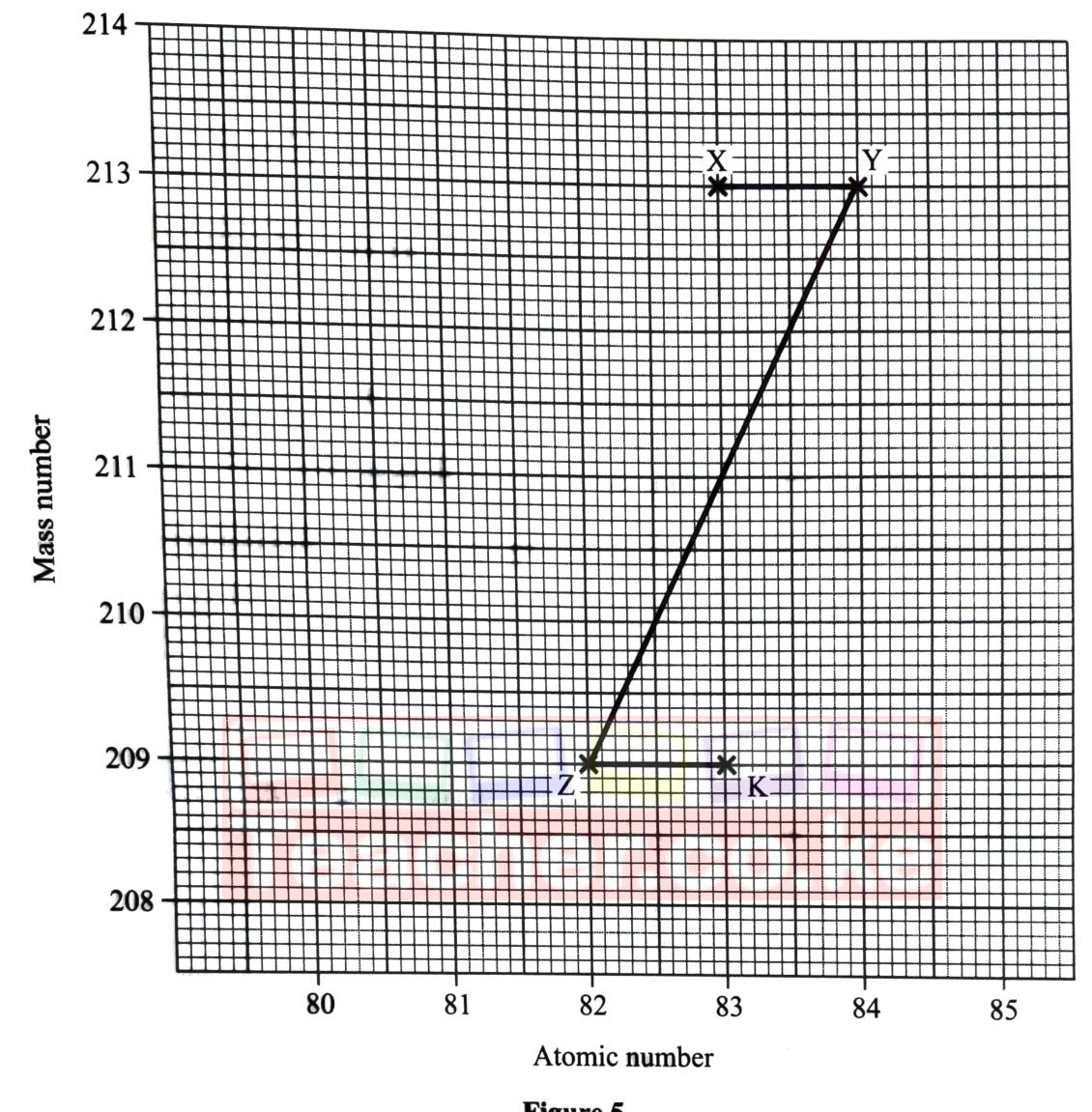
(a) Write a nuclear equation for the formation of nuclide K from nuclide X. (1 mark)
(b) The half-life of nuclide X is 47 minutes. Determine the percentage of nuclide X that remains after 188 minutes. (2 marks)
21. Aluminium is extracted from aluminium oxide by electrolysis.
(a) Other than the cost of electricity, give another reason why this method is expensive. (1 mark)
(b) Calculate the mass of aluminium obtained when a current of 20 A is used for 5 hours. (1 Faraday = 96 500 C; Al = 27.0) (2 marks)
22. Explain each of the following observations:
(a) Articles made of copper turn green when left exposed in air over a long period of time. (1 mark)
(b) Addition of aqueous ammonia to a solution containing copper(II) ions produces a deep blue solution. (1 mark)
23. (a) State what is meant by relative atomic mass of an element. (1 mark)
(b) A compound of carbon and element X with formula CX₄ contains 3.6% carbon by mass. Calculate the relative atomic mass of X. (2 marks)
24. Carbon(II) oxide can be prepared by dehydration of ethanedioic acid.
(a) Complete the following equation to show the reaction that takes place: (1 mark)
(b) Name another reagent that can be used to prepare carbon(II) oxide by dehydration. (1 mark)
25. Figure 6 shows an incomplete diagram of a set-up for laboratory preparation of nitrogen gas.
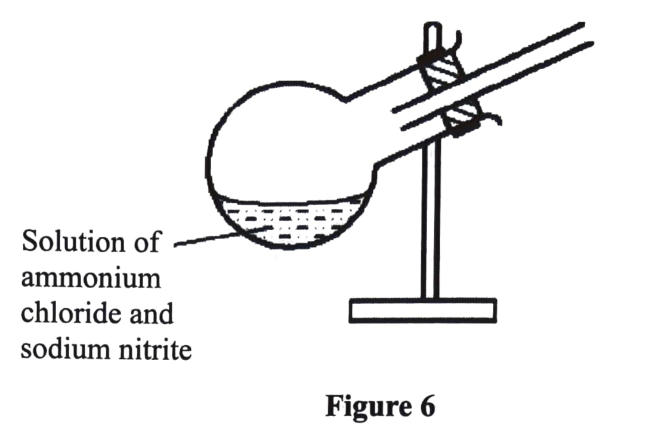
(a) Complete the set-up in Figure 6 to show how nitrogen gas can be collected. (2 marks)
(b) The nitrogen prepared using this set-up is purer than that obtained from air. Give a reason. (1 mark)
26. Hydrazine, H₂N–NH₂, is used as a fuel in rockets. Using the bond energies in Table 2, calculate the enthalpy change for the combustion of hydrazine: (3 marks)
| Bond | N–H | N–N | O=O | N≡N | O–H |
|---|---|---|---|---|---|
| Bond energy (kJ/mol) | 388 | 163 | 496 | 944 | 463 |
27. (a) Table 3 gives the standard reduction potentials of some group VII elements.
| Reduction equation | (V) |
|---|---|
| +1.36 | |
| +1.07 | |
| +0.54 |
State and explain the reactions that take place when aqueous bromine is added to a sample of sea water containing both chloride and iodide ions. (2 marks)
(b) Give a reason why potassium iodide is added to table salt. (1 mark)