121/2 · MATHEMATICS Alt. A · Paper 2 · Nov. 2025 · 2½ hours
Instructions: This paper consists of two sections: Section I and Section II. Answer all the questions in Section I and only five questions from Section II. Show all the steps in your calculations. Non-programmable silent electronic calculators and KNEC mathematical tables may be used, except where stated otherwise.
Section I (50 marks)
1. The first three terms of an arithmetic progression (AP) are , and . Find the value of and hence the common difference of the AP. (3 marks)
2. The temperature in a room was measured as 20 °C in the morning and 25 °C in the afternoon. The difference in the temperature of the room was calculated. Determine the maximum possible error in the calculation. (3 marks)
3. Find the values of and for which . (3 marks)
4. (a) Expand and simplify the expression . (2 marks)
(b) Use the first four terms of the expansion in (a) to estimate the value of . (2 marks)
5. In the following figure, A, B, C and D are points on the circumference of a circle centre O. Line FE is a tangent to the circle at point C. Angle DCE = 30° and ∠BAD = 70°.
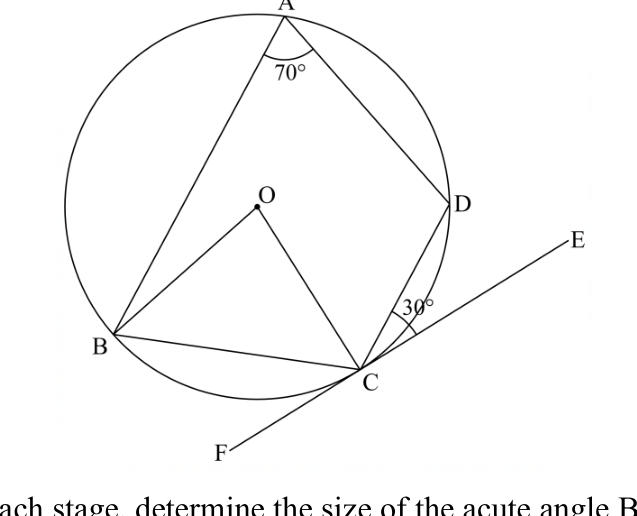
Giving reasons at each stage, determine the size of the acute angle BOC. (3 marks)
6. Two quantities and are such that varies directly as the square of . Given that when , determine the equation connecting the two quantities. (3 marks)
7. The following figure shows an isosceles triangle MLN. The height of the triangle is 5 cm and ∠MLN = 50°.
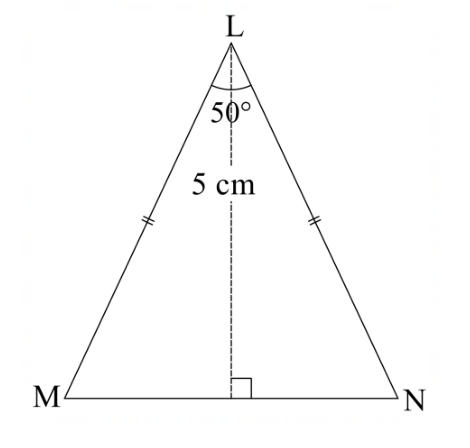
On the figure, use a ruler and a pair of compasses only to construct: (a) the locus of point P such that ∠MPN = 50°; (2 marks) (b) locate point Q such that the area of △MQN is half that of △MLN and ∠MQN = 50°. (2 marks)
8. A point U is 9 000 nm to the east of point T(0°, 50°W). Find the longitude of U. (3 marks)
9. The following graph shows the displacement S metres of a moving particle from a point O after time t seconds (0 ≤ t ≤ 1).
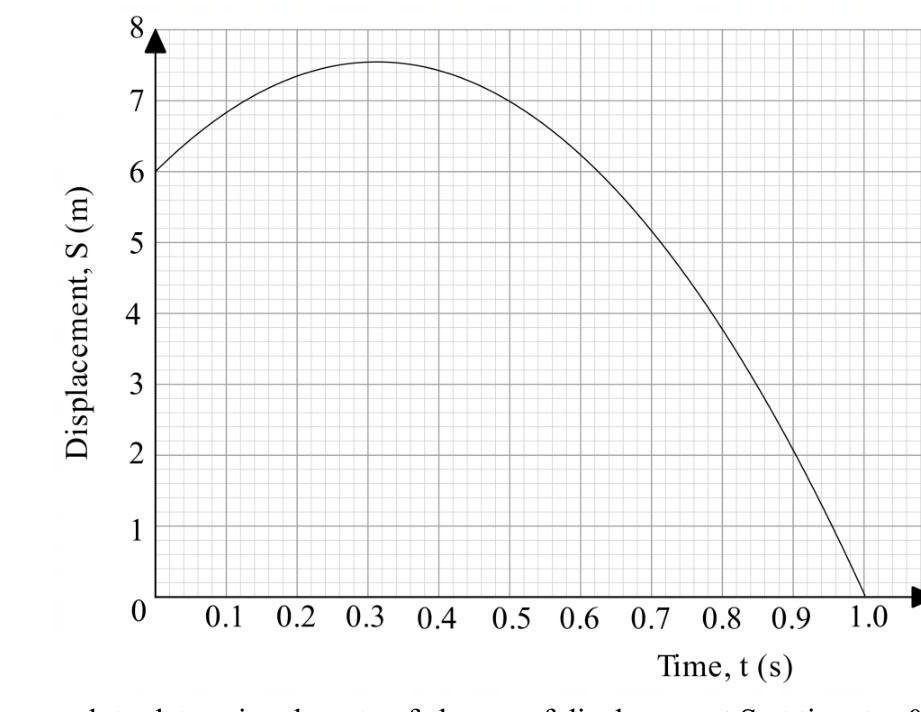
Use the graph to determine the rate of change of displacement S at time t = 0.5 seconds. (3 marks)
10. The ages of 32 residents at a home for the elderly are presented in the following frequency distribution table.
| Age (years) | 70–74 | 75–79 | 80–84 | 85–89 | 90–94 | 95–99 |
|---|---|---|---|---|---|---|
| No. of residents | 5 | 6 | 7 | 8 | 4 | 2 |
Calculate the upper quartile (Q₃) age of the residents. (3 marks)
11. A circle centre (−2, 3) and radius 5 units is drawn on a Cartesian plane. Determine the -intercepts of the circle. (3 marks)
12. An investor deposited Ksh 20 000 in an account that paid compound interest at a rate of 2.5% every 6 months. At the end of the investment period, the interest earned was Ksh 5 600. Determine the duration in years of the investment period. (3 marks)
13. Points A(−4, 7), B(4, 1) and C(16, −8) lie on a straight line. Determine the ratio in which B divides AC. (3 marks)
14. A transformation matrix maps a triangle PQR of area 0.5 square units onto a triangle P′Q′R′ of area 4.5 square units. Determine the possible values of . (3 marks)
15. A particle starts from a point O and moves in a straight line. Its velocity V m/s at time seconds is given by . The distance S of the particle from O at time seconds is 7 m. Calculate S when seconds. (3 marks)
16. The following graph represents a wave of the trigonometric function for .
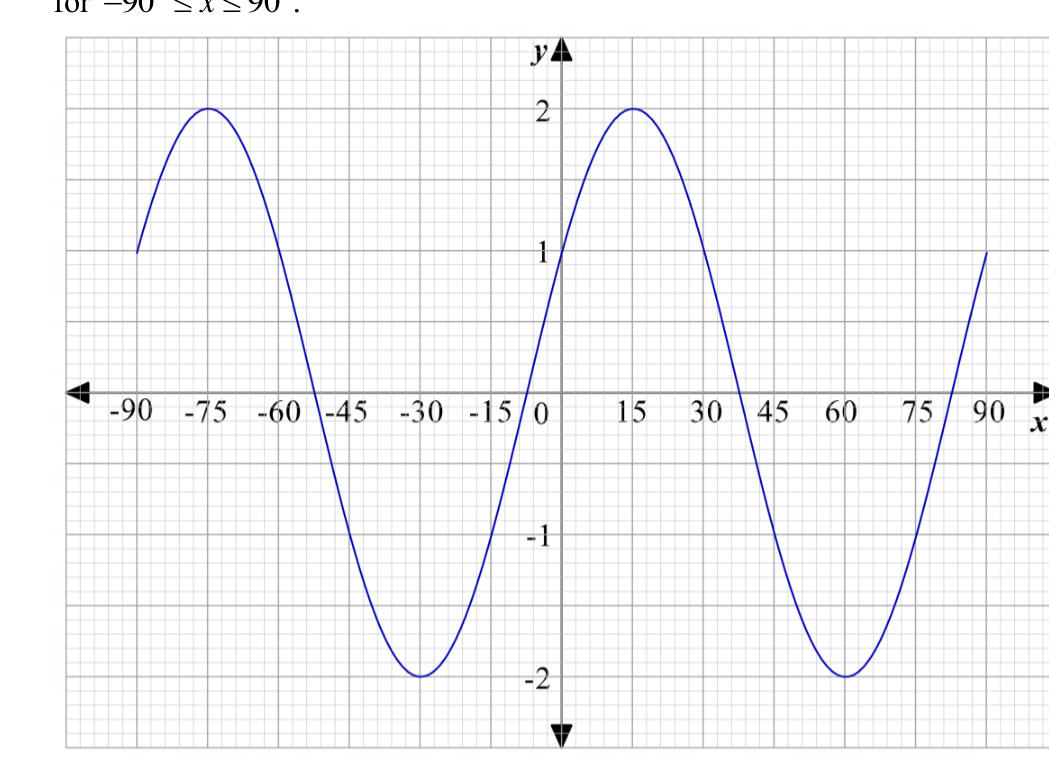
Determine the values of the scalars A and ω. (3 marks)
Section II (50 marks)
Answer only five questions in this section.
17. Two varieties of groundnuts, type q and type r, are sold in the market. Type q is sold at Ksh 130 per kg while type r is sold at Ksh 180 per kg.
(a) A trader bought 50 kg of type q and 75 kg of type r from the market. The two varieties were then mixed.
(i) Determine the cost price of 1 kg of the mixture. (2 marks)
(ii) The trader sold 80% of the mixture at Ksh 170 per kg and the rest at Ksh 180 per kg. Determine the percentage profit made by the trader. (4 marks)
(b) Another trader bought and mixed the two varieties of groundnuts. The trader made a profit of 25% by selling the mixture at Ksh 200 per kg. Determine the ratio in which the trader mixed the two varieties. (4 marks)
18. Registering for a Music club costs Ksh 7 000 while for a Mathematics club it costs Ksh 7 200. The registration cost is shared equally among members of each club. Originally, both clubs had members each. However, before payment for registration, 5 Music club members switched to the Mathematics club.
(a) Write an expression in terms of for the amount contributed by: (i) each Music club member after the switch; (1 mark) (ii) each Mathematics club member after the switch. (1 mark)
(b) Given that a Music club member contributed Ksh 40 more than a Mathematics club member: (i) form an equation in and hence determine the value of ; (5 marks) (ii) determine the percentage increase in the amount contributed by each remaining Music club member due to the switch. (3 marks)
19. The income tax rates of a certain year were as shown in the following table.
| Monthly taxable income (Ksh) | Tax rate (%) |
|---|---|
| 0 – 24 000 | 10 |
| 24 001 – 32 333 | 25 |
| 32 334 – 500 000 | 30 |
| 500 001 – 800 000 | 32.5 |
| Over 800 000 | 35 |
In March that year, Judy's monthly earnings were: basic salary Ksh 104 644; house allowance Ksh 25 000; commuter allowance Ksh 12 000. Judy was entitled to a monthly tax relief of Ksh 2 400.
(a) Calculate: (i) Judy's taxable income that month; (2 marks) (ii) the tax payable by Judy that month. (5 marks)
(b) In July that year, Judy's basic salary changed, her allowances and monthly tax relief remaining as before. Her net tax that month was Ksh 39 483.35. Calculate her new basic salary. (3 marks)
20. (a) The following table shows values of and some values of for the curve for . Complete the table by filling in the missing values of . (2 marks)
| −2 | −1.5 | −1 | −0.5 | 0 | 0.5 | 1 | 1.5 | 2 | |
|---|---|---|---|---|---|---|---|---|---|
| −1 | −3 | 5 | 9 | 2 |
(b) On the grid provided, draw the graph of . Use the scale 2 cm to represent 1 unit on the x-axis and 2 cm to represent 5 units on the y-axis. (3 marks)
(c) (i) Use the graph to solve the equation . (1 mark) (ii) By drawing a suitable straight line on the graph, solve the equation . (4 marks)
21. The following figure represents a cuboid PQRSTUVW. Line PQ = 19 cm, QR = 16 cm and RW = 4 cm. Points M and N are midpoints of lines UT and VW respectively.
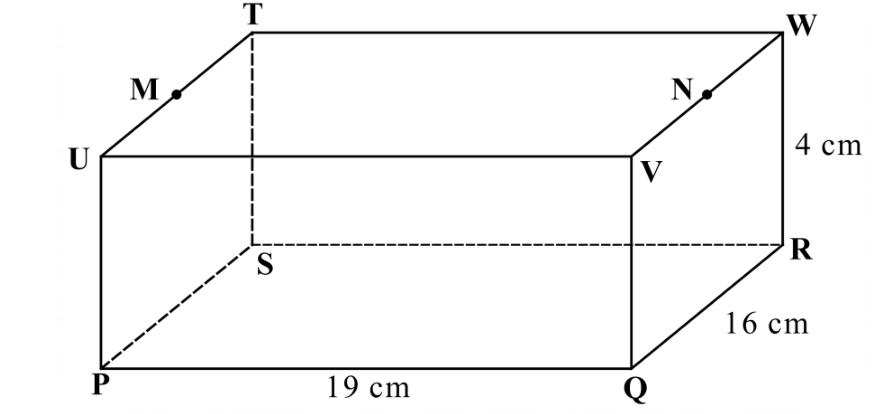
(a) Calculate the length of line RM. (2 marks)
(b) Calculate, correct to 2 decimal places: (i) the angle between line RM and the plane PQRS; (2 marks) (ii) the angle between lines RM and MQ; (3 marks) (iii) the obtuse angle between planes PMNQ and MNWT. (3 marks)
22. A bag contains five balls numbered 1 to 5. The balls are identical except for colour.
(a) Two balls are randomly drawn from the bag, one at a time, without replacement.
(i) Draw a probability space to show all the possible pairs of numbers on the two balls drawn. (2 marks)
(ii) Find the probability that both numbers on the balls drawn were greater than 3. (1 mark)
(iii) Find the probability that the sum of the two numbers on the balls drawn does not exceed 6. (2 marks)
(b) Three balls in the bag are green and the rest are red. Determine the probability that the two balls drawn in (a) were: (i) of the same colour; (3 marks) (ii) of mixed colours. (2 marks)
23. Triangle A″B″C″ is the image of triangle ABC under transformation followed by . Triangles ABC and A″B″C″ are drawn on the following grid.
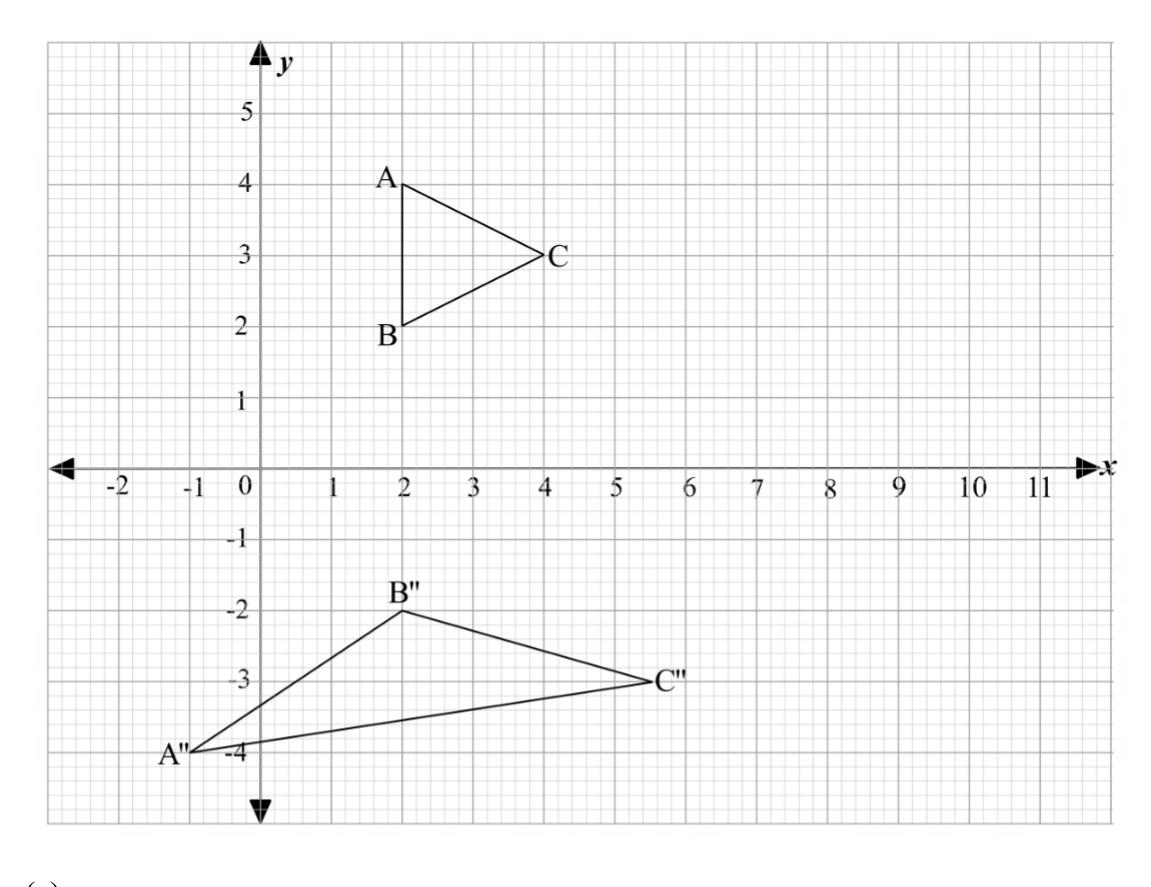
(a) (i) On the same grid, draw △A′B′C′, the image of ABC under the transformation matrix T₁. (3 marks) (ii) Describe fully the transformation represented by matrix T₁. (2 marks)
(b) (i) Find the single transformation matrix that maps △ABC onto △A″B″C″. (2 marks) (ii) Determine the area of △A″B″C″. (3 marks)
24. The following figure is a sketch of the curve whose equation is . The y-intercept of the curve is at while the x-intercepts are at and . The region bounded by the curve, the line and the line is shaded.
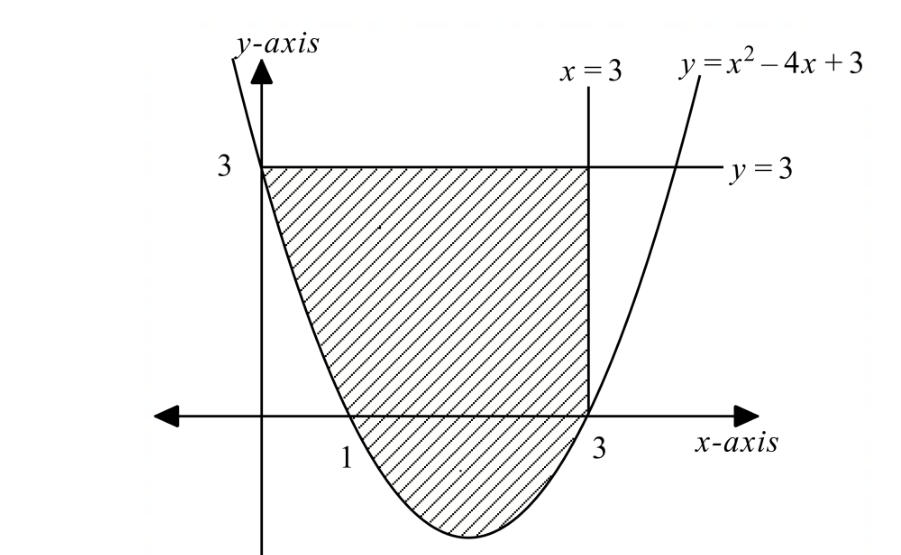
(a) (i) Evaluate . (3 marks) (ii) Calculate the area of the shaded region above the x-axis. (2 marks)
(b) Calculate the area of the shaded region below the x-axis. (3 marks)
(c) Calculate the area of the entire shaded region. (2 marks)