121/1 · MATHEMATICS Alt. A · Paper 1 · Nov. 2025 · 2½ hours
Instructions: This paper consists of two sections: Section I and Section II. Answer all the questions in Section I and only five questions from Section II. Show all the steps in your calculations. Non-programmable silent electronic calculators and KNEC mathematical tables may be used, except where stated otherwise.
Section I (50 marks)
1. Without using mathematical tables or a calculator, evaluate . (3 marks)
2. Baraka earns Ksh 240 per hour working at a supermarket. The employer changed the amount earned per hour in the ratio 8 : 7. Determine the amount that Baraka would earn in hours at the new rate. (3 marks)
3. Solve for in the equation . (3 marks)
4. Solve , giving the answer as a combined inequality. (3 marks)
5. The following figure represents a rectangular farm, PQRS, of length 210 m and width 120 m drawn on a grid of 1 cm squares. The shaded area inside the farm represents a flooded section.
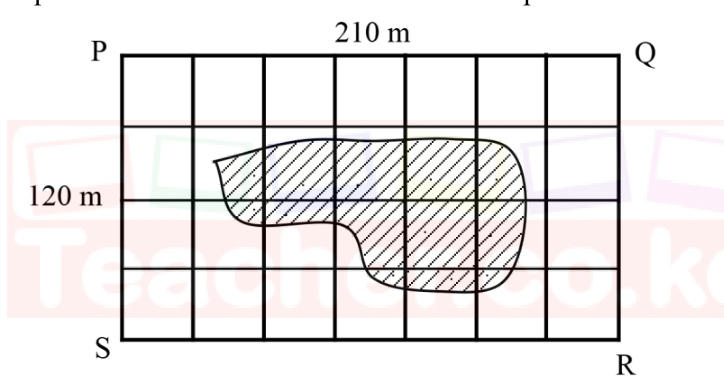
Estimate, in m², the area of the farm that is not flooded. (3 marks)
6. A relief organisation donated 240 kg of maize and 150 kg of beans to needy families. Each family received exactly the same quantity by mass of either maize or beans. No family received both. Determine the least possible number of needy families. (3 marks)
7. Simplify . (3 marks)
8. The area of a sector of a circle is 550 cm². The sector is curved to form an open cone of radius 7 cm. Calculate the height of the cone. (4 marks)
9. A clock which loses 18 seconds every hour was set to read the correct time at 8:00 a.m. on Monday. Determine the time, in the 12-hour system, the clock will read on the following Saturday at 11:20 a.m. (3 marks)
10. Line AB = 5 cm is a side of a triangle ABC in which ∠BAC = 120° and line BC = 10 cm. Using a pair of compasses and a ruler, complete triangle ABC and hence measure the size of angle ABC. (3 marks)
11. A shopkeeper bought an item from a wholesaler. If the shopkeeper sells the item for Ksh 2 740, he would make a profit of Ksh . If the shopkeeper sells that item for Ksh 2 340, he would make a loss of Ksh . Determine the amount that the shopkeeper paid for the item. (3 marks)
12. The following table shows the frequency distribution of marks scored by students in a Mathematics test. The frequencies for two classes are not shown. The table also shows the height of each rectangular bar of a histogram drawn to represent the information.
| Marks | 10 – 14 | 15 – 19 | 20 – 29 |
|---|---|---|---|
| Frequency | 7 | ||
| Height of bar | 1.4 | 2 | 1.5 |
Calculate the missing frequencies. (3 marks) (The first class is printed as 10 – 11 on the question paper [sic]; the marking scheme and the bar height show it is 10 – 14.)
13. On the following grid, line A′C′ is part of △A′B′C′. Triangle A′B′C′ is the image of △ABC after a reflection along a mirror line.
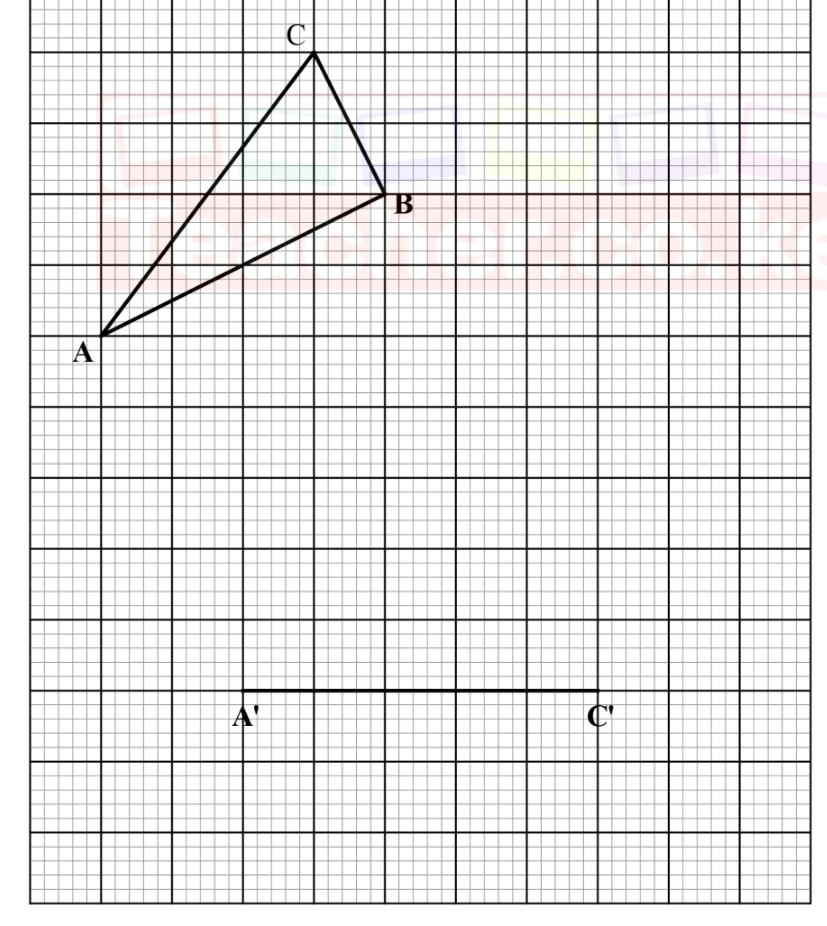
On the same grid, draw the mirror line and hence complete △A′B′C′. (3 marks)
14. The figure below represents a prism ABCDEFGH. The cross-section of the prism is a trapezium. BC = CF = 5 cm, AD = HE = 2 cm and AB = DC = 2.5 cm.
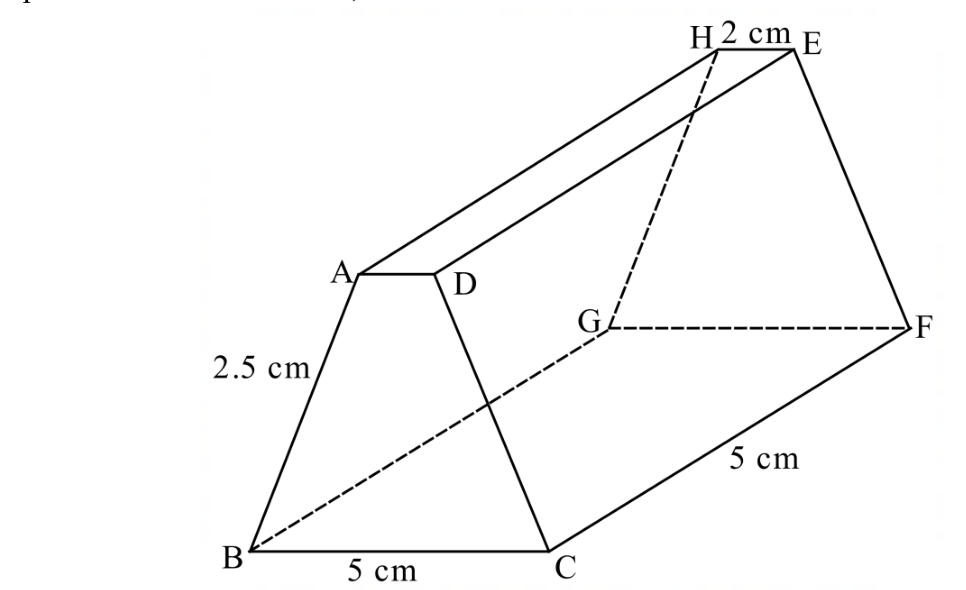
Draw a labelled net of the prism. (3 marks)
15. In the following figure, triangle ABC is right-angled at B and AB = 8 cm. D is a point on AC such that AD = 5 cm and the area of triangle ABD = 10 cm².
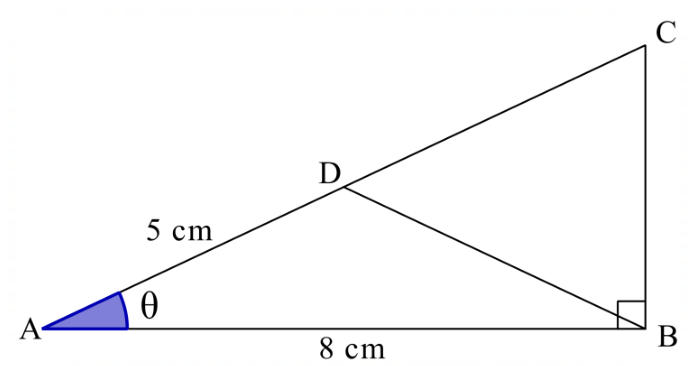
Calculate the length of side BC. (4 marks)
16. The quadratic curve passes through the point P(1, −1). Determine the equation of the tangent to the curve at point P, leaving the answer in the form , where , and are scalars. (3 marks)
Section II (50 marks)
Answer only five questions in this section.
17. The road connecting town A to town B is 160 km long. A lorry, travelling at an average speed of 45 km/h, left town A for town B at 11.50 a.m. At the same time, a car travelling at an average speed of 75 km/h left town B for town A. The two vehicles met at C, a town along the same road.
(a) Determine: (i) the time when the two vehicles met; (4 marks) (ii) the distance, in km, from town A to town C. (2 marks)
(b) The car stopped at town C for a period of 1 hour 40 minutes. The lorry continued with its journey at the same speed of 45 km/h. After the stop, the car left town C for town A and arrived at its destination at the same time as the lorry arrived at B. Determine the average speed of the car for the journey from town C to town A. (4 marks)
18. Figure VABCDEFGH shows a solid consisting of a right pyramid mounted on a rectangular block. The right pyramid and the rectangular block have an identical square base of length 6 cm. The height of the rectangular block is 10 cm while VA = VB = VC = VD = 5 cm.
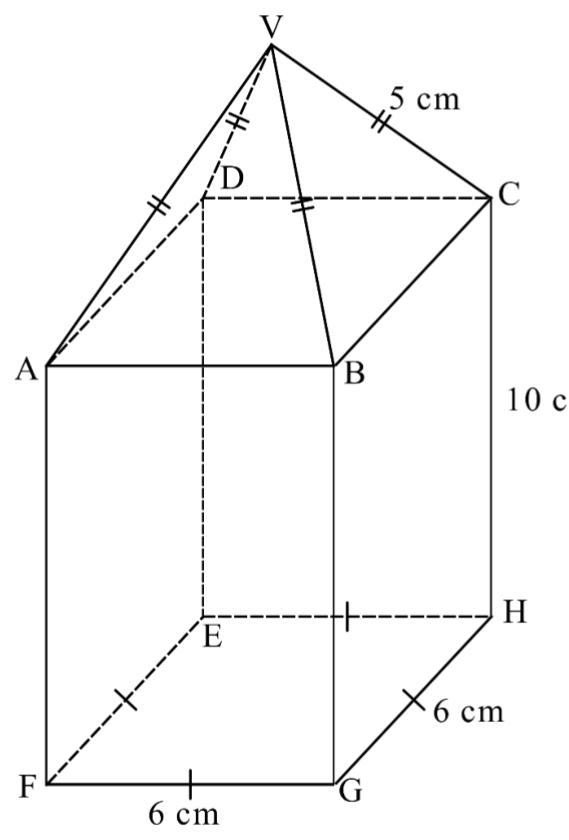
(a) Calculate the volume of the solid. (4 marks)
(b) The solid is cut into two identical halves along the plane of symmetry VAFHCV. Calculate the surface area of one of the pieces. (6 marks)
19. Two lines, L₁ and L₂, are parallel. Line L₃ is perpendicular to both lines L₁ and L₂.
(a) (i) Line L₁ passes through points A(−3, 6) and B(3, 9). Find the gradient of line L₁. (2 marks) (ii) Line L₂ intersects the x-axis at point C(−5, 0). Determine the equation of L₂ in the form . (2 marks)
(b) Line L₃ intersects lines L₁ and L₂ at points A(−3, 6) and P respectively. (i) Determine the equation of L₃ in the form . (3 marks) (ii) Determine the coordinates of point P. (3 marks)
20. A transporter was contracted to transport 133 tonnes of sand from site A to site B. The transporter used two lorries: a 7-tonne lorry and a 14-tonne lorry. The transporter incurred a cost of Ksh 3 000 per trip for the 7-tonne lorry and Ksh 4 000 per trip for the 14-tonne lorry. The total cost incurred by the transporter was Ksh 47 000.
(a) Given that the 7-tonne lorry made trips while the 14-tonne lorry made trips, write down two equations to represent the information. (2 marks)
(b) Use the matrix method to solve the equations in (a). (5 marks)
(c) The transporter was paid Ksh 500 per tonne of sand delivered to site B. Calculate the amount of profit made by the transporter. (3 marks)
21. In the grid provided, the coordinates of points P and Q are (3, 3) and (8, 5) respectively. Vector PQ is also shown.
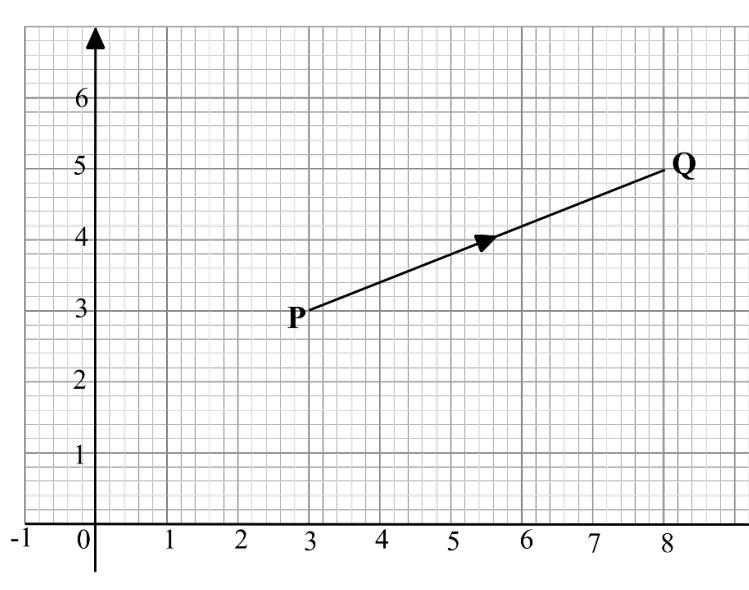
(a) Express PQ as a column vector. (2 marks)
(b) Two vectors and are such that , where and are scalars.
(i) Determine the values of and . (4 marks)
(ii) On the same grid, from point P, represent by accurate drawing the sum of vectors and . (2 marks)
(c) Determine the magnitude of vector . (2 marks)
22. Lines AB = 10 cm and AD = 5 cm are part of a trapezium ABCD in which line AB is parallel to line DC. Angle DAB = 65°.
(a) Using a ruler and a pair of compasses only:
(i) complete trapezium ABCD given that ∠ABC = 67.5°. Measure the length of line DC; (4 marks)
(ii) drop a perpendicular line from D to meet AB at E. Measure the length of line DE; (2 marks)
(iii) draw an arc of a circle, centre A and radius 5 cm. The clockwise-directed arc should join D to a point F on line AB. (1 mark)
(b) Calculate the area of trapezium ABCD that lies outside the arc drawn in (a)(iii). (Take π = 3.142) (3 marks)
23. The quantity of petrol, in litres, used by 40 boda boda riders on a particular day is as follows.
| 1.7 | 2.9 | 2.1 | 2.8 | 3.6 | 2.1 | 1.6 | 2.8 |
| 4.0 | 2.4 | 3.1 | 1.8 | 2.5 | 1.9 | 2.6 | 3.2 |
| 3.1 | 1.5 | 3.4 | 2.9 | 2.9 | 3.4 | 2.1 | 2.6 |
| 3.4 | 4.1 | 3.9 | 4.3 | 3.7 | 2.8 | 2.3 | 2.7 |
| 3.3 | 2.7 | 2.4 | 3.5 | 2.0 | 1.5 | 1.8 | 2.3 |
The cost of 1 litre of petrol is Ksh 160.
(a) Starting with 1.5 litres and using a class size of 0.5, draw a frequency distribution table for the data. (2 marks)
(b) Use the frequency distribution table in (a) to estimate: (i) the mean amount of money spent on petrol by the boda boda riders on that day; (4 marks) (ii) the median amount of money spent on fuel. (4 marks)
24. The figure ABCDEF represents a plot of land. Length AB = 50 m, BC = m, CD = m and DE = 40 m. The figure also shows an adjacent plot of land BCDG. All the angles in the figure are right angles.
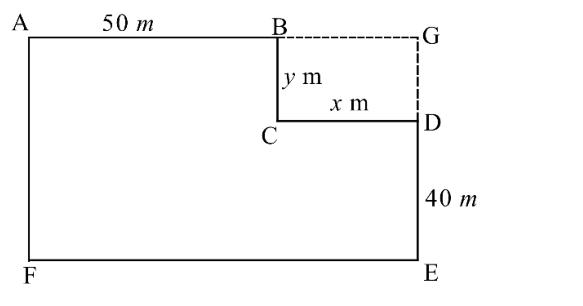
The owner of plot ABCDEF later purchased plot BCDG. Given that the perimeter of plot BCDG is 60 m:
(a) (i) Write an expression for in terms of . (2 marks) (ii) Write down a simplified expression in for the area of the entire plot of land AGEF. (3 marks)
(b) (i) Determine the dimensions of plot BCDG that would maximise the size of the entire plot of land AGEF. (3 marks) (ii) Determine, in m², the maximum possible area of plot AGEF. (2 marks)