121/1 · MATHEMATICS Alt. A · Paper 1 · Nov. 2023 · 2½ hours
Instructions: The paper has two sections. Answer all the questions in Section I and only five questions from Section II. Show all the steps in your calculations. Marks may be given for correct working even if the answer is wrong. Non-programmable silent electronic calculators and KNEC mathematical tables may be used, except where stated otherwise.
Section I (50 marks)
1. Without using a calculator, evaluate . (3 marks)
2. Simplify the expression . (2 marks)
3. A triangle ABC is such that AB = 11 cm, BC = 8 cm and . Calculate the area of the triangle correct to 2 decimal places. (2 marks)
4. A cylindrical solid of radius 7 cm has a conical top of the same radius. The height of the cylindrical part of the solid is 17 cm. The conical top has a vertical height of 9 cm. Calculate the volume of the solid. (3 marks)
5. Two light bulbs are set to light after every 40 seconds and 60 seconds respectively. If they light exactly at the same time initially, calculate:
(a) the time, in minutes, they will take to light together again; (2 marks)
(b) the number of times they would light together in the first half an hour. (1 mark)
6. Solve the equation for . Leave the answer in terms of . (3 marks)
7. Simplify and hence factorise the expression . (3 marks)
8. From a point on top of a cliff 40 m high, two boats A and B are observed due East. The angle of depression of boat A is 32° and that of boat B is 52°. Determine the distance between the two boats, correct to 2 decimal places. (4 marks)
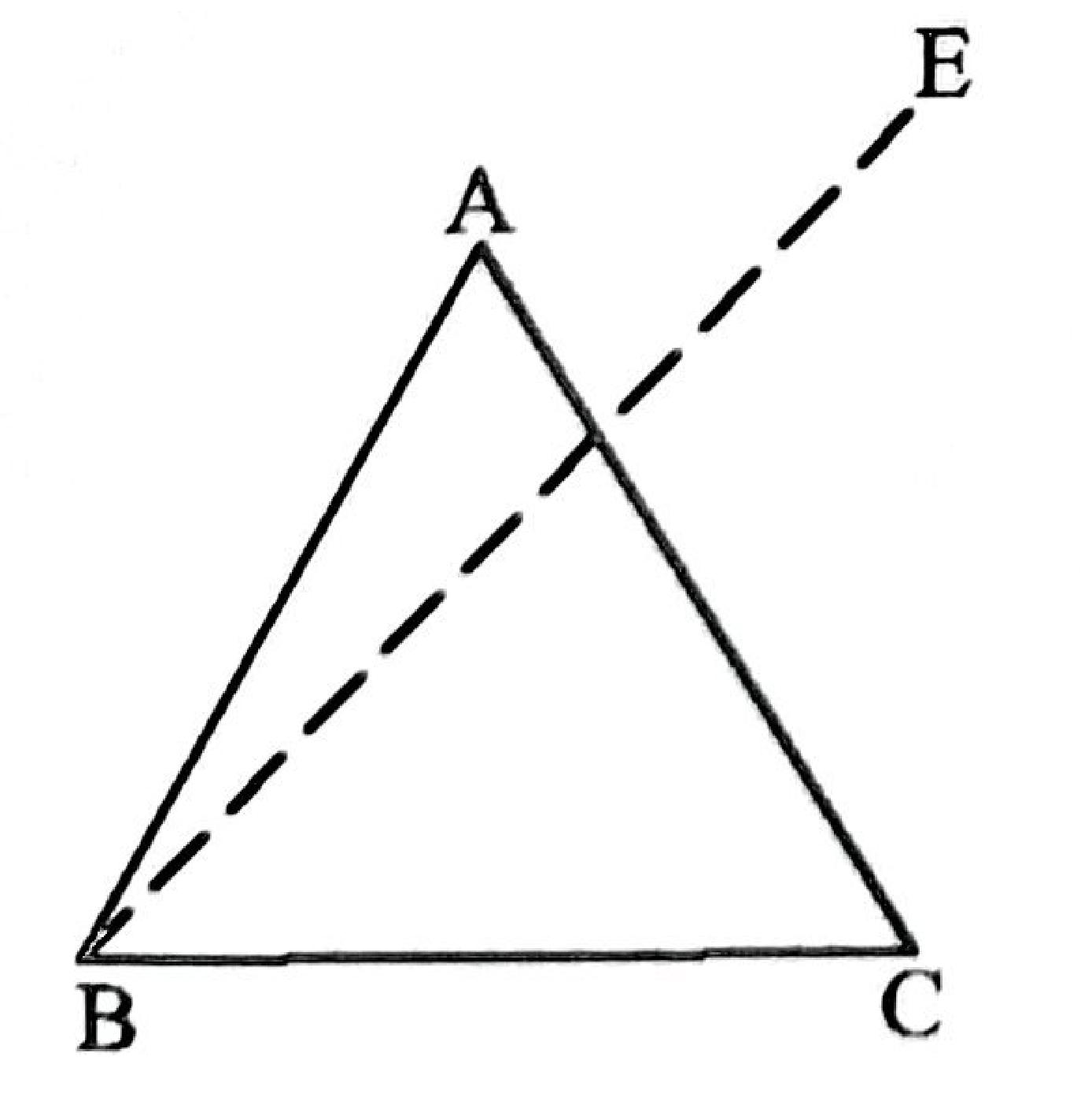
9. In the following figure, triangle ABC is a uniform cross section of a solid ABCDEF. Given that BE is one of the edges of the solid, complete the sketch showing hidden edges with broken lines. (3 marks)
10. A salesman sells story books and textbooks. The cost price of a story book is Ksh 600 while that of a textbook is Ksh 900. The salesman is paid a commission of 10% on the cost of any book sold. One day, the salesman sold twice as many story books as textbooks. He earned a commission of Ksh 8 400. Determine the total number of story books sold. (3 marks)
11. The equation of a curve is given by . Using the trapezium rule with 4 strips, estimate the area enclosed by the curve , the lines , and the x-axis. (4 marks)
12. Vectors a, b and c are represented on the following grid.
On a grid, represent: (a) the resultant vector a + b; (b) the resultant vector (a + b) + c. (3 marks)
13. Given matrix , and , determine matrix R. (3 marks)
14. In a sub county the number of children per family was recorded from 30 families. The data recorded is as follows:
| 2 | 3 | 2 | 3 | 4 | 1 | 4 | 3 | 0 | 3 |
| 2 | 2 | 1 | 3 | 4 | 5 | 2 | 7 | 6 | 3 |
| 6 | 2 | 2 | 3 | 3 | 3 | 5 | 1 | 3 | 2 |
(a) Represent the data in a frequency distribution table. (1 mark)
(b) Calculate the mean number of children per family. (2 marks)
15. The equation of a curve is given by . Determine the equation of a normal to the curve at . (4 marks)
16. On the following cartesian plane provided, solve the simultaneous equations and . (3 marks)
Section II (50 marks)
Answer only five questions in this section.
17. Two towns, A and B are 400 km apart. A motor cyclist travelling at an average speed of 60 km/h left town A for town B at 1.20 p.m. A matatu travelling at an average speed of 80 km/h also left town A for town B at 2.00 p.m.
(a) Calculate the:
(i) distance covered by the motor cyclist by 2.00 p.m.; (2 marks)
(ii) distance from town A in km, where the matatu caught up with the motor cyclist; (3 marks)
(iii) time when the matatu caught up with the motor cyclist. (2 marks)
(b) A lorry travelling at an average speed of 40 km/h left town B for town A at 2.00 p.m. Determine the time when the lorry and the matatu met. (3 marks)
18. On the following grid, triangle PQR is drawn.
(a) On the same grid, draw:
(i) triangle P′Q′R′, the image of △PQR under a reflection in the line ; (2 marks)
(ii) triangle P″Q″R″, the image of △P′Q′R′ under an enlargement scale factor −1.5, centre O; (3 marks)
(iii) triangle P‴Q‴R‴, the image of △P″Q″R″ under a half turn about O. (2 marks)
(b) Describe a single transformation that maps △P′Q′R′ onto △P‴Q‴R‴. (3 marks)
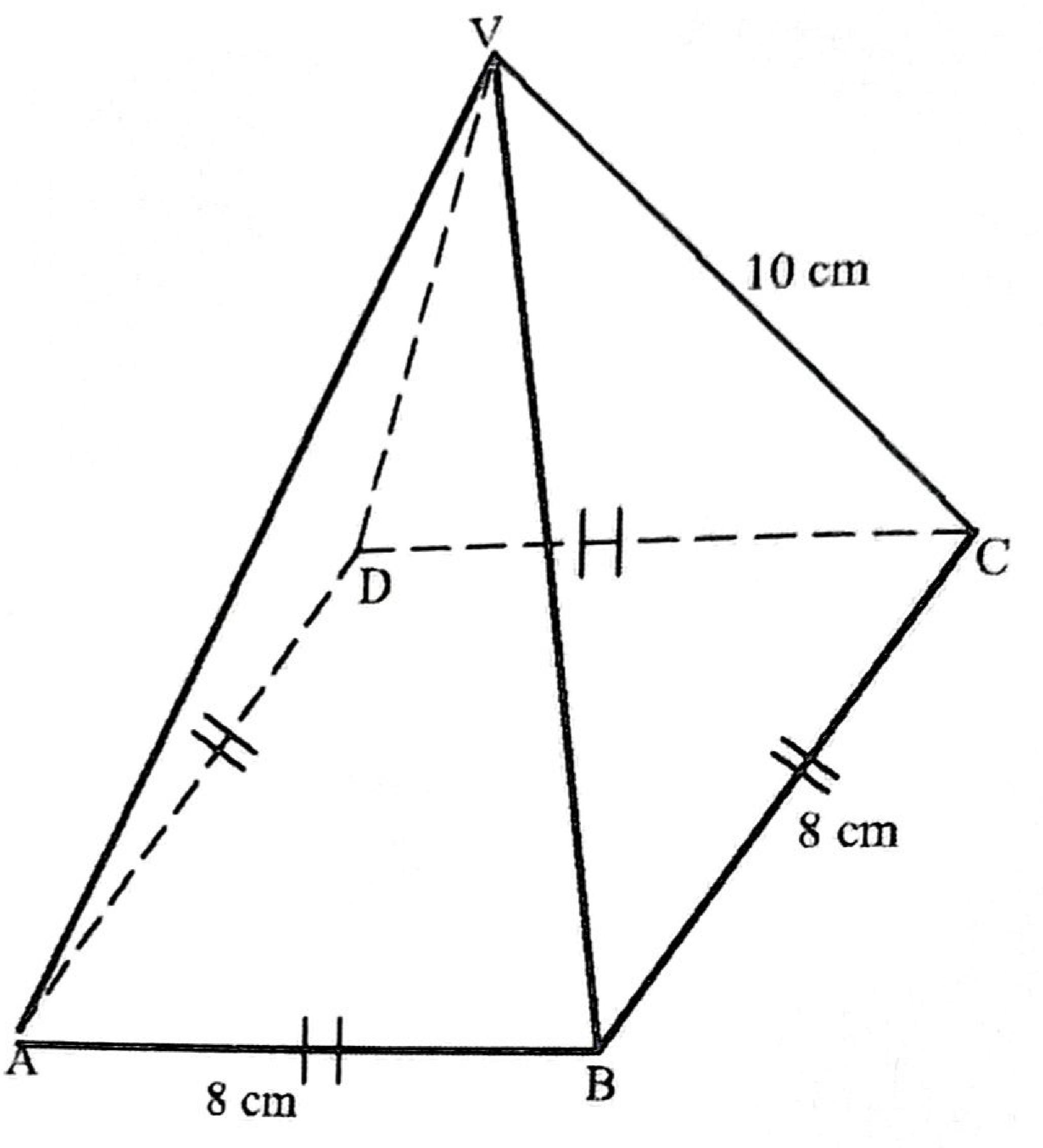
19. The following figure shows a right pyramid VABCD. The base ABCD of the pyramid is a square of side 8 cm. The length of the slanting edges VA = VB = VC = VD = 10 cm.
Calculate:
(a) the vertical height of the pyramid correct to 2 decimal places; (4 marks)
(b) the surface area of the pyramid; (4 marks)
(c) the volume of the pyramid. (2 marks)
20. Neema went to the market to buy bananas worth Ksh 2,100 for a school. The seller offered a discount of Ksh 3 per banana which enabled Neema to buy 35 more bananas.
(a) Taking Ksh as the price per banana before discount, write an expression for the:
(i) number of bananas that Neema would have bought before discount; (1 mark)
(ii) actual number of bananas that Neema bought after the discount. (1 mark)
(b) Form an equation in terms of and hence determine the actual number of bananas Neema bought. (6 marks)
(c) The bananas were given to students in a school. Two fifths of the students got 2 bananas each while the rest got a banana each. Determine the number of students in the school. (2 marks)
21. The end of term test scores of 100 students were recorded as shown in the following table.
| Scores | 30–39 | 40–49 | 50–59 | 60–69 | 70–79 | 80–89 |
|---|---|---|---|---|---|---|
| No. of students | 8 | 10 | 28 | 32 | 12 | 10 |
(a) State the modal class. (1 mark)
(b) Calculate the median score. (3 marks)
(c) On the grid provided, represent the above data using a histogram. (4 marks)
(d) Use the histogram to determine the number of students who scored from 71.5 to 76.5. (2 marks)
22. The following figure shows a quadrilateral PQRS and a circle passing through the vertices P, R and S. Lines PQ = PR = 2.7 cm, PS = 6 cm, SR = 7 cm and .
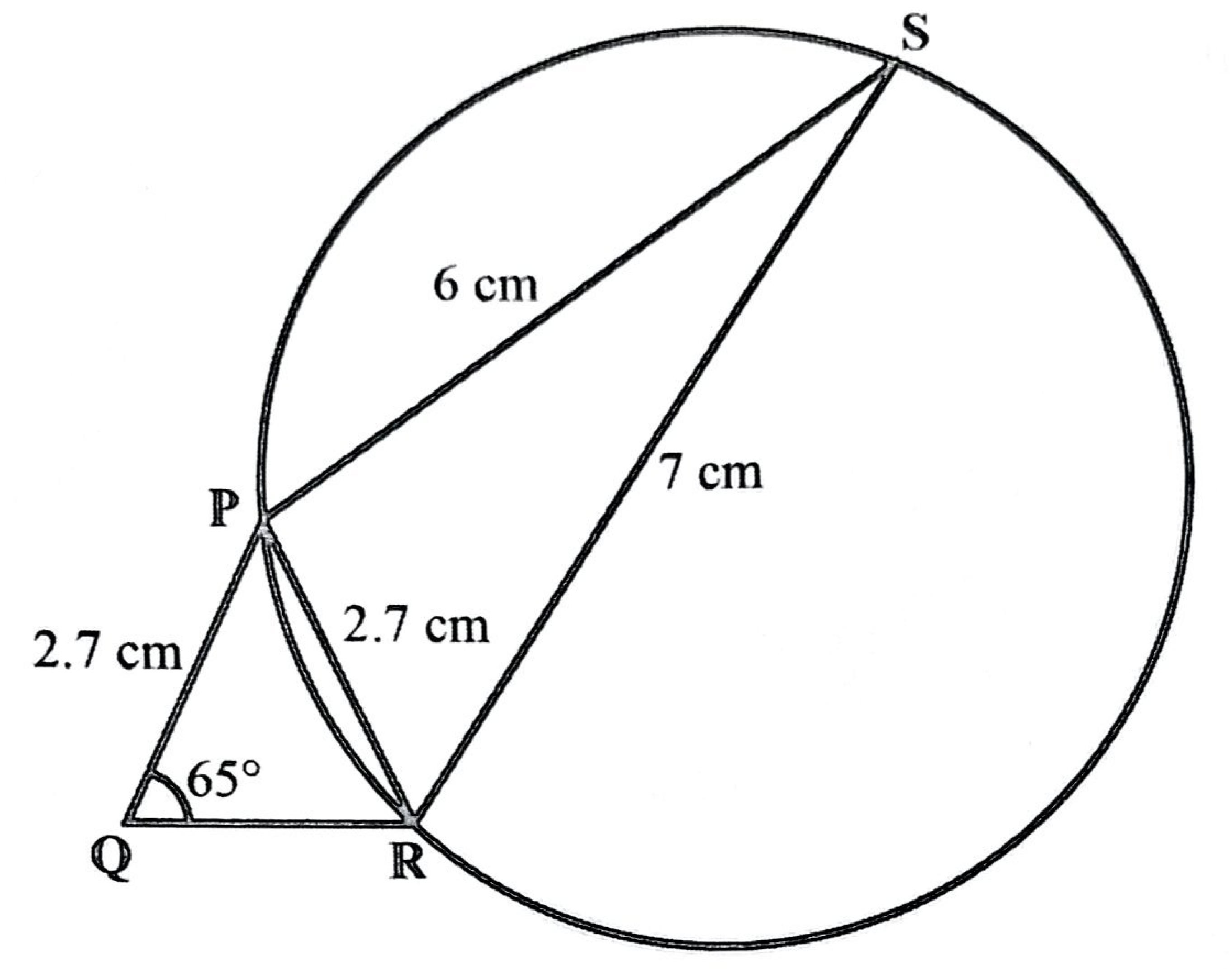
(a) Calculate: (i) length QR; (3 marks) (ii) . (3 marks)
(b) Determine the area of the circle. (4 marks)
23. The displacement, metres, of a particle moving along a straight line after seconds is given by .
(a) Determine:
(i) the values of when the particle is momentarily at rest; (3 marks)
(ii) the values of the displacement metres by the time the particle comes to rest. (2 marks)
(b) Determine the values of when the velocity of the particle is −5 m/s. (3 marks)
(c) Determine the acceleration of the particle at seconds. (2 marks)
24. In this question, use a ruler and a pair of compasses only. Line PR is a diagonal of a quadrilateral PQRS. PR = 6 cm.
(a) Locate vertex Q of the quadrilateral PQRS such that and . Complete triangle PQR and hence measure length PQ. (4 marks)
(b) Diagonal QS, which is 10 cm long, intersects with diagonal PR at a right angle. Complete the quadrilateral PQRS. (3 marks)
(c) Calculate the area of the quadrilateral PQRS. (3 marks)