121/2 · MATHEMATICS · Paper 2 · Mar. 2022 (KCSE 2021) · 2½ hours
Instructions: This paper consists of two sections: Section I and Section II. Answer all the questions in Section I and only five questions from Section II. Show all the steps in your calculations. Non-programmable silent electronic calculators and KNEC mathematical tables may be used, except where stated otherwise.
Section I (50 marks)
1. An empty tank of capacity 18 480 litres is to be filled with water using a cylindrical pipe of diameter 0.028 m. The rate of flow of water from the pipe is 2 m/s. Find the time in hours it would take to fill up the tank. (Take .) (3 marks)
2. The first term of a geometric progression (G.P.) is 2. The common ratio of the G.P. is also 2. The product of the last two terms of the G.P. is 512. Determine the number of terms in the G.P. (3 marks)
3. The expression is a perfect square, where is a constant. Find the value of . (2 marks)
4. Make the subject of the formula . (3 marks)
5. The figure below shows a circle and a point P outside the circle.
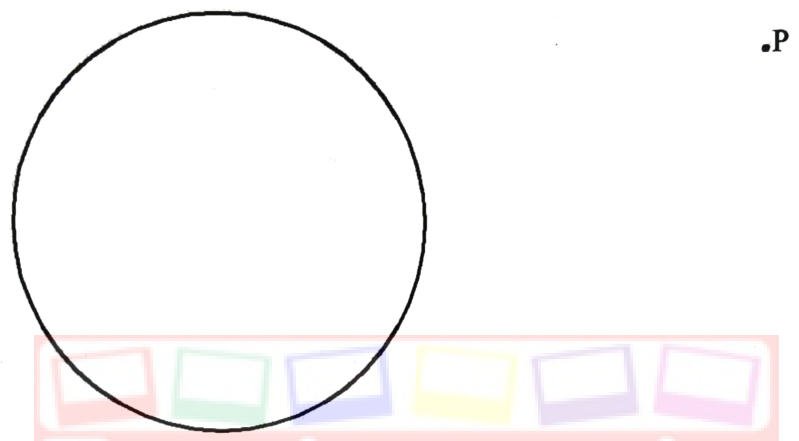
Using a ruler and a pair of compasses, construct a tangent to the circle from P. (4 marks)
6. Four quantities P, Q, R and S are such that P varies directly as the square root of Q and inversely as the square of the difference of R and S. Quantity Q is increased by 44% while quantities R and S are each decreased by 10%. Find the corresponding percentage change in P correct to 1 decimal place. (4 marks)
7. The figure below represents a prism ABCDEFGH of length 6 cm. The cross-section BCFG of the prism is a trapezium in which GF = 11 cm, BC = 8 cm, BG = 5 cm and ∠GFC = ∠BCF = 90°.
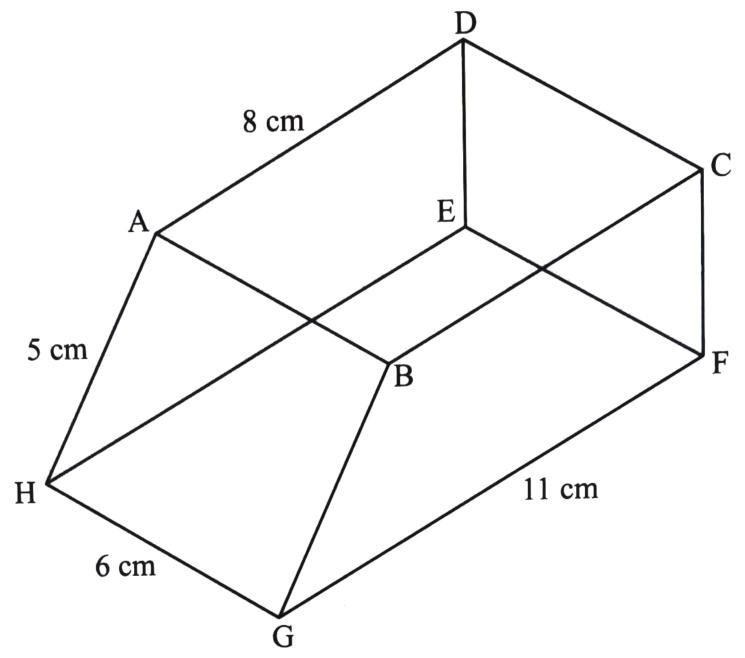
Calculate, correct to 1 decimal place, the angle between the line FA and the plane GFEH. (3 marks)
8. The cash price of a gas cooker is Ksh 20 000. A customer bought the cooker on hire purchase terms by paying a deposit of Ksh 10 000 followed by 18 equal monthly instalments of Ksh 900 each. Annual interest, compounded quarterly, was charged on the balance for the period of 18 months. Determine, correct to 1 decimal place, the rate of interest per annum. (4 marks)
9. The table below shows the values of and the corresponding values of for a given relation.
| 1 | 2 | 3 | 4 | 5 | 6 | 7 | 8 | |
|---|---|---|---|---|---|---|---|---|
| 8 | 4 | 2.7 | 2 | 1.6 | 1.3 | 1.1 | 1 |
(a) On the grid provided, draw a graph to represent the information in the table. (2 marks)
(b) Use the graph to determine, correct to 1 decimal place, the rate of change of at . (2 marks)
10. The equation of a trigonometric wave is . The wave has a period of 180°.
(a) Determine the value of . (1 mark)
(b) Deduce the phase angle of the wave. (1 mark)
11. A point Q is 2 000 nm to the West of a point P(40°N, 155°W). Find the longitude of Q to the nearest degree. (3 marks)
12. A box contains 3 brown balls and 9 green balls. The balls are identical except for the colours. Two balls are picked at random without replacement.
(a) Draw a tree diagram to show all the possible outcomes. (1 mark)
(b) Determine the probability that the balls picked are of different colours. (2 marks)
13. The figure below shows triangle XYZ.
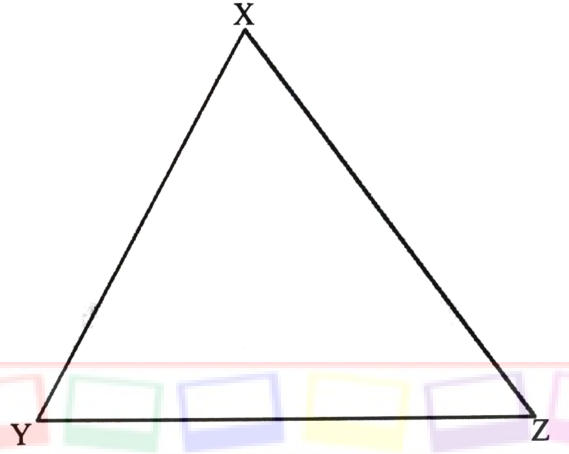
Using a ruler and a pair of compasses, locate a point M on the triangle such that M is 2 cm from line YX and is equidistant from lines YX and YZ. Measure length YM. (3 marks)
14. The position vectors of points P, Q and R are , and . Show that P, Q and R are collinear points. (3 marks)
15. In a transformation an object of area cm² is mapped onto an image whose area is cm². Given that the matrix of the transformation is , find the possible values of . (3 marks)
16. Find the area enclosed by the curve , the straight lines , and the -axis. (3 marks)
Section II (50 marks)
Answer only five questions in this section.
17. Pump P can fill an empty water tank in hours while pump Q can fill the same tank in hours. On a certain day, when the tank was empty, both pumps were opened for hours.
(a) Determine the fraction of the tank that was still empty at the end of the hours. (4 marks)
(b) Pump P was later opened alone to completely fill the tank. Determine the time it took pump P to fill the remaining fraction of the tank. (2 marks)
(c) The two pumps P and Q are operated by different proprietors. Water from the full tank was sold for Ksh 15 750. The money was shared between the two proprietors in the ratio of the quantity of water supplied by each. Determine the amount of money received by the proprietor of pump P. (4 marks)
18. A rectangular plot measures 50 m by 24 m. A lawn, rectangular in shape, is situated inside the plot with a path surrounding it as shown in the figure below.
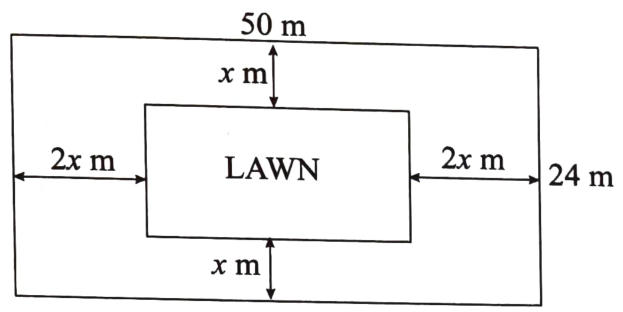
The width of the path is m between the lengths of the lawn and those of the plot, and m between the widths of the lawn and those of the plot.
(a) Form and simplify an expression in for the area of the: (i) lawn; (2 marks) (ii) path. (1 mark)
(b) The area of the path is times the area of the lawn. (i) Form an equation in and hence solve for . (4 marks) (ii) Determine the perimeter of the lawn. (3 marks)
19. In the figure below, points A, B, C, D and E lie on the circumference of a circle centre O. Line FAG is a tangent to the circle at A. Chord DE of the circle is produced to intersect with the tangent at F. Angle FAE = 30°, ∠EDC = 110° and ∠OCB = 55°.
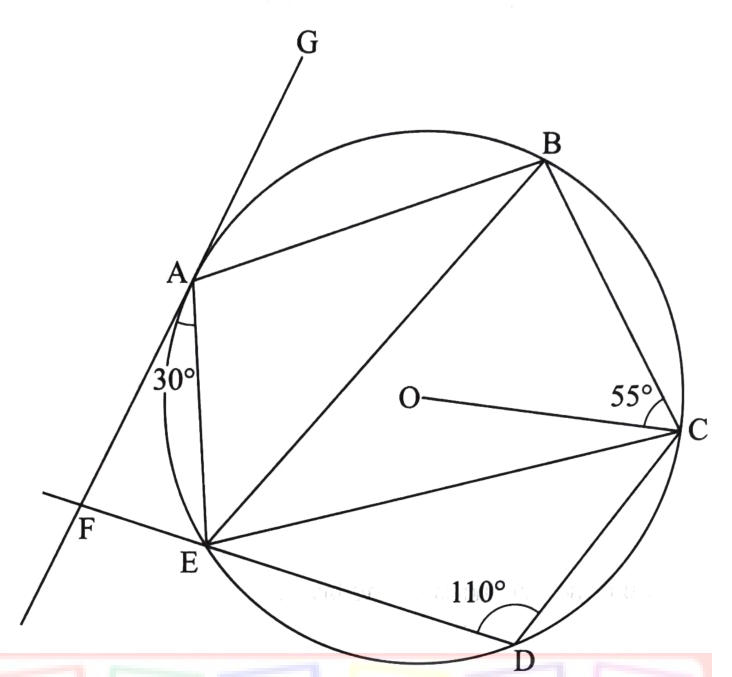
(a) Determine the size of: (i) ∠AEC; (3 marks) (ii) ∠AEB. (3 marks)
(b) Given that AB = 5 cm, ED = 4.4 cm and FE = 2.5 cm, calculate, correct to 1 decimal place: (i) the radius of the circle; (2 marks) (ii) the length of line AF. (2 marks)
20. The table below shows income tax rates in a certain year.
| Monthly taxable income (Ksh) | Tax rate |
|---|---|
| 0 – 12 298 | 10% |
| 12 299 – 23 885 | 15% |
| 23 886 – 35 472 | 20% |
| 35 473 – 47 059 | 25% |
| 47 060 and above | 30% |
In the year, the monthly earnings of Kanini were: basic salary Ksh 64 500; house allowance Ksh 12 000. Kanini contributes 7.5% of her basic salary to a pension scheme. This contribution is exempted from taxation. She is entitled to a personal tax relief of Ksh 1 408 per month. Calculate:
(a) Kanini's monthly taxable income; (2 marks)
(b) the tax payable by Kanini that month; (6 marks)
(c) Kanini's net pay that month. (2 marks)
21. The vertices of the triangle shown on the grid are A′(3, −3), B′(1, −1) and C′(3, −1). Triangle A′B′C′ is the image of triangle ABC under a transformation whose matrix is .
(a) Find the coordinates of A, B and C. (4 marks)
(b) Triangle A″B″C″ is the image of triangle A′B′C′ under a transformation matrix . Determine the coordinates of A″, B″ and C″. (2 marks)
(c) On the same grid, draw triangles ABC and A″B″C″. (2 marks)
(d) Determine a single matrix that maps ABC onto A″B″C″. (2 marks)
22. Workers in a factory commute from their homes to the factory. The table below shows the distances in kilometres covered by the workers.
| Distance (km) | 1–5 | 6–10 | 11–15 | 16–20 | 21–25 | 26–30 |
|---|---|---|---|---|---|---|
| Number of workers | 3 | 6 | 7 | 4 | 2 |
The mean distance covered was 14.5 km.
(a) Determine the value of and hence the standard deviation of the distances, correct to 2 decimal places. (6 marks)
(b) Calculate, correct to 2 decimal places, the interquartile range of the distances. (4 marks)
23. (a) Complete the table below, giving the values correct to 1 decimal place. (2 marks)
| 0 | 30 | 60 | 90 | 120 | 150 | 180 | 210 | 240 | 270 | 300 | 330 | 360 | |
|---|---|---|---|---|---|---|---|---|---|---|---|---|---|
| −2 | −1.1 | 0 | 2 | 2.8 | 2 | 1.1 | 0 | −2 | |||||
| 3 | 2 | 1 | 0 | −0.7 | −1 | 0 | 1 | 2.7 | 3 |
(b) On the same axes, draw the graphs of and for . (4 marks)
(c) Using the graphs in part (b): (i) find the values of for which ; (2 marks) (ii) determine the range of for which . (2 marks)
24. A particle was moving along a straight line. The acceleration of the particle after seconds was given by m s⁻². The initial velocity of the particle was 18 m s⁻¹.
(a) Determine the value of when the particle is momentarily at rest. (5 marks)
(b) Find the distance covered by the particle between the time second and seconds. (5 marks)