121/1 · MATHEMATICS · Paper 1 · KCSE 2020 · 2½ hours
Instructions: This paper consists of two sections: Section I and Section II. Answer all the questions in Section I and only five questions from Section II. Show all the steps in your calculations. Non-programmable silent electronic calculators and KNEC mathematical tables may be used, except where stated otherwise.
Section I (50 marks)
1. Without using mathematical tables or a calculator, evaluate . (3 marks)
2. Express as a mixed number. (3 marks)
3. Without using a calculator or mathematical tables, evaluate . (3 marks)
4. A rectangular floor of a room measures 5.4 m long and 4.2 m wide. The room is to be covered with square tiles. Calculate the minimum number of square tiles that can be used to cover the floor. (4 marks)
5. Simplify . (3 marks)
6. The line is perpendicular to a line L. Line L passes through point (2, −1). Determine the equation of L in the form , where and are constants. (3 marks)
7. The sum of the interior angles of a regular polygon is 1260°. Find the size of each exterior angle of the polygon. (3 marks)
8. Using the grid provided, solve the simultaneous equations and . (3 marks)
9. Given that , find the value of . (3 marks)
10. In the figure below, AB and CD are arcs of two concentric circles, centre O. Angle AOB = 60° and AD = BC = 7 cm.
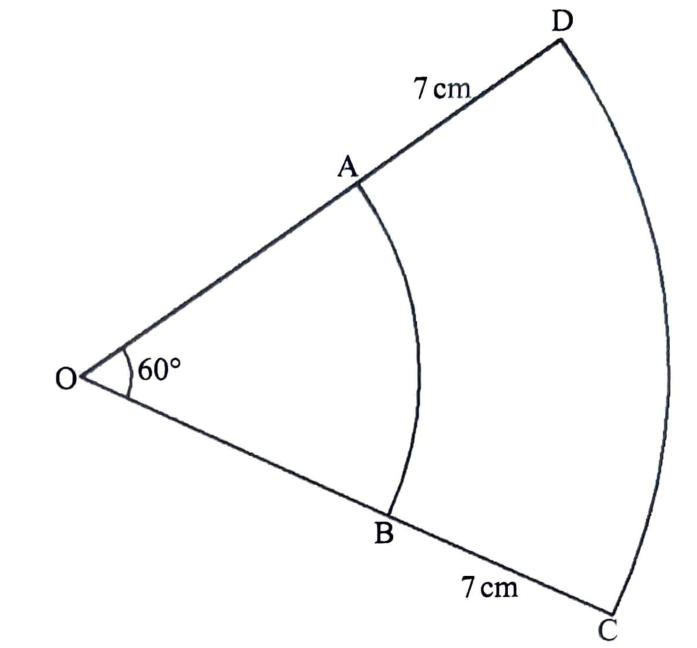
Given that the perimeter of ABCD is cm, find OA, the radius of the inner circle. (3 marks)
11. Using a ruler and a pair of compasses only, construct a parallelogram ABCD in which AB = 6 cm, BC = 5 cm and angle ADC = 150°. (3 marks)
12. A Kenyan non-governmental organisation (NGO) received a donation of 200 000 US dollars. The money was converted into Kenyan shillings in a bank which buys and sells foreign currency as follows:
| Buying (Ksh) | Selling (Ksh) | |
|---|---|---|
| 1 US dollar | 102.40 | 102.50 |
| 100 Japanese yen | 92.80 | 93.30 |
(a) Calculate the amount of money, in Kenya shillings, the NGO received. (1 mark)
(b) The NGO used 90% of the donation to buy a machine from Japan. Calculate the cost of the machine to the nearest Japanese yen. (3 marks)
13. A chord of a circle, 7 cm long, subtends an angle of 60° at the centre of the circle. Determine the area, correct to 2 decimal places, of the major segment of the circle. (4 marks)
14. A vertical electric pole was erected 6.4 m from the foot of a vertical fencing pole on the same horizontal level. The fencing pole is 2 m high. The angle of elevation of the top of the electric pole from the top of the fencing pole is 30°. Determine the height of the electric pole correct to 1 decimal place. (2 marks)
15. In a 4 × 400 m relay competition, a team of athletes each completed their round in 45 sec, 43 sec, 44 sec and 45 sec respectively. If the race started at 1:35:31 p.m., find the time when the team completed the race. (3 marks)
16. The figure below shows a quadrilateral ABCD and a mirror line M₁M₂.
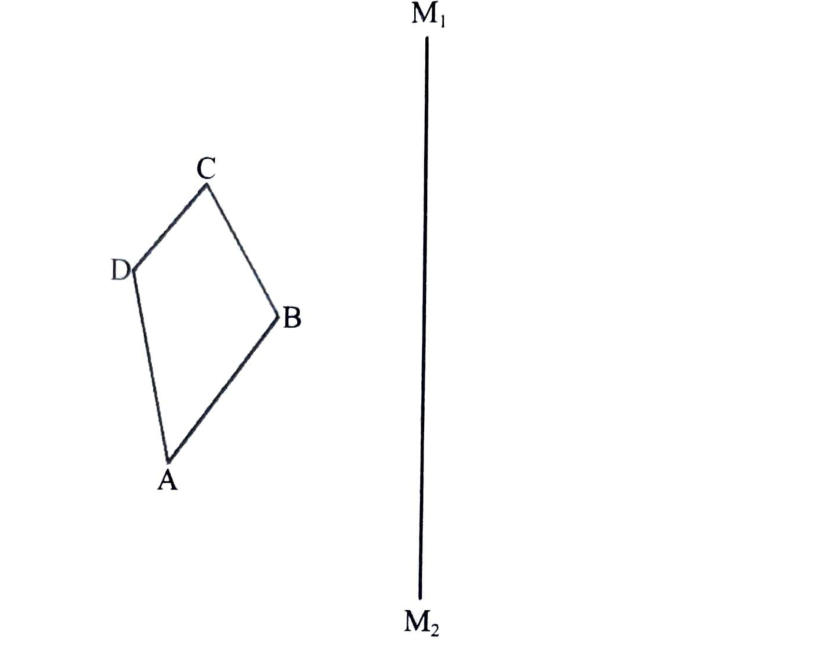
(a) Draw quadrilateral A′B′C′D′, the image of ABCD under a reflection in the mirror line M₁M₂. (2 marks)
(b) State the type of congruency between ABCD and A′B′C′D′. (1 mark)
Section II (50 marks)
Answer only five questions in this section.
17. Three business partners, Kosgei, Kimani and Atieno, contributed Ksh 1 750 000 towards an investment. Kosgei contributed 20% of the money. Kimani and Atieno contributed the remainder in the ratio 3 : 5 respectively.
(a) (i) Calculate the amount of money Kimani contributed. (2 marks) (ii) Find the ratio of the contributions by the three partners. (2 marks)
(b) The money earned compound interest at a rate of 8% per annum. After 3 years, the partners withdrew the interest and donated 10% to a charitable organisation. The partners then shared the remainder in the ratio of their contributions. Calculate the amount of money, to the nearest shilling, that each partner received. (6 marks)
18. A solid consists of a conical part, a cylindrical part and a hemispherical part. All the parts have the same diameter of 12 cm. The height of the cylindrical part is 15 cm and the slant height of the conical part is 10 cm. (Take π = 3.142.) Calculate the:
(a) height of the solid; (2 marks)
(b) surface area of the solid, correct to 1 decimal place; (4 marks)
(c) volume of the solid, correct to 1 decimal place. (4 marks)
19. The average speed of a pick-up was 20 km/h faster than the average speed of a lorry. The pick-up took 45 minutes less than the lorry to cover a distance of 180 km.
(a) If the speed of the lorry was km/h: (i) write expressions in terms of for the time taken by the lorry and the pick-up respectively to cover the distance of 180 km; (2 marks) (ii) determine the speed of the lorry and that of the pick-up. (5 marks)
(b) The distance between towns A and B is 240 km. On a certain day the pick-up started from town A at 8.30 a.m. and the lorry started from town B at the same time. Determine the time that the lorry and the pick-up met. (3 marks)
20. A forest is enclosed by four straight boundaries AB, BC, CD and DA. Point B is 25 km on a bearing of 315° from A, C is directly south of B and on a bearing of 260° from A, and D is 30 km on a bearing of 210° from C.
(a) Using a scale of 1 : 500 000, represent the above information on a scale drawing. (3 marks)
(b) Using the scale drawing, determine the: (i) distance, in kilometres, of D from A; (2 marks) (ii) bearing of A from D. (1 mark)
(c) Calculate the area, correct to 1 decimal place, of the forest in square kilometres. (4 marks)
21. The position vectors of points A and B are and . A point M is on AB such that and a point N is on OB such that ON : NB = 1 : 3.
(a) Find: (i) AB; (2 marks) (ii) NM; (3 marks) (iii) |NM|, correct to 1 decimal place. (2 marks)
(b) A translation vector maps A onto A′(5, −1). Find the coordinates of the image of B under the translation vector. (3 marks)
22. The number of students in 40 schools in a certain sub-county were recorded as follows:
| 238 | 100 | 173 | 115 | 398 | 597 | 572 | 299 | 255 | 750 |
| 587 | 403 | 250 | 217 | 797 | 386 | 362 | 486 | 453 | 279 |
| 436 | 248 | 780 | 316 | 529 | 305 | 372 | 286 | 842 | 235 |
| 420 | 492 | 226 | 245 | 695 | 720 | 267 | 617 | 198 | 830 |
(a) Complete the frequency distribution table for the data, using the classes 100–199, 200–249, 250–399, 400–599, 600–799 and 800–849. (2 marks)
(b) On the grid provided, draw a histogram to represent the data. (4 marks)
(c) Use the histogram to estimate the: (i) median; (2 marks) (ii) number of schools with more than 350 students. (2 marks)
23. (a) Given that matrix is a singular matrix, find the value of . (3 marks)
(b) Kirai earned a basic salary of Ksh per month and Ksh for each extra hour worked. Mutua's basic salary is 20% more than Kirai's basic salary but he also earns Ksh for each extra hour worked. In a certain month, Kirai worked 30 extra hours and earned a total of Ksh 70 000 while Mutua worked an extra 40 hours and earned a total of Ksh 88 000.
(i) Form two equations in and to represent Kirai's and Mutua's total earnings. (2 marks)
(ii) Use the matrix method to solve for and . (5 marks)
24. The displacement, metres, of a moving particle after seconds is given by . Determine the:
(a) velocity of the particle when ; (3 marks)
(b) time, seconds, when the particle is momentarily at rest; (3 marks)
(c) displacement, metres, when the particle is momentarily at rest; (2 marks)
(d) acceleration of the particle when seconds. (2 marks)